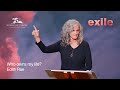
Every human life is a precious gift, lovingly crafted by God Himself. Our value and dignity are not determined by our abilities, achievements, or health, but by the truth that we are created in the image of God and belong to Him. This foundational reality calls us to humility and gratitude, recognizing that our lives are not our own possessions but entrusted to us by our Creator. In every season—whether strong or frail, joyful or suffering—God’s intimate care surrounds us, and our worth remains unshaken. [16:24]
Psalm 139:13-16 (ESV)
For you formed my inward parts;
you knitted me together in my mother’s womb.
I praise you, for I am fearfully and wonderfully made.
Wonderful are your works;
my soul knows it very well.
My frame was not hidden from you,
when I was being made in secret,
intricately woven in the depths of the earth.
Your eyes saw my unformed substance;
in your book were written, every one of them,
the days that were formed for me,
when as yet there was none of them.
Reflection: In what ways do you struggle to believe that your worth is rooted in being God’s beloved creation, rather than in your abilities or circumstances? How might you remind yourself of this truth today?
Suffering is never easy, but it is not meaningless. At the heart of our faith is Jesus, the Man of Sorrows, who entered into our pain and suffering, even to the point of death on a cross. He did not avoid suffering but embraced it for our sake, showing us that God is present with us in our darkest moments. Through suffering, we can grow in character, perseverance, and hope, and we are reminded that our present pain is not the final word—God’s glory and comfort await us. [32:21]
Philippians 2:3-8 (ESV)
Do nothing from selfish ambition or conceit, but in humility count others more significant than yourselves. Let each of you look not only to his own interests, but also to the interests of others. Have this mind among yourselves, which is yours in Christ Jesus, who, though he was in the form of God, did not count equality with God a thing to be grasped, but emptied himself, by taking the form of a servant, being born in the likeness of men. And being found in human form, he humbled himself by becoming obedient to the point of death, even death on a cross.
Reflection: When you face suffering or witness it in others, how might you look for God’s presence and purpose in the midst of pain, following the example of Christ?
Though we experience loss, pain, and death in this life, these are not the end of our story. God promises a future where He will dwell with His people, wipe away every tear, and abolish death and suffering forever. This hope sustains us in our grief and empowers us to live with courage and compassion, knowing that Christ’s resurrection has defeated death and that God’s love will have the final word. [39:48]
Revelation 21:3-4 (ESV)
And I heard a loud voice from the throne saying, “Behold, the dwelling place of God is with man. He will dwell with them, and they will be his people, and God himself will be with them as their God. He will wipe away every tear from their eyes, and death shall be no more, neither shall there be mourning, nor crying, nor pain anymore, for the former things have passed away.”
Reflection: How does the promise of God’s ultimate renewal and the end of suffering shape the way you approach grief, loss, or fear today?
God designed us not for isolation or autonomy, but for deep connection and interdependence. In Christ’s body, we are family to one another, called to carry each other’s burdens and to care for the most vulnerable among us. No person is ever a burden; rather, we are invited to embody Christ’s love through practical acts of presence, compassion, and support, especially for those who are suffering, lonely, or nearing the end of life. [43:14]
Galatians 6:2 (ESV)
Bear one another’s burdens, and so fulfill the law of Christ.
Reflection: Who in your life might need your presence or support today? What is one tangible way you can help carry their burden this week?
Our calling as followers of Jesus is to be faithfully present with those who suffer, to see and honor the image of God in every person, and to respond with small acts of love and kindness. Whether it’s sitting in silence with someone in pain, offering a meal, or simply listening, these acts reflect Christ’s heart and bring dignity to those who feel unseen or unwanted. We are invited to start with the person nearest to us, trusting that God’s love flows through our ordinary faithfulness. [45:11]
Matthew 25:40 (ESV)
And the King will answer them, ‘Truly, I say to you, as you did it to one of the least of these my brothers, you did it to me.’
Reflection: Who is the “least of these” near you today? What is one small, concrete act of love you can offer them this week as an expression of Christ’s presence?
Three months ago, I experienced the sudden loss of my father, a moment that stripped away all illusions of control and left my family and me in deep grief. Death, in its finality, exposes our vulnerability and reminds us of our limits. In recent days, I have also sat with friends who are dying, entering that sacred space where words often fail and presence becomes the greatest gift. These experiences, along with my work among the suffering and dying, have made the questions of death, dignity, and suffering intensely personal and real.
We live in a culture that idolizes autonomy, health, and longevity, often framing debates about life and death in terms of individual rights. Yet, as followers of Christ, we are called to filter these cultural assumptions through the lens of God’s Word. The foundational question is not about rights, but about ownership: Who owns our lives? Scripture, especially Psalm 139, reveals that our lives are not our own. We are fearfully and wonderfully made, knit together by God, and our days are written in His book. Life is a gift, not a possession, and our dignity is rooted in being beloved children of God, not in our abilities, independence, or accomplishments.
The legalization and rapid expansion of medical assistance in dying (MAID) in Canada raises profound ethical and spiritual questions. While the desire to relieve suffering is understandable, the primary reasons people seek MAID are often rooted in fear of losing autonomy, being a burden, or lacking meaning. Autonomy, however, is an illusion; we are created for connection and community, not for radical independence. Our lives are deeply intertwined, and our choices affect others.
Suffering is a reality none of us seek, but it is not meaningless. At the center of our faith is Jesus, the suffering servant, who entered into our pain and transformed it through His death and resurrection. Figures like Joni Eareckson Tada and Mother Teresa remind us that even in suffering, life retains its worth and dignity. The Christian response is not to eliminate suffering by eliminating the sufferer, but to offer faithful presence, robust care, and deep community. We are called to bear one another’s burdens, to see Christ in the least and the suffering, and to be a family for those who have none.
In the face of death and suffering, we hold to the hope that God is with us, that death is a defeated enemy, and that one day He will wipe away every tear. Until then, we are called to be faithfully present, to love, to serve, and to witness to the truth that every life is precious in God’s sight.
Psalm 139:13-16 (ESV) — > For you formed my inward parts;
> you knitted me together in my mother’s womb.
> I praise you, for I am fearfully and wonderfully made.
> Wonderful are your works;
> my soul knows it very well.
> My frame was not hidden from you,
> when I was being made in secret,
> intricately woven in the depths of the earth.
> Your eyes saw my unformed substance;
> in your book were written, every one of them,
> the days that were formed for me,
> when as yet there was none of them.
Philippians 2:3-8 (ESV) — > Do nothing from selfish ambition or conceit, but in humility count others more significant than yourselves. Let each of you look not only to his own interests, but also to the interests of others. Have this mind among yourselves, which is yours in Christ Jesus, who, though he was in the form of God, did not count equality with God a thing to be grasped, but emptied himself, by taking the form of a servant, being born in the likeness of men. And being found in human form, he humbled himself by becoming obedient to the point of death, even death on a cross.
Galatians 6:2 (ESV) — > Bear one another’s burdens, and so fulfill the law of Christ.
Death has a way of stripping off layers, of exposing deeper truths, more vulnerable questions. Death is the starkest reminder of our limits, of our finite condition. Illusions of control fall away. Death changes us. This week, I sat with two dear friends who are dying, entering that sacred space of end of life. No more fixing it. In the presence of the dying, we are uncertain what to say. Being present. Listening. Whispering prayers. I love you. Thank you. And no words at all. [00:04:00] (64 seconds) #PresenceInTheFaceOfDeath

Sitting in these vulnerable spaces raises many difficult and complex questions. And it makes it even more difficult as followers of Christ living as exiles in a culture that does not share our deepest held beliefs. A culture enamored with health and longevity, with comfort and autonomy. As Christians, we want to be aware of cultural assumptions and idols of our own time. And we want to filter them through the lens of God's word. [00:10:22] (37 seconds) #FaithInACultureOfChallenge
Rather than striving for individual autonomy, we are an interdependent community. We need each other. We are family to each other. So how, then, do we uphold dignity of life in all stages of our human existence? Is it really my life, my choice? Is it really my body, my choice? Do slogans like dying with dignity imply that we somehow lose dignity when we endure suffering? How do we measure quality of life? And who decides which life is worth living and which is not? [00:13:13] (50 seconds) #DignityInEveryStage
Our ethics, our moral principles that govern our behavior cannot be built on trends or a majority of opinion or just what feels right to us. As Christians, we build our ethics on God's eternal truth. This is our compass, that's our north star, that is our lighthouse as we navigate these murky ethical waters. And this is why I chose Psalm 139 for our passage today. [00:14:44] (35 seconds) #EthicsRootedInTruth
So the song that you all know, he's got the whole world in his hands, is not just a cute children's song, but it expresses a deep truth about the author and sustainer of all life. So life is not a right, but it's a gift of a gracious God. We don't belong to ourselves, but every person is foremost a child of God. In Christ's body, through baptism, we become members of each other. The church is now the true family. [00:17:14] (45 seconds) #LifeIsAGiftFromGod
Our intrinsic value and dignity does not come from our accomplishments, our status, or our health profile, or our functionality, or our mental acuity. So I want to say to you, if you are struggling today, sitting here, listening, with feeling less than, because of a disability maybe, maybe because of memory impairment, maybe because of age or loneliness, or depression, or despair, let this truth from God's heart wash over you this morning. [00:18:52] (41 seconds) #GodsPoemMasterpiece
We are God's poema in Greek, God's poem, often translated we are God's handiwork, but the original word is poem, we are God's poem. We are a masterpiece created with purpose and beauty by God, like a poet crafting a beautiful poem. So this is where we start. This is where we must start to lay a solid and a truthful foundation that fits reality. [00:20:25] (36 seconds) #ControlIsAnIllusion
Christ entering our world, Christ incarnate, carrying our sins on the cross, being obedient all the way to a cruel and terrible death death on the cross. That is the center of our faith. I feel that sometimes in our attempt to spiritualize Christ's atonement, we forget that he had a body, he was whipped, he was tortured, he was crucified, in order to attain the greatest good for us. For us, we find a God who is familiar with suffering. [00:32:21] (50 seconds) #PersonNotBurden
But in the waiting, we continue to suffer, to die, to mourn and to grieve. But we know that death is a defeated enemy through the victory of Christ's death and resurrection. And in the meantime, in the waiting, Psalm 34 tells us he is close to the broken hearted and saves those who are crushed in spirit. We live in hope in the midst of pain. The crucified Jesus, whom God raised from the dead, will have the last word. [00:40:28] (44 seconds)
I'm an AI bot trained specifically on the sermon from Nov 25, 2025. Do you have any questions about it?
Add this chatbot onto your site with the embed code below
<iframe frameborder="0" src="https://pastors.ai/sermonWidget/sermon/who-owns-life-edith-rae-2025" width="100%" height="100%" style="height:100vh;"></iframe>Copy