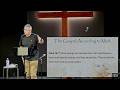
The Gospel of Mark anchors our faith in real history, eyewitness testimony, and God’s faithfulness across generations. Its origins trace back to Peter’s firsthand accounts, carefully recorded by Mark to preserve the truth about Jesus. This chain of testimony—from disciples to early church leaders—assures us that Scripture is no myth, but God’s enduring word to His people. Trusting this foundation strengthens our confidence to live boldly for Christ. [38:45]
“Men of Israel, hear these words: Jesus of Nazareth, a man attested to you by God with mighty works and wonders and signs that God did through him in your midst, as you yourselves know—this Jesus, delivered up according to the definite plan and foreknowledge of God, you crucified and killed by the hands of lawless men. God raised him up, loosing the pangs of death, because it was not possible for him to be held by it.” (Acts 2:22–24, ESV)
Reflection: What doubts or questions about the Bible’s reliability have you wrestled with? How might the early church’s care in preserving eyewitness accounts reshape your trust in Scripture?
God specializes in redeeming imperfect stories. Mark, once a deserter, became a vital coworker through Paul and Barnabas’ grace. His journey reminds us that failure does not define us—Christ’s transformative power does. No past mistake disqualifies us from participating in God’s mission when we surrender to His refining work. [30:10]
“Luke alone is with me. Get Mark and bring him with you, for he is very useful to me for ministry.” (2 Timothy 4:11, ESV)
Reflection: Where have you felt disqualified by past failures? How might God be inviting you to step into renewed purpose, trusting His grace over your history?
Mark’s growth flourished under Peter’s guidance, illustrating how faith is nurtured in relationship. The early church thrived through shared lives—homes like Mary’s became hubs of discipleship. We, too, are called to invest in others and lean on fellow believers, knowing growth happens best in community. [27:47]
“She who is at Babylon, who is likewise chosen, sends you greetings, and so does Mark, my son.” (1 Peter 5:13, ESV)
Reflection: Who has intentionally poured into your spiritual journey? How might you intentionally encourage or mentor someone else this week?
Our faith rests on tangible history: real people, places, and events. Mark’s Gospel, validated by early church leaders, links directly to Peter’s testimony. This “chain of custody” guards against myth, inviting us to stake our lives on the resurrection’s reality. [39:18]
“And a young man followed him, with nothing but a linen cloth about his body. And they seized him, but he left the linen cloth and ran away naked.” (Mark 14:51–52, ESV)
Reflection: How does knowing Scripture’s historical grounding impact your willingness to share Jesus with others? What fears might this truth dissolve?
Mark’s Gospel unveils Jesus as the Messiah who conquers through sacrifice, not force. He came not to demand service but to give His life, redefining power as love in action. This upside-down kingdom calls us to follow His example of humility and redemptive surrender. [47:17]
“For even the Son of Man came not to be served but to serve, and to give his life as a ransom for many.” (Mark 10:45, ESV)
Reflection: Where do you cling to worldly notions of success or control? How might Jesus’ model of servant leadership reshape your priorities this week?
Thirteen years of ministry memories lead into an exploration of the gospel according to Mark and why it matters. Mark collects the eyewitness preaching of Peter and shapes those memories into a tight, action-driven account of Jesus’ life, death, resurrection, and ascension. Early church testimony—from Papias through Justin Martyr, Irenaeus, Clement, Origen, Eusebius, and Jerome—identifies John Mark as Peter’s interpreter who recorded what Peter preached, giving the gospel a direct link to apostolic witness. That chain of custody grounds the gospel in real time and real people, not later invention.
Mark chooses economy over ornament. He opens where the other gospels begin later: with ministry, not birth narratives. He moves quickly from scene to scene, favoring vivid detail and dramatic episodes—healings, exorcisms, feedings—so readers feel present at the events. That narrative speed and sensory detail reflect a preacher’s urgency: these stories do not invite academic debate first; they call for attention to the person who acted and spoke.
The gospel shapes understanding of the Messiah by refusing popular expectations. Mark reframes messiahship away from worldly power and toward servanthood, humility, and substitutionary sacrifice. The “messianic secret” restrains public acclaim so people can learn to see power in self-giving rather than domination. Structurally, Mark divides the story into two halves with a hinge in the middle that forces readers to reckon with misunderstanding, faith, and rejection.
Mark also carries a human stamp. Small, personal details—nicknames, a frightened young man fleeing naked, Peter’s prominence at the beginning and end—ground the narrative in ordinary lives transformed by the risen Lord. The gospel asks readers to see Jesus as the promised Messiah who inaugurates God’s kingdom through service and suffering, and it presents that claim backed by eyewitness testimony and early, consistent attestation. The result drives both conviction and invitation: the gospel stands as a historical, spiritual, and pastoral record intended to persuade people to believe and live under the reign of the servant-king.
Well, listen. If you're gonna base your life on something, you need to know it's legit. You need to know what it claims it is is actually what it says it is. This is important because when someone tells you that your faith is built on myths created in the third and fourth century by chat GPT gospels, you can remember this very long and painful introduction to the gospel of Mark and go, hang on a minute. That's not true.
[00:38:15]
(30 seconds)
#VerifyYourFaith
There's an actual, physical, historic, go and look it up in a museum. There's the text in actual print chain of custody from the eyewitnesses of Jesus to the church canon to that bible that you have now in your hands. Christianity is an evidence based faith. Right? It's historic. Real people, real places, real Jesus doing real things in a real resurrection. That's our faith. And the chain of custody is unanimous and unified in content and construction.
[00:38:45]
(38 seconds)
#HistoricBibleEvidence
I'm an AI bot trained specifically on the sermon from Apr 12, 2026. Do you have any questions about it?
Add this chatbot onto your site with the embed code below
<iframe frameborder="0" src="https://pastors.ai/sermonWidget/sermon/who-is-jesus-freeway-live" width="100%" height="100%" style="height:100vh;"></iframe>Copy