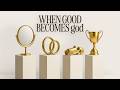
We cling to tangible reminders of past achievements, relationships, or seasons like trophies gathering dust. These items often symbolize deeper attachments—comfort, identity, or control—that quietly demand our allegiance. Just as physical clutter distracts, heart-clutter of misplaced priorities competes with wholehearted devotion. The challenge isn’t to purge sentimentality but to discern what still holds power over our present purpose. What we struggle to release often reveals what we’ve subtly worshiped. [03:18]
“Son of man, these men have set up idols in their hearts.”
(Ezekiel 14:3, NIV)
Reflection: What tangible item, habit, or memory do you cling to for a sense of security or significance? How might releasing it create space for deeper trust in God?
Modern cities don’t have temples to Zeus, but our routines reveal altars to success, comfort, and validation. Like Paul surveying Athens, we’re surrounded by silent demands to earn worth through productivity, appearance, or social approval. These “gods” whisper promises of fulfillment but leave hearts restless. The true crisis isn’t their existence but our unconscious participation in their rituals—checking phones, rehearsing anxieties, sacrificing rest for achievement. [06:06]
“While Paul was waiting for them in Athens, he was greatly distressed to see that the city was full of idols.”
(Acts 17:16, NIV)
Reflection: What cultural norm or daily habit quietly competes with your worship of God? When do you feel most pressured to bow to it?
Idols peddle satisfaction, security, and significance—legitimate longings God designed. Yet they counterfeit these gifts, trading soul-deep peace for temporary relief. A promotion numbs insignificance until the next review; a relationship mutes loneliness until conflict erupts. Like the Athenians, we mistake the craving for the cure. Every idol’s lie follows a pattern: “If you attain ____, then you’ll finally ____.” But only the Giver of breath can fill what He formed. [11:13]
“Yet when I surveyed all that my hands had done and what I had toiled to achieve, everything was meaningless, a chasing after the wind.”
(Ecclesiastes 2:11, NIV)
Reflection: Which of the three S’s (satisfaction, security, significance) do you most often seek from sources other than God? What emptiness follows that pursuit?
We build mental shrines to unrecognized idols—the “unknown gods” of hurry, productivity, or others’ opinions. These altars hide in plain sight: rushed mornings, rehearsed apologies, endless scrolling. Like the Athenians, we fear offending forces we can’t name, so we hedge our bets. Paul’s indictment cuts deep: we’re often ignorant of what we truly worship. The path to freedom begins by naming the unnamed gods that siphon our time, energy, and joy. [19:27]
“For as I walked around and looked carefully at your objects of worship, I even found an altar with this inscription: TO AN UNKNOWN GOD.”
(Acts 17:23, NIV)
Reflection: What unrecognized “altar” exists in your daily routine? What fear or craving keeps you offering sacrifices there?
Life audits expose what we value most. Bank statements reveal spending; calendars show priorities; emotional triggers highlight insecurities. Like sorting a bin of mementos, we must ask: Does this align with who I am now? Does it point me to Christ? Some items stay as reminders of grace; others must go to make room for growth. True worship begins when we hold our treasures loosely enough to repurpose them for God’s glory. [27:29]
“For where your treasure is, there your heart will be also.”
(Matthew 6:21, NIV)
Reflection: If someone audited your time, spending, and conversations this week, what would they conclude you treasure most? How does that compare to what you want to treasure?
Acts 17 plants Paul in Athens with his jaw on the floor, not from the beauty but from a city “full of idols.” Athens turns out to be a living museum of devotion, where gods fill the skyline and shape identity, security, and success. The idols are transactional. People give to get. Fear keeps the sacrifices coming. Paul reads the culture and calls it what it is: worship arranged around promises of survival, prosperity, blessing, and protection. The text exposes a deeper problem though. Traditional idolatry is external, but the human heart is a factory. It takes good things and turns them into god things in a quiet, interior way. Ezekiel’s warning lands again: idols get set up in the heart.
The doctrine of idolatry steps into the room with clarity. An idol is anything sought to give what only God can give. It is any good thing elevated to the ultimate. It is any God-alternative pursued for satisfaction, security, and significance. That triad drives so much of life. Jobs, achievement, money, status, family, social media, even Christian ministry can slide into the center. The refrain sounds modern and honest: if I only had blank, then I’d finally be okay. Athens mass-produced idols. So does the heart.
Paul does more than deconstruct. He proclaims. The God who made the world and everything in it is not contained by temples and is not served as if he needed anything. He gives. He gives everyone life and breath and everything else. So the real God is not a taker who must be appeased. He is the living Giver who actually delivers what souls chase in all the old places. In him people live and move and have their being. The turn is simple and searching: is the god being worshiped worthy of it? Do the good things that get treated like God actually give what they promise, or do they always fall short?
The call lands practical. Repentance starts with recognition. The text invites an audit: what holds deepest affection, what gets trusted for security, where comfort is sought when life gets hard, what the calendar and bank statement reveal, what cannot be said no to, what triggers the loudest emotions, and what title or status would shatter identity if stripped away. The aim is not to trash good gifts. The aim is to put them back where they belong and return worship to the Giver. Do not let good things become God.
So basically, Paul is saying, hey, my God, the one true God who reigns over heaven and all of the earth cannot be placed in these temples, even these big, tall no, it doesn't matter. He doesn't need any temple built by human hands, further there is no amount of offering to be given. Why is that? Because this God, my God, the only God will give you and give me and give everyone life and breath and everything else. He gives us life. He gives us breath and everything else. Everything else.
[00:21:10]
(44 seconds)
#BeyondTemples
Guys, we are all after the same thing. We're all after satisfaction, We're all after security. We're all after significance. The problem is we have a tendency to prop up good things in our lives in order to find it. And that's our one thing today. Don't let good things become God. So maybe spend some time today or this week, have an audit of your life. Crack open your calendars, your priorities, take an inventory of those potential idols. Just like when my parents hand me that bin, I had to decide what to keep, what was truly important, what is useful to my life. We have to do the same. We have to decide what's important and what's worthy of our worship.
[00:26:55]
(55 seconds)
#DontMakeGoodThingsGod
those in Athens would worship these idols to get whatever they considered to be the good life and we can do the same exact thing. We have each individually defined and are in the pursuit of happiness, in the pursuit of peace, in the pursuit of security and significance in our lives, whether we like to admit it or not. And in that pursuit, we can develop idols. So let's start off by defining what an idol is. An idol is anything we seek to give us what only God can give.
[00:10:01]
(41 seconds)
#IdolsVsGod
To say it another way, an idol is anything that becomes more important to us than God, an idol is anything that consumes our hearts more than God, an idol is anything that we look to in order to find happiness, to find meaning, to find a sense of identity, it's a God alternative. We prop these things up in our lives as an ultimate position in hopes of finding these three things: satisfaction, security, and significance. Satisfaction, fulfillment or enjoyment, security, maybe comfort or assurance of the future that everything will be okay, or significance, our worth, or our value.
[00:10:42]
(53 seconds)
#IdolOfTheHeart
none of these things are bad but when we begin to elevate them to a position that is higher than God, that is the danger zone. When we say to ourselves, If I only had blank or if I only had a better blank, or more of blank, then I would finally find satisfaction, security, and significance. Athens mass produced idols, but so do our hearts.
[00:15:50]
(33 seconds)
#HeartsProduceIdols
And the takeaway is that the human heart is naturally going to take good things and make them god things. We tend to take good things and elevate them to that ultimate position in hopes of finding satisfaction, security and significance. For some of us, these good things, the idols that worship and put focus on today represent the gods of work, maybe a job or a job title, success, maybe an achievement that we have, skill and expertise that we have, money or material things is where we put our most amount of significance or find security in.
[00:13:45]
(48 seconds)
#ModernDayIdols
how we treat our kids' successes and failures, I think he would be just as distressed as he was in Athens. Actually, think he would be more distressed because no one in Athens was claiming to be a Christian. See, traditional idolatry was an external thing, but modern idolatry is an idolatry of the heart. And the prophet Ezekiel actually gave us this warning, he says, Son of man, these men have set up idols in their hearts.
[00:12:56]
(36 seconds)
#WatchYourHeartIdols
Religious here just means that they feared these gods that they worshipped. And this is us too, we might not even consider ourselves a person of faith, but we are more religious than we think. We all worship at the altar of something. We are natural worshippers and we prop things up saying, if I can get it, if I can have it, if I can obtain it, then I have everything I need.
[00:18:26]
(29 seconds)
#WeAllWorshipSomething
I'm an AI bot trained specifically on the sermon from Jun 01, 2026. Do you have any questions about it?
Add this chatbot onto your site with the embed code below
<iframe frameborder="0" src="https://pastors.ai/sermonWidget/sermon/when-good-becomes-god-scott-anderson" width="100%" height="100%" style="height:100vh;"></iframe>Copy