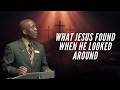
Jesus’ final journey was marked by a profound and unwavering sense of purpose. He moved with deliberate intention towards Jerusalem, fully aware of the suffering that awaited Him. This was not a path of passive acceptance but one of active obedience to the Father’s will. Every step, from the triumphal entry to the cross, was filled with meaning and resolve for the sake of our redemption. His determination invites us to consider the steadfastness of our own walk with Him. [00:52]
“Then he said to them all: ‘Whoever wants to be my disciple must deny themselves and take up their cross daily and follow me.’” (Luke 9:23 NIV)
Reflection: As you consider the deliberate and purposeful steps Jesus took toward the cross, what is one area of your daily routine where you feel invited to walk with more intentionality and resolve in your faith?
A life that appears spiritually vibrant on the outside can sometimes be barren on the inside. Like a fig tree full of leaves but without fruit, we can cultivate an image of faith that promises nourishment but offers none. This external religiosity, which lacks the authentic fruit of a transformed life, is a form of hypocrisy that God judges. The call is to move beyond a deceptive appearance and into a life of genuine substance that flows from a heart connected to Christ. [13:15]
““Not everyone who says to me, ‘Lord, Lord,’ will enter the kingdom of heaven, but only the one who does the will of my Father who is in heaven.” (Matthew 7:21 NIV)
Reflection: Where in your life do you sense the most significant gap between your outward profession of faith and the inward reality of your heart’s condition?
God’s house is designed to be a place of prayer for all people, a haven of life and connection with Him. It loses its purpose when it becomes a marketplace for personal gain or a members-only club that excludes others. True worship is not about our comfort or cultural preferences but about creating space for everyone to encounter God’s grace. It challenges us to remove any barriers that might prevent others from drawing near to Him. [16:45]
““And as for them, whether they listen or not—for they are a rebellious people—they will know that a prophet has been among them.” (Ezekiel 2:5 NIV)
Reflection: What is one practical way you can help make your faith community a more welcoming and accessible place for someone who does not yet know Jesus?
It is possible for the church to reflect the values of the world more than the heart of God. The pursuit of cultural influence, political power, and worldly success can often overshadow our core calling to love, serve, and make disciples. Jesus calls His church to be a counter-cultural community known for its radical love, generosity, and humility, set apart as a light in the world rather than a mirror of it. [20:07]
““You are the salt of the earth. But if the salt loses its saltiness, how can it be made salty again? It is no longer good for anything, except to be thrown out and trampled underfoot.” (Matthew 5:13 NIV)
Reflection: In what specific area of your life do you find it most challenging to live out the counter-cultural values of God’s kingdom instead of conforming to the patterns of the world around you?
Authentic faith is deeply connected to the condition of our hearts, especially in the area of forgiveness. We cannot ask God to move mountains on our behalf while harboring bitterness and unforgiveness toward others. A heart that is right with God and others is fertile ground for powerful, mountain-moving prayer. This intertwining of faith and forgiveness is a prerequisite for experiencing the full measure of God’s power in our lives. [25:53]
““And when you stand praying, if you hold anything against anyone, forgive them, so that your Father in heaven may forgive you your sins.”” (Mark 11:25 NIV)
Reflection: Is there a relationship in your life where unforgiveness is currently hindering your fellowship with God and your ability to pray with faith? What would be one step toward releasing that hurt to Him?
Jesus deliberately marches toward Jerusalem in the final week, fully aware that death awaits. The narrative frames that journey as urgent and confrontational: a triumphal entry that risks reputation, a prophetic act against hypocrisy, a cleansing of sacred space, and a tender yet decisive moment of judgment enacted on a barren fig tree. The fig tree, leafed but fruitless, becomes a visible parable for a people who appear alive but produce no true fruit. The temple, grand yet corrupted into a marketplace, stands as a symbol of worship turned inward and commercialized, calling out practices that block genuine access to God.
The two scenes—the withered tree and the overturned tables—function as a single prophetic critique: outward religiosity without inward devotion provokes divine judgment. Scripture repeatedly uses the image of a fig tree to portray national unfaithfulness, and the cleansing of the temple points to the end of a system that had failed its mission to be “a house of prayer for all nations.” True worship must welcome the stranger, feed the poor, and practice radical generosity rather than hoard wealth or seek cultural power.
The account also exposes human self-deception: good reputations can mask hollow hearts; creeds can conceal greed. The narrative warns against mistaking strategic plans, programs, or polished appearances for the work of the Spirit. Authentic change begins where God moves hearts, not where human ingenuity arranges outcomes.
Finally, the withered tree becomes the occasion to teach about prayer, faith, and forgiveness. Sincere prayer, unclouded by doubt and hardened resentment, unleashes God’s power; faith that claims mountains must carry a forgiving heart. The call closes with a clear summons: place trust in God rather than in human schemes. Only God can change hearts, break chains, and transform communities, and authentic discipleship bears visible fruit in lives that pray, forgive, serve, and welcome the marginalized.
What is really going on here? Jesus uses the discovery of the withered tree as an opportunity to teach on prayer, faith and forgiveness. His point, God does great things in response to the prayers of his people. And speaking hyperbolically, he emphasizes the point in reminding them that when God's people sincerely pray, in other words, without doubt, he'll move mountains in response. However, he adds, bitterness and unforgiveness are detrimental to our faith, And so he reminds his followers that authentic faith and prayer are tied to a forgiving heart.
[00:25:17]
(45 seconds)
#FaithAndForgiveness

It's not the strategic plan that gets us to achieve these things as good and as important as it is. It is not our wisdom or our experience. We need to hear Jesus's instruction. Verses 22, he says this, have faith in God. Not have faith in yourselves, or have faith in your plans, or have faith in your incredible ability to plan. No. Have faith in God. Why? Because he's the only one who can change hearts. He's the only one who can break chains of bondage that are holding us. He's the only one who can walk in and through us to change our community, our city, and our world. Authentic faith in God will move mountains.
[00:26:55]
(53 seconds)
#TrustGodNotPlans
Like the casting of the fig tree, much of what Jesus did in the temple is a parable of what was to come. God would judge the nation of Israel for their rebellion, and he would fulfill and accomplish what the temple could never fully accomplish. By driving out the money changers, Jesus acts as a judge, declaring that the temple that was meant to be a house of prayer, and he adds this, for all nations had instead been diverted into a den of thieves.
[00:16:20]
(33 seconds)
#TempleNotMarketplace
See the test of true worship is not how we feel about God, it's how open we are to God, and how we make worship accessible for others. The true test of worship doesn't reside in showy religiosity, but in God glorifying lives, And just as it costs Jesus, it might cost you and me. We may have to lay down our preference, our preferences, and open our hearts to those who are not like us. We'll have to let Jesus actually rule in his church.
[00:23:17]
(38 seconds)
#TrueWorshipServes
So this is a parable about the work of God with the nation of Israel, and the history of redemption, but it's also a warning for all Jesus' disciples about the dangers of hypocrisy. We can appear godly all the while carrying a heart that is far from God. We can be like the fig tree, have lives that promise life, and are full, and yet have no fruit. Jesus makes it clear that God's judgment awaits those who just profess him outwardly, but inwardly live for themselves.
[00:12:45]
(40 seconds)
#FruitOverForm
As Jesus clears the temple and teaches the crowds, many are astonished, and the chief priests and the scribes are more motivated than ever to silence him. Of course their actions would make it possible for Jesus' mission to be fulfilled, which was ultimately to die for our sin and for our salvation, but it's important to notice here that Jesus cared so much about removing barriers to worship that he lost it over its misuse. And the question for you maybe and I is, how much do we care?
[00:22:43]
(35 seconds)
#ProtectWorship
Leighton Hickman, who is a pastor, writes the following, says the tree advertised life and fruit, but it had none. The temple advertised life and fruit to a dead and hopeless world, but it had none either. And I have done the same. You and I have done the same. In fact, the mainstay, the call sign, the common thread linking all lukewarm Christianity that I have ever seen all perpetrated, practices this same crooked ideology, saying, I know what I'm doing is wrong, but I'm basically a good person.
[00:23:55]
(36 seconds)
#LukewarmExposed
Now while many have suggested that Jesus' response is unfair and maybe over the top, the actions of Jesus were never about the tree. Jesus is providing a parable about the nation of Israel, highlighting their unfaithfulness and the judgment that awaited them. And throughout scripture, a fig tree often represents Israel, a tree with leaves, but no fruit symbolize a deceptive nation and a hypocritical religious system. And there are lots of references of Israel as a fig tree in the old testament, I've just listed a few of them here, including Hosea nine ten, Jeremiah eight thirteen, Jeremiah 24, Micah seven verses one to three, among many others.
[00:11:58]
(47 seconds)
#FigTreeParable
I'm an AI bot trained specifically on the sermon from Mar 01, 2026. Do you have any questions about it?
Add this chatbot onto your site with the embed code below
<iframe frameborder="0" src="https://pastors.ai/sermonWidget/sermon/what-jesus-found" width="100%" height="100%" style="height:100vh;"></iframe>Copy