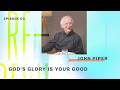
What Does God Care About Most? | A Conversation with John Piper
Sep 30, 2026
Devotional
Day 1: When Love Means Being Enthralled, Not Elevated
The world defines love as being made much of—a constant drumbeat of “you’re somebody!” But God’s love flips this script. His love isn’t about inflating our worth; it’s about binding our joy to His infinite glory. Like a parent who gives a child not just candy but nourishing food, God sacrifices everything to enthrall us with what truly satisfies: Himself. This love costs Him dearly but gifts us eternally. To be loved by God is to be freed from the exhausting chase for significance and anchored in His radiant worth. [00:11]
“Everyone who is called by my name, whom I created for my glory, whom I formed and made.” (Isaiah 43:7, ESV)
Reflection: Where have you subtly believed love means being praised? How might embracing God’s definition of love shift your daily pursuits?
Day 2: “Not for Your Sake” – The Shock of God’s Glory-Fueled Grace
God’s deliverance comes with a jarring disclaimer: “It is not for your sake that I act” (Ezekiel 36:22). He rescues, renews, and restores not because we deserve it, but to vindicate His holy name. This truth crushes pride yet kindles awe—our salvation is a billboard for His worth. Like a surgeon removing cancer, God’s kindness cuts deep to heal, leaving us both ashamed and astonished. His grace glorifies Him by making rebels into reflectors. [18:12]
“It is not for your sake, O house of Israel, that I am about to act, but for the sake of my holy name… Then the nations will know that I am the Lord.” (Ezekiel 36:22-23, ESV)
Reflection: Where do you still expect God to center your comfort? How might His “not for your sake” love actually free you?
Day 3: Weakness as a Spotlight for God’s Sufficiency
Thorns in the flesh—chronic pain, persistent failures, unanswered prayers—feel like divine neglect. But Paul’s story reframes them as megaphones: “My power is made perfect in weakness.” When God denies relief, He’s not withholding love but amplifying His worth. Like a diamond displayed on black velvet, Christ’s strength shines brightest against the dark backdrop of our limitations. Our cracks become conduits for His glory. [38:58]
“But he said to me, ‘My grace is sufficient for you, for my power is made perfect in weakness.’ Therefore I will boast all the more gladly of my weaknesses, so that the power of Christ may rest upon me.” (2 Corinthians 12:9-10, ESV)
Reflection: What thorn have you begged God to remove? How might this weakness uniquely showcase Christ’s strength if you embraced it?
Day 4: The Radical Prayer – “Glorify Your Name, Not Mine”
Jesus’ Gethsemane cry—“Father, glorify your name”—redefines desperation. In agony, He sought not deliverance but the Father’s magnification. This prayer dismantles our transactional view of God: we don’t negotiate blessings but join His glory-mission. Like a sunflower turning not for its own growth but to reflect the sun, our deepest cries shift from “fix this” to “magnify You here.” True deliverance begins when God’s glory becomes our non-negotiable. [16:45]
“Now is my soul troubled. And what shall I say? ‘Father, save me from this hour’? But for this purpose I have come to this hour. Father, glorify your name.” (John 12:27-28, ESV)
Reflection: What current struggle tempts you to prioritize relief over God’s glory? How could praying Jesus’ prayer recalibrate your heart?
Day 5: Creation’s Unspoken Sermon – God’s Silent Roar
Apple blossoms and sunrises preach without words. The universe isn’t a random gallery but a curated exhibit declaring God’s majesty. Like a bridegroom’s joy radiates on his wedding day, creation’s beauty broadcasts God’s delight in Himself. Our call isn’t to make nature spiritual but to decode its message: the Maker’s glory demands a response. Even rocks cry out—how much more should His image-bearers? [52:23]
“The heavens declare the glory of God, and the sky above proclaims his handiwork. Day to day pours out speech, and night to night reveals knowledge.” (Psalm 19:1-4, ESV)
Reflection: When did creation last arrest you with God’s glory? How will you intentionally “listen” to its silent proclamation today?
Sermon Summary
God’s God-centeredness means that God has a goal in everything he thinks, feels, and does: the magnifying, displaying, and vindicating of his own worth, beauty, and greatness. This truth produces a Copernican revolution because the self goes out of the center. The fallen world keeps telling people that love means making much of them, that the great rescue is to assure everybody, “You’re somebody.” But the Bible puts God where he belongs, at the center of the universe and at the center of his own purposes.
The Bible grounds this claim across the whole history of redemption. Election happens unto the praise of the glory of grace. Creation exists for God’s glory. Exodus displays God’s power so that his name is known in all the earth. Isaiah hammers the point home: “For my name’s sake,” “for my own sake,” “my glory I will not give to another.” Ezekiel 36 joins God’s zeal for his holy name to staggering mercy: cleansing, a new heart, the Spirit within, obedience, abundance, and restoration. God’s salvation is not finally a recognition of human worth. The cross and grace create worth in sinners who were not diamonds waiting to be found.
The objection rises quickly: does God’s pursuit of his glory make him a megalomaniac? Love answers that objection when love is defined rightly. Love does whatever it can, even at the cost of life or the Son’s life, to enthrall the beloved with the only joy that can be full and forever. God’s commitment to glorify himself is therefore his commitment to give his people himself. He gets the glory, and his people get the joy. Christian hedonism names that reality: God is most glorified in a person when that person is most satisfied in him.
The kindness of God also brings a serious joy, not a shallow rah-rah kind of joy. Ezekiel’s “be ashamed and confounded” fits with God’s lavish mercy because divine kindness exposes sin, leads to repentance, and restores fellowship. Paul’s thorn likewise shows that Christ’s glory can become more precious than immediate comfort. Weakness becomes a place where grace shines, and long suffering can display a radiant satisfaction in God that a momentary miracle could never show.
The image of God means that human beings exist to image, reflect, and make much of God. The Father delights infinitely in the Son, the Son delights infinitely in the Father, and the Spirit is the personal fullness of that mutual enjoyment and magnification. The heavens, apple blossoms, sunshine, prayer, marriage, obedience, suffering, and ordinary work all belong under the same great petition: “Hallowed be your name.”
##
Key Takeaways
1. God’s glory is love’s deepest gift God’s self-exaltation is not competition with human joy. God’s glory is the only reality weighty enough to satisfy a soul forever. A God who gave people something less than himself would not be loving them fully. [27:15]
2. Grace creates worth in sinners The cross does not discover a hidden diamond in fallen humanity. Grace takes crummy shale and, through Christ, makes it shine. Human dignity rests finally in God’s merciful work, not in autonomous self-importance. [34:34]
3. Kindness produces serious, repentant joy God’s kindness can make sin look more shameful, not less, because mercy reveals how badly it has been treated. That shame need not end in despair. God brings his people through brokenness into a deeper, steadier enjoyment of himself. [21:35]
4. Weakness can magnify Christ’s sufficiency Paul’s thorn shows that immediate relief is not always God’s highest purpose. Christ’s sufficient grace turns unwanted weakness into a platform for divine power. Enduring faith can bear witness to God’s beauty over many years. [39:31]
5. Image bearers exist to reflect God Human beings become rightly human by imaging the God whose glory they were made to display. Good deeds and truthful words should direct attention beyond the creature to the Creator. Redemption restores this purpose through conformity to Christ.
[53:34] - God-Hungry People and Hallowed Be Your Name
Bible Study Guide
Bible Reading
Ezekiel 36:22-32 “Therefore say to the house of Israel, Thus says the Lord God: It is not for your sake, O house of Israel, that I am about to act, but for the sake of my holy name, which you have profaned among the nations to which you came. And I will vindicate the holiness of my great name, which has been profaned among the nations, and which you have profaned among them. And the nations will know that I am the Lord, declares the Lord God, when through you I vindicate my holiness before their eyes. I will take you from the nations and gather you from all the countries and bring you into your own land. I will sprinkle clean water on you, and you shall be clean from all your uncleannesses, and from all your idols I will cleanse you. And I will give you a new heart, and a new spirit I will put within you. And I will remove the heart of stone from your flesh and give you a heart of flesh. And I will put my Spirit within you, and cause you to walk in my statutes and be careful to obey my rules. You shall dwell in the land that I gave to your fathers, and you shall be my people, and I will be your God. And I will deliver you from all your uncleannesses. And I will summon the grain and make it abundant and lay no famine upon you. I will make the fruit of the tree and the increase of the field abundant, that you may never again suffer the disgrace of famine among the nations. Then you will remember your evil ways, and your deeds that were not good, and you will loathe yourselves for your iniquities and your abominations. It is not for your sake that I will act, declares the Lord God; let that be known to you. Be ashamed and confounded for your ways, O house of Israel.” [17:56]
Isaiah 48:9-11 “For my name's sake I defer my anger; for the sake of my praise I restrain it for you, that I may not cut you off. Behold, I have refined you, but not as silver; I have tried you in the furnace of affliction. For my own sake, for my own sake, I do it, for how should my name be profaned? My glory I will not give to another.” [15:18]
2 Corinthians 12:9 “But he said to me, “My grace is sufficient for you, for my power is made perfect in weakness.” Therefore I will boast all the more gladly of my weaknesses, so that the power of Christ may rest upon me.” [38:40]
Observation questions
In Ezekiel 36:22–32, what reason does God give for acting on behalf of Israel, and what gifts does he promise to give them afterward? [18:54]
What repeated phrases in Isaiah 48:9–11 show God’s concern for his own name, praise, and glory? [15:29]
In 2 Corinthians 12:9, what answer does Paul receive concerning his weakness, and how does that answer reshape his response? [39:31]
What two results are held together in the claim that God’s love gives people himself: what does God receive, and what do his people receive? [27:26]
Interpretation questions
Ezekiel 36 connects God’s concern for his holy name with cleansing, a new heart, the Spirit, and restored obedience. Why is it important that God’s glory and his people’s good are not competing purposes? [19:52]
Why does God’s pursuit of his own glory sound selfish or harsh to many people, and how does the Bible’s definition of love answer that concern? [26:06]
Isaiah 48 emphasizes that God acts for his own sake. How does this truth protect grace from becoming a reward for human worthiness? [34:31]
Paul’s thorn was not immediately removed, yet Christ’s grace proved sufficient. What does this suggest about the difference between God’s goodness and a life of constant comfort? [39:31]
Application questions
Where are you most tempted to measure God’s love by whether life is making much of you—through comfort, recognition, success, or approval? How might finding joy in God himself change that measure? [32:29]
Is there a recent sin, harsh word, or selfish choice that God’s kindness has brought to mind? What would serious, repentant joy look like as you bring it honestly before him rather than hiding or excusing it? [21:35]
What “thorn” or ongoing weakness are you asking God to remove? How could you pray not only for relief, but also for Christ’s sufficient grace to be seen in that place? [40:27]
In your ordinary routines this week—work, school, caregiving, chores, or conversations—where could you consciously aim to reflect God rather than draw attention to yourself? [45:23]
How might your daily Bible reading or prayer change if you began by asking God to satisfy your soul in himself and to make his name great in your life? [37:30]
Think of a place where you feel pressure to prove that you are “somebody.” What would it look like to rest in the worth God creates by grace rather than trying to establish your worth through performance or other people’s praise? [34:34]
Sermon Clips
“Christian hedenism. God is most glorified in me when I'm most satisfied in him is the answer to the megalomania of God and why that is love and not megalomania.” [00:24:20]
“Okay, get this definition. Love does everything it can even at the cost of its own life or its son's life. in order to enthral the beloved with a joy that will be full and forever. That's my definition of love.” [00:26:23]
“And if if it grips you, if it takes hold of you that he does absolutely everything he does, it does have a Capernac revolution effect. And what goes out of the center is you. Which just changes everything in life.” [00:05:19]
“What is he up to in the universe? And the answer of the Bible on almost every page is he's up to the magnifying, the displaying, the vindicating of his own worth, beauty, greatness.” [00:04:51]
“When God loves us like this for his sake and shames us for our horrible sinfulness, he's doing it with a smile that brings us through shame back into a new kind of serious enjoyment of God. Not a rah rah, praise God. anyhow kind of joy, but a serious joy that has deep brokenness at the bottom of it.” [00:21:52]
“They they stand and fall together because God's God- centeredness really is in the end the last defense of God's grace. God's absolutely sovereign, free grace. He does everything freely.” [00:12:32]
“So election unto the praise of the glory of his grace. Ephesians 1:6. He elected you. He predestined you. He purpose to adopt you unto the praise of the glory of his grace. He means to get praise for the glory of his grace.” [00:14:10]
“He's not responding when he elects. He's not responding when he regenerates. It is absolutely free. Well, what's it about then? What's motivating him if it's not response to what's going on in your life? And the answer is sovereign purposes. The purpose according to his election, his free self, free will. God's the one person who has free will.” [00:12:51]
“Yeah. Discovering how it is good news is a miracle. That is the fundamental change that has to happen because it does not sound like good news to a self-centered person or to a person who wants to be central in community. not not just them but I want my my tribe to be central. It it just won't look like good news.” [00:23:44]
“Absolutely. I'm just not at the center of this enterprise anymore. And I can either join him in that and be happy about it or I can be swept aside. Right?” [00:05:36]
“Love does whatever it can or must even at the cost of its own life or its son's life in order to enthral the beloved with a joy that will be full and forever.” [00:00:17]
“I don't think I heard anybody say till I was 22 actually God also does everything for his own glory. Isn't that amazing? I've never heard anybody say that. God does everything.” [00:03:34]
“‘not for your sake.’ What? It is not for your sake that I will act, declares the Lord. Let that be known to you. Be ashamed and confounded for your ways, oh house of Israel.” [00:19:52]
“Because if God is seeking his own glory, he's a megalomaniac. That'd be number one. Number two would be people just aren't systematizers. They don't. They see one, they see a text and they don't think, ‘Oh, there's 15 other texts in this book of Isaiah that sound just like that. That must be a big deal that God does everything for his own names sake.’” [00:10:17]
“For my name's sake I defer my anger. So here defer so this is really your salvation. I defer my anger from destroying you in the exile. I defer my anger for my name's sake, for my name's sake. For my praise, I restrain you that I may not cut you off. Behold, I refined you not as silver. I've tried you in the furnace. For my own sake, for my own sake, I do it. How should my name be profane? My glory I will not give to another.” [00:15:29]