God often chooses the most unlikely individuals to fulfill His divine purposes. He does not call the qualified but qualifies the called. These were not men of noble birth or exceptional learning; they were fishermen, tax collectors, and ordinary citizens. Yet, through their willingness to follow, they were woven into the greatest story ever told. Their lives remind us that our background does not limit God's ability to use us. He specializes in transforming the ordinary into the extraordinary for His glory. [04:01]
Now as he walked by the sea of Galilee, he saw Simon and Andrew his brother casting a net into the sea: for they were fishers. And Jesus said unto them, Come ye after me, and I will make you to become fishers of men. And straightway they forsook their nets, and followed him. (Mark 1:16-18, KJV)
Reflection: In what areas of your life do you feel your "ordinary" background or abilities are insufficient for God's work? How might God be inviting you to trust Him with those limitations today?
Following Jesus is an invitation to a life of profound love, but it is not without cost. True discipleship often requires laying down our lives, whether through physical sacrifice or the daily surrender of our own desires and ambitions. This path is not one of ease but of purpose, where our greatest comfort is found in His presence, not our circumstances. The call to follow is a call to die to self so that we might truly live for Him. [08:32]
Then said Jesus unto his disciples, If any man will come after me, let him deny himself, and take up his cross, and follow me. For whosoever will save his life shall lose it: and whosoever will lose his life for my sake shall find it. (Matthew 16:24-25, KJV)
Reflection: Where is Jesus asking you to "lay down your life"—to surrender a personal ambition, comfort, or security—in order to take up your cross and follow Him more closely?
It is possible to be near Jesus, to know about Him, and yet to have a heart that remains closed. Knowledge of His teachings and even witnessing His works is not a substitute for a surrendered will. A heart that is not fully yielded can slowly drift into disillusionment, holding onto its own plans rather than embracing His. The true mark of a disciple is not mere presence but a heart that trusts and obeys. [10:13]
Not every one that saith unto me, Lord, Lord, shall enter into the kingdom of heaven; but he that doeth the will of my Father which is in heaven. (Matthew 7:21, KJV)
Reflection: Is there an area where you are maintaining proximity to Jesus through routine or knowledge, but have been withholding full surrender and obedience?
Genuine faith is not born from blind acceptance but from an honest seeking after truth. It is a journey that begins with questions and finds its rest in the person of Christ, who knows us completely and calls us by name. When truth is revealed, the response is not just intellectual assent but a life of worship, characterized by integrity and a deep, personal trust in the One who is Truth itself. [13:19]
Jesus saith unto him, I am the way, the truth, and the life: no man cometh unto the Father, but by me. (John 14:6, KJV)
Reflection: What honest question or doubt are you wrestling with that you can bring before Jesus, asking Him to reveal more of His truth and character to you?
The old covenant, with its reminders of sacrifice, found its ultimate fulfillment in the final, perfect sacrifice of Christ. His body was broken and His blood was shed to establish a new covenant, once and for all. This was not an act of desperation but a decisive, loving act of atonement, paying a debt He did not owe to cancel the debt we could never pay. [16:56]
For this is my blood of the new testament, which is shed for many for the remission of sins. (Matthew 26:28, KJV)
Reflection: As you reflect on the sacrifice of Christ, what specific burden of guilt or shame are you being invited to release, knowing it has been fully paid for by His blood?
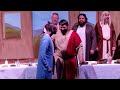
A moment freezes a circle of friends and betrayers around a table that already knows its destiny. Jesus takes the lead role as Son of God and servant, willingly embodying the lamb who carries humanity’s debt. Ordinary fishermen, questioners, connectors, and honest seekers gather: Thaddeus wrestles with how God reveals himself and learns the kingdom comes through sacrifice; Philip questions practically and later preaches where opportunity opens; James’s thunderous ambition meets the cost of kingdom greatness; Judas sits with greed growing in his heart despite close proximity; Andrew quietly brings others to Christ; Bartholomew meets truth through honest confrontation. Each man enters with a history that will shape his witness and, for many, his martyrdom.
The Passover setting reframes centuries of sacrificial remembrance into an imminent fulfillment. Bread and cup become decisive signs: the bread signifies a body given for others, the cup reinterprets the Passover blood as the seal of a new covenant. The sacrificial system finds its end not in ritual repetition but in a once-for-all atonement that cancels the need for further sacrifices. When betrayal surfaces among those closest, the revelation lands without anger; knowledge of what must happen stands firm from the beginning.
Atonement receives theological clarity through the witness of Scripture: justification by faith, reconciliation through Christ’s death, and the hope that follows in risen life. The cross answers humanity’s powerlessness by demonstrating divine love when people remained enemies. Resurrection completes the trajectory—Sunday morning promises an empty tomb and restored life for all who receive new birth. The table therefore becomes both memorial and summons: a call to recognize the sacrifice, to respond in renewed commitment, and to stand in the grace already purchased. A closing prayer frames the elements as means to revive faith, remind identity, and recommit lives to the gospel’s cost and call.
The first to enter is Jesus, the son of God, the lamb who has come to take away the sin of the world, the teacher who spoke with authority, the servant who has now washed the feet of those who would serve him, the savior who would lay down his life. This table was not a surprise to him. He knew the betrayal that was to come. He knew the suffering that would follow. And still, here he is, our God who took on flesh, who took on the form of a servant, who has come to pay for our atonement, a debt we should be paying ourselves.
[00:04:08]
(78 seconds)
#ServantSavior

Andrew was a fisherman by trade, but a connector by nature. He was one of the first to follow Jesus and immediately went to find his brother, Simon Peter, to introduce him. Andrew did not seek attention. He simply brought people to Jesus, like the boy with loaves and fish or Greeks who wanted to see and meet Christ for themselves. Andrew knew that introducing someone to Jesus was never a small thing. Bound to an x shaped cross in Greece, Andrew hung for days, yet preached the gospel to onlookers until his final breath.
[00:11:22]
(74 seconds)
#BringPeopleToJesus
James, brother of John, enters next. A fisherman, bold and ambitious, once called a son of thunder. He and his brother asked for seats of honor when Jesus establishes his earthly kingdom, not yet understanding the cost of such a request. James would become the first of the 12 to die for his faith, learning that greatness in God's kingdom comes through sacrifice. As scripture records, James was beheaded by Herod's sword in Jerusalem. The first apostolic blood spilled. His thunderous zeal silenced in martyrdom.
[00:08:13]
(79 seconds)
#GreatnessThroughSacrifice
Philip enters and approaches thoughtfully. He was practical, analytical. He seemed to always count the cost. When Jesus wanted to feed the 5,000, Philip asked, how can we feed so many? When Jesus said he was going to prepare a place in heaven for them, Philip replied, show us the father and we will believe. Philip was one of the first to preach in Samaria after the door was opened for the gospel there. In Hierapolis, tradition says Philip was crucified upside down or possibly scourged to death. In either case, it was clear his heart was settled, his questions answered, for he died for the one who was the answer to each and every question he ever had.
[00:06:48]
(78 seconds)
#QuestionsToConviction
We invite you into a moment frozen in time. A moment filled with friendship and fear, with devotion and betrayal, with love that knew what was coming yet chose the path foreseen since the beginning of eternity. This is the final meal Jesus would share with his disciples before the garden, before the trial, before the cross. As each man enters to take his place at the table, we remember not only who they were, but why Jesus chose them. Ordinary men called into an extraordinary story of redemption.
[00:03:24]
(42 seconds)
#OrdinaryCalledExtraordinary
Finally, here comes Bartholomew, also known as Nathaniel, a man of honesty and integrity. When first told about Jesus, he questioned whether anything good could come from Nazareth. But when Jesus spoken to his life naming him, knowing him, Nathaniel believed. Jesus said of him, here is a true Israelite in whom there is nothing false. Bartholomew reminds us that faith does not begin with blind acceptance, but with honest seeking and surrender when truth is revealed. Tradition recounts that Bartholomew was skinned alive in Armenia, yet he preached Christ until the executioner's blade ended his testimony with beheading.
[00:12:44]
(64 seconds)
#HonestFaith
And every time we are reminded of what Jesus did on our behalf Because what Jesus did that Good Friday, he did for each of us. The sacrifice for our sins. He paid the debt he did not owe. He paid the debt we are destined to pay.
[00:21:42]
(32 seconds)
#PaidTheDebt
They have convened in this upper room to celebrate the Passover together. The Passover, the annual reminder of what God had done to rescue the Hebrew people from Egypt long ago, And now to be a reminder of how God would rescue them once again, this time from the very thing that has kept them truly captive.
[00:13:51]
(61 seconds)
#PassoverRemindsRescue
I'm an AI bot trained specifically on the sermon from Mar 29, 2026. Do you have any questions about it?
Add this chatbot onto your site with the embed code below
<iframe frameborder="0" src="https://pastors.ai/sermonWidget/sermon/upper-room-jesus-new-covenant" width="100%" height="100%" style="height:100vh;"></iframe>Copy