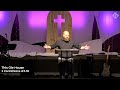
We hold a precious and powerful message within ourselves, yet we are fragile vessels. This contrast is not a design flaw but a divine intention. The surpassing power of God’s work is made evident precisely because it is housed in our weakness. Our physical limitations cannot contain or diminish the spiritual reality of Christ in us. This truth allows us to find hope and purpose regardless of our earthly condition. [09:06]
But we have this treasure in jars of clay, to show that the surpassing power belongs to God and not to us. (2 Corinthians 4:7 ESV)
Reflection: The "treasure" is the good news of Jesus. What does it look like, in the practical realities of your day, to rely on the power of this treasure rather than your own strength or abilities?
Humanity often equates value with youth, strength, and physical beauty. Yet, the economy of God’s kingdom operates on a different principle. His power is perfected in our weakness, not in our human capabilities. A life of spiritual vitality and profound impact is available to all, regardless of age or physical state. The effectiveness of a believer is rooted in Christ’s indwelling power, not in the vessel that contains it. [17:18]
But he said to me, “My grace is sufficient for you, for my power is made perfect in weakness.” Therefore I will boast all the more gladly of my weaknesses, so that the power of Christ may rest upon me. (2 Corinthians 12:9 ESV)
Reflection: Where in your life are you most tempted to believe that your usefulness to God is limited by a physical, mental, or emotional weakness? How might this scripture change your perspective on that area?
The Christian life is not a guarantee against hardship. In fact, Scripture assures us that we will face affliction, confusion, and persecution. These challenges are a normal part of following Christ in a broken world. The promise is not the absence of pain, but the presence of God within it. He provides the grace to endure without being ultimately crushed or destroyed by our circumstances. [20:08]
We are afflicted in every way, but not crushed; perplexed, but not driven to despair; persecuted, but not forsaken; struck down, but not destroyed. (2 Corinthians 4:8-9 ESV)
Reflection: When a difficult circumstance arises, what is your first response? How can you train yourself to look for how God is sustaining you in the trial, rather than only asking Him to remove you from it?
The difficulties we face are not without meaning. God uses our trials to make the life of Jesus visible to those around us. Our faithful endurance through suffering becomes a powerful testimony that points others toward the hope we have in Christ. Our personal pain can be the very platform God uses to extend His grace to more people, resulting in increased thanksgiving for His glory. [24:43]
For it is all for your sake, so that as grace extends to more and more people it may increase thanksgiving, to the glory of God. (2 Corinthians 4:15 ESV)
Reflection: Can you identify a past or present struggle that God might be using to display His faithfulness to someone in your life? How does this purpose change the way you walk through that challenge?
While our physical bodies are in a state of inevitable decline, our inner being is being renewed each day. This reality allows us to view our present afflictions as light and momentary when weighed against the eternal glory that awaits us. Our focus must shift from the temporary, visible things of this world to the eternal, unseen realities of God’s kingdom. [28:29]
So we do not lose heart. Though our outer self is wasting away, our inner self is being renewed day by day. For this light momentary affliction is preparing for us an eternal weight of glory beyond all comparison. (2 Corinthians 4:16-17 ESV)
Reflection: What is one "unseen" eternal reality (e.g., God's love, your future hope, the power of prayer) that you can choose to fix your eyes on today, instead of the visible temporary problems vying for your attention?
Humanity has chased youth for millennia, hunting mythical springs and miracle cures to stall decay. Ancient stories from Gilgamesh to medieval and colonial legends show a persistent craving for physical vitality. Modern culture trades in supplements, surgeries, and image-making to hide aging, but scripture frames the body differently: transient and fragile, shaped from dust and subject to decline. Ecclesiastes lays the reality bare with stark images—trembling hands, dimmed eyes, snapped cords—and insists that physical breakdown happens to everyone, removing shame from personal frailty.
The biblical hope, however, refrocuses desire from the seen to the unseen. Resurrection promises a new, embodied life like the risen Christ’s—real, physical, yet glorified—and anchors present suffering within that future restoration. Meanwhile the gospel functions as a priceless treasure held inside fragile jars of clay: the body can fail, but the surpassing power belongs to God and manifests through weakness. Paul models this theology by cataloging relentless pressures—affliction, perplexity, persecution, physical strikes—while insisting none of those experiences cancel God’s sustaining presence or purpose.
Suffering receives purpose on two levels. Publicly, persistent witness under hardship displays the life of Jesus and draws others to grace, turning testimony into communal thanksgiving. Personally, trials produce inward renewal: although the outer self wastes away, the inner self grows day by day, preparing believers for an eternal weight of glory that dwarfs present afflictions. The comparison does not trivialize pain; it reorders values so the spiritual gains outweigh temporal loss.
Concrete witness emerges in modern lives that refuse bitter resignation. Stories of forgiveness and reconciliation show spiritual strength outliving physical prowess—forgiveness can prove more powerful than former feats of strength and can rekindle life when the body weakens. Ultimately, aging and suffering do not nullify usefulness. Breath remains a call to mission, fragility highlights God’s power, and inward renewal prepares for an incomparable, eternal glory.
People carry it around, and I can't articulate to you in words what forgiveness is, but forgiveness is divine. The love that's required, the humility that's required to forgive unconditionally, and that's why I trust Christ, he said. I mean, Blinky understood the pain of life. His son was lost. Son was murdered, and he's getting old. His hook, it was not as strong as it used to be, but you know what was even stronger? The ability to forgive the person that had done the unthinkable to him. And he did it because Christ lives in him. If you have Christ, the outer self is gonna waste away, but inwardly, you can continue to be strong. You can hit your prime when you're stepping into heaven.
[00:34:31]
(51 seconds)
#DivineForgiveness

But he says, we have this treasure in jars of clay to show the surpassing power belongs to God and not to us. So that no matter how fragile we are, the power of God can work through us. The apostle Paul was bent over. He he couldn't see well. He probably was up here preaching like this, and and the people called him on that. And there's some super apostles in the church that you're listening to this guy. He can he he he can barely get out the door. He can barely preach a sermon, and and the apostle Paul is saying, it's not dependent. You're all you're seeing the wrong things. The power of god is in the message, not in my body.
[00:15:29]
(37 seconds)
#PowerInWeakness
He said, I've always said this. Since that day that god did that, the power of forgiveness is more powerful than my left hook. And I always had a good one, Joe. He did. He's a professional kickboxer, but he's a old man now in his seventies. He said, Joe, the power of forgiveness, it gives you the chance to rekindle the fire. It gives you the opportunity to live life without carrying a heavy yoke on your neck.
[00:34:06]
(25 seconds)
#ForgivenessOverForce
Though the older older self is wasting away, our inner self is being renewed day by day. Over about the age of 60, you wanna make that your life verse. You wanna print that baby up. You wanna put it right in the mirror. K? Because when you go in the mirror, you're not gonna see the same person that you saw when you were 25. But this is a great spot for an amen. You're gonna see a more mature believer and follower of Jesus Christ than when you were 25.
[00:26:11]
(32 seconds)
#RenewedInnerSelf
And so part of the reason that we experience pain and challenges of life, some just with old age, others with wrongs that people have done to us, others with sin that we've committed, gotten ourselves in hot water. All those things that we experience, god asks us to bear the life of Christ in those things so that other people see, that other people believe, that other people can see your testimony that even though if you're you're going through some of the hard stuff that life can throw at you, you're still saying god is good.
[00:24:30]
(34 seconds)
#LiveYourTestimony
And so just as jars of clay were fashioned by a creator for a specific purpose and yet we're fragile, so are we designed by God and given a body. Praise God. It's awesome. Life is an a a miracle. But we also know the fragility of life. And some of you here, you you can speak to that in your own life, in the life of your family. Life is very fragile. We're jars of clay, and the apostle Paul says this, we have this gospel powerful message of the cross and of God and of salvation. We are holding it in this fragile vessel, a jar of clay.
[00:14:44]
(44 seconds)
#FragileVesselGospel
And when he said, can I get a hug? I grabbed him and embraced him, and I began to weep. I began to weep. I began to travail, and I began to weep, and it was a holy ghost moment where the spirit of god was moving. And an hour later, he led this man, David, who had killed his son in a prayer to receive Jesus Christ as his lord and savior.
[00:33:38]
(23 seconds)
#RedemptionMoment
When we preach the gospel to ourselves, we remind ourselves that our salvation is not found in our doing or our earning, but it's found in the accomplished work of Christ on the cross. And this should give us great joy. Because if we've walked with God for some amount of time, we can be tempted to go down the road of religion. Religion says, you do the right things. You say the right prayers. You you earn god's acceptance, that you you earn god's salvation.
[00:10:41]
(30 seconds)
#GraceNotWorks
I'm an AI bot trained specifically on the sermon from Feb 15, 2026. Do you have any questions about it?
Add this chatbot onto your site with the embed code below
<iframe frameborder="0" src="https://pastors.ai/sermonWidget/sermon/this-ole-house-lombardo" width="100%" height="100%" style="height:100vh;"></iframe>Copy