God did not drop humanity into chaos and say, “Good luck.” He formed us, breathed life into us, and settled us in a garden where work and safety lived together. The assignment was clear and joyful: cultivate and guard what God had already made. Tending means cooperating with God’s provision rather than trying to manufacture it ourselves. It is steady, attentive, and relational, not frantic or fearful. Today, receive your place as a gift before you lift a hand to serve [03:12].
Genesis 2:8-15
The LORD planted a garden in Eden and placed the human there. From the ground God caused trees to grow that were beautiful to look at and nourishing to eat. A river flowed out to water the garden and branched into many streams. God took the human and settled him in that garden to cultivate it and to watch over it.
Reflection: Where are you currently trying to make something happen that God has already provided, and what is one small, faithful act of tending you can do instead this week?
When humanity chose independence from God, the ground itself began to resist our efforts. Thorns and thistles became the companions of our labor, and sweat became the price of daily bread. Work shifted from shared joy with God to survival on our own terms. Yet even here, God’s mercy meets us, teaching us to discern anxious striving from necessary effort. He invites us to bring our toil back under His care, so our labor becomes aligned with His heart again [02:47].
Genesis 3:17-19
Because you turned from My command, the soil is now burdened. You will wrestle with the earth to eat from it, and it will push back with thorns and thistles. By hard sweat you will get your food until you return to dust, for you are dust and to dust you will return.
Reflection: Name one task that keeps “sprouting thorns” for you. How could you approach it this week as a caregiver who trusts God, rather than a controller who must force results?
Jesus does not recruit exhausted people to push harder; He calls weary people to come closer. His yoke is an invitation to shared work with a gentle Master who carries the heavy end. Learning from Him is not an information dump; it is a pace and posture shaped by His humility. In the yoke, you discover that rest and purpose are not opposites but companions. Find the rhythms that fit His steps, and your soul will breathe again [03:05].
Matthew 11:28-30
Come to Me, all who are worn down and loaded with burdens, and I will give you real rest. Take My yoke and learn My ways, for I am gentle and humble at heart. In step with Me you will discover rest deep within, because My yoke fits well and My load is light.
Reflection: What specific burden are you carrying that feels heavier than Jesus’ yoke, and how will you bring it to Him today—both in prayer and in one practical action?
You are not asked to invent your purpose; you are God’s handiwork, already shaped for meaningful service. The Father has placed good works along your path in advance—opportunities to cultivate, guard, and bless. When you aim at everything, you end up toiling at nothing; when you align with what He prepared, your effort gains grace. Let your priorities be adjusted to God’s priorities. Ask for eyes to see the assignments right in front of you [02:59].
Ephesians 2:10
We are God’s craftsmanship, made new in Christ Jesus so that we can walk out the good works God planned ahead of time—works He set before us to do.
Reflection: Identify one “prepared” work already in your path today—a person, place, or responsibility. What is one concrete, timely way you can tend it with God’s help?
God’s world is not only useful; it is beautiful. He fills our environment with goodness to enjoy, not just resources to exploit. Delight trains the heart to trust that God is generous, and boundaries remind us that He is wise. As you pause to notice beauty and receive freedom within God’s limits, striving loosens its grip. Make space today to enjoy God’s presence and His gifts without forcing a lesson or an outcome [03:22].
Genesis 2:9, 16-17
From the soil the LORD caused every kind of tree to grow—pleasant to see and good for food. He told the human, “You are free to eat from every tree here, but do not eat from the tree that brings the knowledge of good and evil, for if you do, you will surely die.”
Reflection: Where could you pause today to simply enjoy something God made—without squeezing a result from it—and how might that pause gently reset your pace?
In the beginning, God formed a world he called very good and settled humans into a garden he had planted. He didn’t ask us to create the garden, only to tend and guard it. Genesis uses two different words for “put”: first, God put the human there, and then he settled him there, a word that carries rest and safety. He gave work, yes, but work held inside of rest—watching over creation, receiving provision, and walking in communion. When we reached for what wasn’t ours, work bent into toil. Fruit that was once gathered in fellowship became bread won by sweat. We started doing God’s job and stopped doing ours.
Jesus meets us in that weariness with an invitation: “Come to me… take my yoke upon you… learn from me.” His yoke isn’t an escape from effort; it’s a way of effort that returns us to Eden’s balance—purpose without panic, labor without losing our souls. That yoke signals loyal attachment: he first binds himself to us, then asks us to bind ourselves to him as our only rabbi. In him, we become God’s workmanship, walking in the good works he already prepared (Eph. 2:10). The question, then, is painfully practical: Where am I toiling where I could be tending? Where am I trying to manufacture outcomes only God can give? Where am I undertending what he actually put in my hands?
God is not frantically signaling hidden messages; sometimes he simply shows us a really good tree. He delights, and he wants us to share his delight as we work with him. Religion that piles rules on the soul is exhausting. Trying to invent our own purpose is exhausting. But apprenticing ourselves to Jesus—gentle, humble, and already committed to us—brings rest that doesn’t cancel calling; it clarifies it. So we repent of overreaching, and we repent of neglect. We thank him for past grace, ask for fresh grace, and re-enter the ordinary places—jobs, homes, communities, church—as tenders rather than toilers. We were created for this: to tend, not toil, in God’s world.
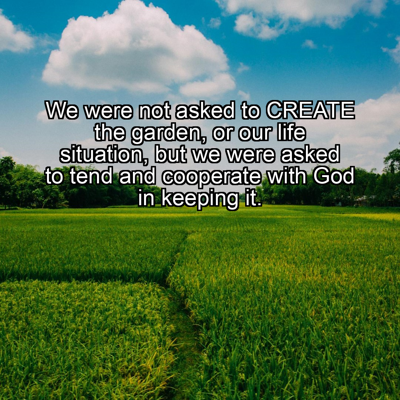
We were not asked to CREATE the garden, or our life situation, but we were asked to tend and cooperate with God in keeping it.
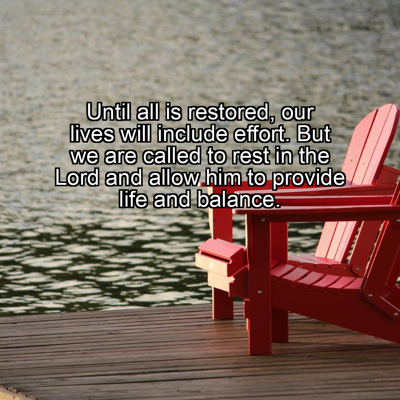
Until all is restored, our lives will include effort. But we are called to rest in the Lord and allow him to provide life and balance.

Jesus says, “Get yoked to me – be as committed to me as I am to you.” Note: Jesus was committed first. We are joining him at his invitation.
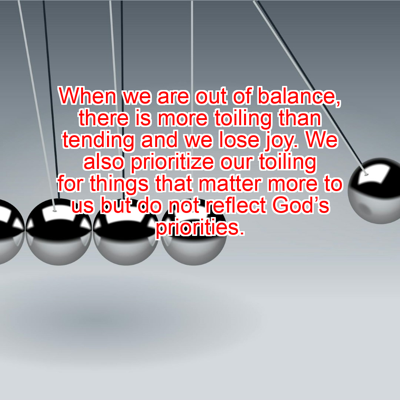
When we are out of balance, there is more toiling than tending and we lose joy. We also prioritize our toiling for things that matter more to us but do not reflect God’s priorities.
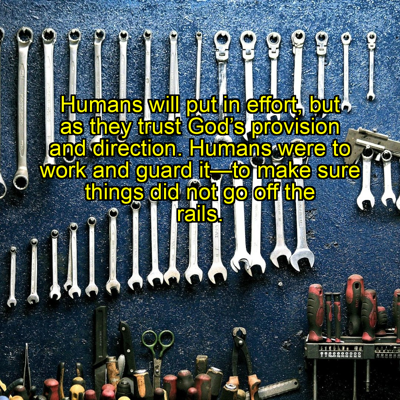
Humans will put in effort, but as they trust God’s provision and direction. Humans were to work and guard it—to make sure things did not go off the rails.
Eating moved from the fruit they tended now to the fruit they would toil for. The fruit God provided before would now have to come with sweat effort.
Jesus’ invitation to take up his easy yoke and to learn from him—that is, to make him your only rabbi—is the most certain promise of rest.

Religion is exhausting; trying to create our own purpose is exhausting. Jesus promises rest because he is manifestly gentle and humble, offering rest for the soul instead of burden.
We humbly confess that we trust our own plans and make our own way out of pride. Forgive us for walking away from your provision and help.
He put humans in the garden to tend it. He meant for them to feel settled and safe as they worked with God.
Add this chatbot onto your site with the embed code below
<iframe frameborder="0" src="https://pastors.ai/sermonWidget/sermon/tend-or-toil" width="100%" height="100%" style="height:100vh;"></iframe>Copy