Apr 25, 2026
The Corinthian church was divided over food. Some believers, armed with correct theology, ate meat previously sacrificed to idols. They knew an idol was nothing. They saw no problem. Their knowledge was accurate. But it was also cold. It failed to consider the newer believers who saw this act and were deeply troubled. Their consciences were wounded.
Paul agrees with the theology. An idol is not a real god. The food itself is not sinful. But he immediately redirects the conversation. Correct knowledge is not the ultimate goal. Knowledge, when detached from love, produces arrogance. It puffs up the individual. Only love actively builds up the entire community. The central issue shifts from the plate to the heart.
You have knowledge and freedom in many areas. You know certain actions are not explicitly forbidden. Yet your freedom operates in a community of people at different stages of faith. Your exercise of a right can inadvertently cause a brother or sister to stumble. The question is not merely "Am I allowed?" but "Is this loving?" What personal freedom might you be holding onto that could be wounding a fellow believer's conscience?
Now concerning food offered to idols: we know that “all of us possess knowledge.” This “knowledge” puffs up, but love builds up.
(1 Corinthians 8:1, ESV)
Prayer: Ask God to reveal any area where your knowledge has made you proud instead of loving.
Challenge: Identify one opinion you hold strongly and consider how you might express it with more love today.
The real scandal in Corinth was not on the altar of a pagan temple. It was at the dinner table of a Christian. A mature believer, feeling free, ate the meat. A newer believer, seeing this, felt pressure to violate his own conscience. His faith was shaken. The mature believer’s right became a stumbling block. The act of eating, though theologically neutral, became spiritually destructive because of its impact.
Paul condemns this careless exercise of freedom. To sin against a brother in this way is to sin against Christ himself. Jesus identifies so closely with his people that wounding them is to wound him. The issue is no longer the food. The issue is the flippant disregard for the spiritual well-being of someone for whom Christ died. The stronger believer’s right was less important than the weaker believer’s ruin.
Many of us prioritize being right over being righteous. We defend our liberties with logical arguments while ignoring the trail of hurt feelings and confused souls left in our wake. We win the debate but lose the brother. Stop and consider the impact of your actions before you take them. Hear the Holy Spirit’s caution. Is your insistence on your freedom creating a barrier for someone else’s walk with Jesus?
Therefore, if food makes my brother stumble, I will never eat meat, lest I make my brother stumble.
(1 Corinthians 8:13, ESV)
Prayer: Confess to Jesus any time you have chosen being right over building up another person.
Challenge: Before you post a comment online today, pause to ask if it builds up or just shows off.
Jesus possessed the ultimate freedom. He existed in the form of God. He had every right to cling to his glory and authority. Yet, he did not consider this equality something to be used for his own advantage. Instead, he made himself nothing. He emptied himself. He took the form of a servant. He surrendered his rights completely. His entire mission was an act of loving self-sacrifice for the benefit of others.
This is the pattern for all Christian conduct. Our model is not the Corinthian know-it-all, flexing his theological rights. Our model is Christ, who willingly laid his rights down. If the Son of God emptied himself for our salvation, how can we insist on asserting our minor freedoms when they cause harm? Our calling is to imitate his love, his humility, and his radical consideration for the weak.
Your life is filled with opportunities to imitate this kenosis, this self-emptying. It happens when you choose to listen instead of speak, to yield instead of insist, to serve instead of be served. It is the voluntary laying down of a privilege for the good of another. Where is God inviting you to empty your hands of your rights to take up the towel of service?
Have this mind among yourselves, which is yours in Christ Jesus, who, though he was in the form of God, did not count equality with God a thing to be grasped, but emptied himself, by taking the form of a servant, being born in the likeness of men.
(Philippians 2:5–7, ESV)
Prayer: Ask for the mind of Christ, who valued love over his own rights.
Challenge: Intentionally yield your preference in a conversation today to fully hear someone else’s view.
The Corinthian conflict was not solved with a theological treatise alone. Paul called for a tangible shift in behavior. Love required action. It meant the mature believer had to make a choice. He had to see his brother’s fragile faith as more valuable than his dinner menu. Love meant willingly choosing an empty plate if that plate protected a brother’s heart. This was the practical outworking of true knowledge.
This love is not a feeling. It is an active commitment to seek the good of others. It moves us from being spectators of grace to participants in it. We move from asking “What can I get away with?” to “How can I build up?” This is the maturity Paul describes. It is strength used for service, not for show. It is freedom governed by love for the body of Christ.
You are part of a body. Your actions have consequences that ripple through it. Your choices either strengthen or weaken those around you. Move beyond the theoretical debate about rights and step into the practical reality of love. Make your decisions with the health of the whole body in mind. What is one concrete way you can actively build up your church family this week?
Let no one seek his own good, but the good of his neighbor.
(1 Corinthians 10:24, ESV)
Prayer: Pray for a specific person in your church, asking God how you can actively seek their good.
Challenge: Send an encouraging text to one person in your church, specifically noting a strength you see in them.
Christian liberty is a glorious gift. It frees us from the bondage of sin and useless regulations. But this liberty has a purpose greater than self-expression. Our freedom is meant for love. It is a platform from which we serve, not a podium from which we perform. The ultimate question is not about the permissibility of an action, but about its purpose. Does it serve only me, or does it serve others?
Paul’s instruction redefines strength. The strong person is not the one who knows the most or exercises the most freedom. The strong person is the one who lovingly restricts his freedom for the sake of a weaker brother. This is the paradox of the cross. Strength is shown in sacrifice. Victory is found in surrender. True liberty is found in becoming a servant to all.
Your life is a testament to what you truly value. Do your daily choices testify to a value of personal liberty or of communal love? The world argues for its rights. The Kingdom calls us to lay them down. Embrace the greater freedom of loving restraint. Follow the way of Christ, who used his freedom to secure yours. Are you willing to trade your right to be right for the joy of loving well?
For you were called to freedom, brothers. Only do not use your freedom as an opportunity for the flesh, but through love serve one another.
(Galatians 5:13, ESV)
Prayer: Thank God for the freedom you have in Christ, and ask Him to help you use it to serve others.
Challenge: Choose one media item you are free to consume, and fast from it today to create space to pray for a friend.
1 Coríntios 8 concentra a questão dos alimentos sacrificados a ídolos como um caso paradigmático para discutir liberdade e responsabilidade dentro da comunidade. A passagem reconhece que os ídolos não são deuses e que, em termos teológicos, comer dessas carnes não constitui pecado; contudo, desvenda o problema real: um conhecimento sem amor transforma-se em soberba espiritual. A tensão apresentada não está no prato, mas na disposição de exercer um direito pessoal à custa da consciência alheia.
A narrativa parte de uma pergunta sincera de um adolescente para ilustrar a dificuldade prática de aplicar princípios bíblicos no cotidiano. Paulo concorda com quem afirma que o ídolo é nada, mas denuncia uma fé que sabe muito e se importa pouco. O conhecimento, quando não é governado pelo amor, constrói um triunfo pessoal e ignora o dano que certas ações causam aos irmãos. O critério bíblico deixa de ser apenas “é permitido?” e passa a ser “isso edifica o corpo de Cristo?”
O texto estende a questão dos alimentos para as escolhas contemporâneas: redes sociais, entretenimento, linguagem, consumo, bebidas, posicionamentos públicos e hábitos que, embora não sejam pecados em si, podem tornar-se pedras de tropeço. A liberdade cristã perde sentido quando se transforma em ego que prioriza conveniência e afirmação própria. O mandamento de Cristo de esvaziar-se por amor funciona como antítese dessa postura: exercer liberdade exige renúncia quando essa liberdade fere a fé do outro.
Paulo propõe uma conclusão prática e radical: a liberdade que destrói a fé do irmão deve ser abandonada. Essa renúncia não indica fraqueza, mas maturidade espiritual; revela prioridade por pessoas e pela edificação da fé acima de vitórias intelectuais ou direitos pessoais. O problema fundamental, portanto, não é a prática em si, mas a falta de amor que permite que a prática se torne escândalo. O apelo final concentra-se numa pergunta decisiva para a vida cristã: menos “posso fazer isso?” e mais “estou disposto a amar?”, pois a resposta a essa pergunta revela o estado do coração e da comunidade.
O conhecimento que não é governado pelo amor se torna arrogância espiritual.

O verdadeiro escândalo daquele texto não é a carne sacrificada, mas a disposição de ferir a consciência do irmão mais fraco para preservar um direito pessoal.
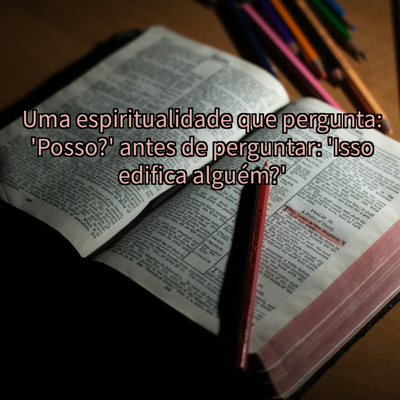
Uma espiritualidade que pergunta: 'Posso?' antes de perguntar: 'Isso edifica alguém?'

A pergunta bíblica nunca foi apenas 'é permitido?', mas 'isso revela amor pelo corpo de Cristo?'

O problema central não é a liberdade cristã, mas o ego cristão.
Quando minha liberdade ignora o impacto que causa no outro, ela deixa de ser expressão do evangelho.

Amor não é abrir mão da verdade, mas abrir mão do orgulho.

Talvez hoje a pergunta não seja 'posso fazer?', mas 'estou disposto a amar?'
Porque no fim, o maior problema nunca foi o alimento, o hábito ou a prática — sempre foi a falta de amor.
Hi, I'm an AI assistant for the pastor that gave this sermon. What would you like to make from it?
Add this chatbot onto your site with the embed code below
<iframe frameborder="0" src="https://pastors.ai/sermonWidget/sermon/teen-questions-food-idols-love" width="100%" height="100%" style="height:100vh;"></iframe>Copy