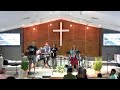
In the quiet moments of prayer, Jesus modeled the ultimate act of trust. Facing immense suffering, He did not rely on His own divine power but turned to the Father. He acknowledged the struggle, yet chose obedience over comfort, saying, "not my will, but yours be done." This is the heart of surrender—trusting God's plan even when it conflicts with our own desires. It is an invitation to lay down our own agendas and embrace the Father's perfect will. [57:56]
“Father, if you are willing, take this cup from me; yet not my will, but yours be done.” An angel from heaven appeared to him and strengthened him.
Luke 22:42-43 (NIV)
Reflection: Where in your life are you currently holding tightly to your own plan, saying "my will" instead of "your will"? What would it look like to take that specific situation to God in prayer and surrender it to His plan today?
When life feels heavy and the path ahead seems daunting, our first response is often to rely on our own strength. Jesus shows us a different way. In His anguish, He withdrew to pray, bringing His honest struggle before the Father. Prayer is not a last resort; it is the primary place where we find divine strength for obedience. It is in this honest communion with God that we are recharged and refilled, empowered to face the temptation or trial before us. [58:58]
He withdrew about a stone’s throw beyond them, knelt down and prayed.
Luke 22:41 (NIV)
Reflection: When you feel overwhelmed or exhausted by a circumstance, what is your default response? How might you intentionally create space this week to bring that burden to God in prayer before you try to solve it on your own?
Faith does not mean the absence of struggle or pain. True, living faith is choosing to obey God right in the middle of the anguish. Jesus was in such distress that His sweat was like drops of blood, yet He prayed more earnestly and chose the Father’s will. This demonstrates that our feelings do not have to command our actions. We can feel the weight of a situation and still choose faithfulness, trusting that God’s strength is made perfect in our weakness. [01:02:08]
And being in anguish, he prayed more earnestly, and his sweat was like drops of blood falling to the ground.
Luke 22:44 (NIV)
Reflection: Can you identify an area of your life where you are waiting for a difficult feeling to pass before you choose obedience? What is one step of faith you can take this week, even if the struggle remains?
Temptation often prevails when we are spiritually weary, trying to fight our battles through self-discipline alone. The disciples, exhausted from sorrow, fell asleep when they should have been praying. This serves as a warning that our own strength will eventually fail. We were never meant to carry the weight of obedience by ourselves. Lasting victory comes not from our grit, but from continually surrendering to God and drawing on the power He freely provides. [01:07:52]
When he rose from prayer and went back to the disciples, he found them asleep, exhausted from sorrow.
Luke 22:45 (NIV)
Reflection: Where have you been trying to fight a spiritual battle through your own willpower, and how has that led to exhaustion? What would it look like to shift from self-reliance to Spirit-reliance in that specific area?
Hard times are not a matter of if but when. Just as we prepare for a rainy day, we are to prepare for life’s storms through a lifestyle of surrender. Time in prayerful surrender—our "garden"—determines how we will stand in the battle. Cultivating a habit of saying “your will be done” builds a history of trusting God, making it easier to rely on Him when the rain finally falls. This daily surrender invites God’s strength into our lives before the crisis hits. [01:16:40]
“Why are you sleeping?” he asked them. “Get up and pray so that you will not fall into temptation.”
Luke 22:46 (NIV)
Reflection: What is one routine you could establish this week—a specific time or place—to regularly pray “not my will, but yours be done,” building your spiritual readiness for future challenges?
Palm Sunday opened with worship, community announcements, and practical invitations for Easter-week participation—packing thousands of eggs, a Good Friday service, an Easter egg hunt, a sunrise service, and an Easter morning gathering. Children processed with branches as a visible echo of Jerusalem’s welcome, and the assembly moved into prayer requests for births, healing, students, leadership, missionaries, and global peace. Worship then shifted to Scripture: Luke 22:39–46 recounted Jesus withdrawing to the Mount of Olives, praying with intense anguish, asking the Father to take the cup if possible, and submitting with the words, “Not my will, but yours.” An angel strengthened him; his sweat fell like drops of blood. Returning to the disciples, Jesus found them asleep and warned them to pray so they would not fall into temptation.
That passage served as the theological center: prayer functions as survival rather than decoration, and surrender to the Father supplies strength in the face of overwhelming trials. Jesus modeled honest struggle—he did not pretend ease—but chose obedience amid anguish, showing that faith often looks like kneeling and handing over will and plans to God. The text stressed how exhaustion weakens moral resolve; attempts to resist sin in one’s own strength eventually fail. Peter’s failure illustrated that even committed followers can fall when they skip spiritual vigilance. The sermon argued that God’s response does not always remove trials; sometimes God gives strength to obey through them. Growth happens by repeated surrender; each surrendered moment builds a history of trust that makes future surrender easier. The call closed with concrete spiritual questions: where must surrender replace control, what temptations require prayerful vigilance, and whether spiritual sleep requires awakening. The closing prayer asked for softened hearts, daily surrender, and empowered witness in the community as Easter approaches.
We have to surrender to Jesus. We have to surrender to the lord. It's the only way it works. Augustine of Hippo says this. He says, Christ became obedient for us so that we might heal our disobedience. I'm a reread that. Christ became obedient for us so that he might heal our disobedience. That Jesus surrendered to the will of the father so that we had an opportunity to be healed
[01:04:42]
(42 seconds)
#ChristObedienceHeals
Church, that's what it means to grow and mature in your faith. Not my will, but your will be done. Not your plan, but the Lord's plan. And how you get into that moment, church, is requires you to surrender. The cross wasn't won by strength. It was won by surrender to the father's will. Our salvation comes from Jesus' surrender to the father's will.
[01:04:00]
(42 seconds)
#SurrenderIsMaturity
I'm an AI bot trained specifically on the sermon from Mar 30, 2026. Do you have any questions about it?
Add this chatbot onto your site with the embed code below
<iframe frameborder="0" src="https://pastors.ai/sermonWidget/sermon/surrender-palm-sunday" width="100%" height="100%" style="height:100vh;"></iframe>Copy