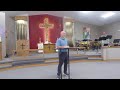
Worship gathers early and contemporary congregations into a single Easter-season service that centers on remembrance. Singing, confession, and liturgical prayers frame readings from Scripture, culminating in the Gospel of John chapter 16. John 16 presents Jesus teaching the disciples in the upper room: commands to love one another, promises of the Father’s many rooms, the claim that Jesus is the way, truth, and life, the promise of another Helper, and the image of the vine and branches to illustrate dependent union with Christ. The Holy Spirit receives the role of teacher who brings Jesus’ words back to memory and who grants peace that the world cannot give.
A children’s message highlights the cross as a tangible reminder: an inscription that declares You are loved and points to the reason for gathering and remembering. The teaching underscores memory as spiritual discipline. Repetition, physical reminders, communal practices, and the sacraments operate as means by which God’s Word penetrates hearts so the Spirit can restore what is needed in times of failure, fear, or forgetfulness.
The text emphasizes sorrow preceding joy. Jesus uses the image of childbirth to explain that the disciples will experience deep sorrow at his death, but that sorrow will be transformed into sustained joy through his resurrection and reunion with him. The vineyard image warns that fruitfulness flows only from abiding in Christ; separation yields withering. Communion functions as both sacrifice remembered and spiritual nourishment that strengthens faith and love.
Prayers intercede for named individuals, military service members, childcare ministries, neighboring congregations, and local construction safety. The service also welcomes new members through public confession of faith and vows to remain steadfast in the gospel. Announcements invite practical participation in congregational life. The liturgy closes with the post-communion canticle, a benediction, and an invitation for children to assist in the closing song, reinforcing the call to remember, to abide, and to live out the love demonstrated on the cross.
Key Takeaways
- 1. Remember Christ through regular worship Regular, gathered worship forms memory muscle. Corporate liturgy, preaching, sacraments, and simple physical reminders create repeated exposure to the gospel so the Holy Spirit can bring Jesus’ words back in moments of doubt or failure. Treat Sunday assembly as spiritual feeding that prevents slow spiritual amnesia. [28:35]
- 2. Holy Spirit restores Christ’s teaching The promised Helper does not invent new doctrine but brings to remembrance what Christ taught. In seasons of anxiety or insufficient understanding, the Spirit retrieves truth anchored in the upper room words and applies them to present trials. Dependence on the Spirit cultivates calm confidence rooted in divine continuity rather than human recollection. [31:49]
- 3. Abide in Christ, bear fruit The vine metaphor makes dependence practical: union with Christ produces fruit and separation produces decay. Spiritual disciplines and corporate life keep branches connected so grace flows and service results. Fruitfulness therefore stands as proof of life, not as ground for acceptance. [32:44]
- 4. Sorrow yields unstealable joy The childbirth image reframes present pain as provisional and purposeful. The resurrection secures a joy that the world cannot take away because it rests on Christ’s triumph, not fluctuations of circumstance. Endurance in sorrow exists within a horizon already shaped by promised reunion and lasting gladness. [34:43]
Youtube Chapters
- [00:00] - Welcome
- [02:48] - Invocation and Opening Song
- [06:58] - Confession and Absolution
- [12:47] - Psalm and Prayer
- [18:45] - Gospel Reading John 16
- [21:34] - Children’s Message: You Are Loved
- [30:05] - Upper Room Teachings Overview
- [31:49] - Promise of the Holy Spirit and Peace
- [34:43] - Sorrow to Joy Explained
- [43:36] - Communion and Intercessions
- [56:05] - New Members Received
- [62:21] - Blessing and Closing Song