In the spiritual battles we face, a crucial piece of armor is given to us: the shield of faith. This isn't just any shield; it is designed to be taken up "in all circumstances," suggesting its paramount importance in our defense. Just as a Roman shield protected a soldier from the front, our faith acts as a vital barrier, guarding our hearts and minds. It is the material that allows us to stand firm against the onslaughts of the enemy, extinguishing the fiery darts that seek to wound and discourage us. This shield is always available, ready to be wielded by those who trust in its divine origin and purpose. [00:45]
Ephesians 6:16 (paraphrased):
Above all, take up the shield of faith, with which you will be able to put out all the flaming arrows of the evil one.
Reflection: When you consider the challenges you currently face, how might actively taking up the shield of faith change your perspective or your response to them?
While faith is deeply personal, it is never meant to be private. Just as ancient Roman soldiers formed a "testudo" with their shields, creating an impenetrable wall of protection, we too are called to stand together. A single shield offers limited defense, leaving flanks exposed. In the same way, a solitary believer can become vulnerable, even one as courageous as Elijah. God's divine cure for isolation is community, providing us with companions like Elisha to stand alongside us. We find strength, encouragement, and shared protection when we unite our shields of faith. [02:05]
1 Kings 19:4-7 (paraphrased):
Elijah went a day's journey into the wilderness, sat under a broom tree, and asked to die, saying he was no better than his ancestors. He lay down and slept, but an angel touched him and told him to get up and eat, for the journey ahead was too much for him.
Reflection: Who is your "Elisha" – someone in your life with whom you can share your struggles and strengthen your faith, and how can you intentionally connect with them this week?
Faith serves as our unique translator, enabling us to interpret the world through a divine lens rather than solely by what we see. Just as a good translator can make complex ideas clear, faith helps us make sense of experiences that might otherwise confuse or overwhelm us. It provides a sixth sense, allowing us to perceive God's presence and purpose even in situations that seem contradictory or difficult. This spiritual interpretation helps us navigate life's complexities, understanding that there is more to reality than meets the eye. [03:15]
2 Corinthians 5:7 (paraphrased):
For we live by faith, not by what we can see with our eyes.
Reflection: Think of a recent situation where your initial interpretation was based purely on what you saw or felt. How might viewing that same situation through the "translator" of faith offer a different understanding or peace?
One of the most challenging "flaming darts" we face is unanswered prayer, especially when we plead for good outcomes that do not materialize. Even Jesus, in His agony, prayed for the cross to be removed, yet His Father's will prevailed. Faith translates these moments, helping us understand that God's "no" or "not yet" is often part of a greater, redemptive plan for our eternal good. Similarly, faith helps us navigate suffering, reminding us that while pain is not God's original design, He can use it to forge an "eternal weight of glory" within us. Hardship is not inherently bad; through faith, it can serve a profound, lasting purpose. [05:45]
Hebrews 5:7 (paraphrased):
During His time on earth, Jesus offered prayers and pleas with loud cries and tears to the One who could save Him from death, and He was heard because of His reverence.
Reflection: When you reflect on a prayer that felt unanswered, or a season of suffering, how might the understanding that God's will, not just our own, is at work, reshape your perspective on that experience?
Sometimes, God's presence and activity are not immediately obvious; He works in hidden ways. The story of Dothan illustrates this: Elisha saw chariots of fire, while Joseph, a thousand years earlier, was thrown into a pit without visible intervention. Yet, in both instances, God was profoundly at work. Joseph's long years of slavery and imprisonment, though seemingly devoid of divine rescue, were precisely what matured him, preparing him to lead a nation and forgive his betrayers. Faith allows us to trust God's hiddenness, believing that even when we don't see the chariots, He is shaping us and working all things for good. [07:15]
Genesis 50:20 (paraphrased):
You intended to harm me, but God intended it for good, to accomplish what is now being done—the saving of many lives.
Reflection: Consider a time in your life when God seemed distant or His plan unclear. How might Joseph's journey encourage you to trust that God was still at work, even in the hiddenness, shaping you for a future purpose?
I began with a small family test—what tells you what matters most—and moved quickly into Ephesians 6:14–18 to look closely at the shield of faith. That shield is not abstract; Paul pictures a Roman testudo, a living formation where shields overlap to protect front, sides, and top. That image insists Christianity is personal but never private: one person’s faith misses the full protection unless surrounded by others. I used stories—Elijah’s lone bravado and later desperation, Elisha’s steady companionship, Joseph’s long pit and hidden refining, and Jesus’ unanswered prayer in Gethsemane—to show how faith functions in real life.
Faith works like a translator. I told the kava story to show how a translator can shape the meaning of an encounter; faith interprets the world and gives sense to suffering, temptation, and unanswered prayer. Flaming darts come in many forms—unanswered pleas, deep suffering, the hiddenness of God, sexual temptation—and the shield’s work is to extinguish those flaming darts so they don’t set our souls on fire. Unanswered prayer does not automatically mean divine neglect; Jesus himself prayed against the cup and did not escape the cross. Suffering is not necessarily God’s punishment or His hand at work to harm; often it is the fallout of a fallen world or the raw material God may use, not the cause He intends.
I pressed the practical: build a testudo. Show up in community groups, prayer partners, and real friendships where shields can overlap. Pray like Elisha—expect God to show up—and wait like Joseph—patient when God seems hidden. Take up the shield of faith in all circumstances; it’s not magic, but it’s the way to interpret reality so the flaming darts do not have the final word.
Christianity is personal but not private. We need one another. You can be as courageous as Elijah, but if you are alone like Elijah you will get flanked.
Paul adds the shield made of faith and says its purpose is to extinguish the flaming darts of the evil one. Faith is the material that protects us from those fiery attacks.
The Roman shield protected the front but left your flanks exposed. The Testudo arranged shields to protect front, sides, and top. That requires other people, because Christianity is not a private, solo defense.
The Father didn’t answer the Son’s plea to avoid the cross; the outcome remained the cross. If God had answered those prayers, the kingdom of darkness would be undefeated. Faith trusts the hard, mysterious path.
We make the mistake of saying hard equals bad. Hard is not bad; hard can serve you and me for eternity. The shield of faith helps us see suffering differently.
God’s hiddenness sometimes forges character. Joseph’s pit without divine chariots matured him so he could lead and forgive. The work of hiddenness prepares us for destiny; we should pray like Elisha and patiently trust like Joseph.
Faith becomes the believer’s translator for the world. It gives a sixth sense to interpret reality differently, so we walk by conviction rather than merely by what our eyes report.
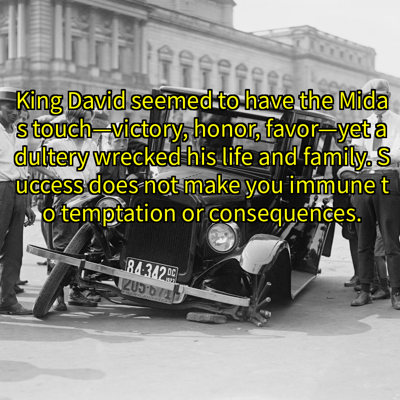
King David seemed to have the Midas touch—victory, honor, favor—yet adultery wrecked his life and family. Success does not make you immune to temptation or consequences.
Hi, I'm an AI assistant for the pastor that gave this sermon. What would you like to make from it?
Add this chatbot onto your site with the embed code below
<iframe frameborder="0" src="https://pastors.ai/sermonWidget/sermon/shield-faith-flaming-darts" width="100%" height="100%" style="height:100vh;"></iframe>Copy