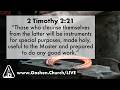
God’s painful grace works like a blacksmith’s fire – not to destroy, but to reshape what’s rigid and jagged into something purposeful. Judah’s story reveals how God uses discomfort to expose hidden selfishness, just as fire softens iron for the hammer’s blow. Resistance to this process keeps us brittle, but surrender lets God mold us. The heat feels unbearable, but the blacksmith knows the exact moment to pull the metal from the flames. What feels like ruin becomes the path to redemption. [36:46]
“Consider it pure joy, my brothers and sisters, whenever you face trials of many kinds, because you know that the testing of your faith produces perseverance. Let perseverance finish its work so that you may be mature and complete, not lacking anything.” (James 1:2–4, NIV)
Reflection: Where have you resisted God’s “fire” in your life – a situation, relationship, or conviction – because the heat felt too intense? What might He be softening in you through this?
Judah’s confession – “she is more righteous than I” – cracks open a life built on self-deception. Like shattered glass, the truth cuts: his moral posturing hid a heart willing to sacrifice others. Tamar’s quiet confrontation mirrors God’s grace, using even flawed people to reflect our blind spots. Repentance begins when we stop justifying our harm and name it plainly. The words taste bitter, but they cleanse like medicine. [53:11]
“Then Judah acknowledged them and said, ‘She is more righteous than I, since I wouldn’t give her to my son Shelah.’ And he did not sleep with her again.” (Genesis 38:26, NIV)
Reflection: When has someone’s honesty about your actions – a spouse, friend, or even an “unlikely” person – become a mirror showing what you couldn’t see? How did you respond?
Judah’s selfishness started small – a choice to “go down” from his family – but spread like spilled ink, staining his sons, Tamar, and his own soul. Blindness to our flaws doesn’t contain them; it lets them seep into every relationship. We justify “harmless” compromises, not seeing how they warp our loves and legacy. The trail of brokenness always outlives our excuses. [48:14]
“He went to her by the roadside and said, ‘Come now, let me sleep with you.’… He did not know that she was his daughter-in-law. She said, ‘What will you give me?’” (Genesis 38:16, NIV)
Reflection: What “compromise” have you normalized – in speech, habits, or treatment of others – that might be causing harm you’ve refused to acknowledge?
Transformed Judah pleads, “Let me stay as a slave instead of the boy.” The man who sold a brother now offers himself – proof of grace’s alchemy. Painful exposure reshapes us from takers to givers, from users to protectors. What the fire burns away – pride, fear, self-interest – makes room for Christ’s heart to beat in ours. New creation starts where self-defense ends. [54:37]
“Now then, please let your servant remain here as my lord’s slave in place of the boy, and let the boy return with his brothers.” (Genesis 44:33, NIV)
Reflection: Where is God asking you to replace old patterns of self-preservation with costly love? What makes this surrender feel vulnerable yet necessary?
Jesus entered the ultimate fire – the cross – not for His sins but ours. His resurrection proves God’s refining flame doesn’t consume; it liberates. Our suffering gains meaning when united to His – no longer punishment, but participation in remaking the world. What we fear will devour us becomes the forge where hope is hammered into being. [01:00:26]
“For the joy set before him he endured the cross, scorning its shame, and sat down at the right hand of the throne of God.” (Hebrews 12:2, NIV)
Reflection: How might viewing your current struggle through the lens of Christ’s cross and resurrection change your relationship to the “fire” you’re in?
Genesis 38 traces Judah’s descent and God’s hard mercy. Judah “goes down,” leaves his brothers, and shrugs off covenant loyalties. He treats a nameless Canaanite woman as useful for pleasure and sons, and he fathers boys who mirror his selfishness. Er is wicked and the Lord takes him. Onan uses Tamar for his own gratification and refuses to give a son to his dead brother’s line, and the Lord takes him too. Tamar remains vulnerable, a twice-widowed daughter-in-law put away. Judah will not see himself; he blames her and lies, promising Shelah with no intent to keep his word. Self-protection blinds him and spreads harm.
Tamar answers within Genesis’s recurring pattern of deception that exposes what is hidden. At the roadside she asks for Judah’s seal, cord, and staff, and later sends them back with the quiet word, “See if you recognize whose these are.” Judah’s hypocrisy erupts first. He will not be a laughingstock. He will burn her. But when the tokens confront him, the light finally comes on. He does not argue. He does not defend himself. He bows and says, “She is more righteous than I.” In that sentence Judah sees himself and sees Tamar for the first time.
God’s painful grace is like a blacksmith’s fire and hammer. The heat and blows do not exist to destroy the iron, but to re-form it into something strong and useful. So God puts Judah through exposure, not to crush him, but to prepare him through repentance. The fruit shows up later. The man who once sold a brother now offers himself in place of a brother: “Let your servant remain here as my lord’s slave in place of the boy.” Self-preservation turns into self-giving.
Through this humbled man’s line comes David, then Solomon, and finally Jesus Christ. God takes a story that is crooked and shameful and forges it into a line of kings, all the way to the King of kings. Christ himself entered the fire for sinners, endured the shame, and rose. Because he passed through and was not destroyed, those who entrust themselves to him can step into God’s fire without fear. The church is called to stop starring as the victim-hero in its own retellings, to invite exposure, to ask those nearest to name unseen harms, and to learn to say, “She is more righteous than I.” In God’s hands, even painful grace becomes preparation for something beautiful.
Judah, when he finds out, what does he say? I can't become a laughingstock, but we can burn her. Judah is so blind that now he is willing to destroy the vulnerable. And he's blind to what he is becoming. At no point do we see Judah consider anyone except himself. He doesn't mourn the loss of his sons. He doesn't care for the vulnerable. He seeks justice for others to be carried out on others, but not for himself.
[00:47:55]
(40 seconds)

Have you ever seen metal go into a fire? A big piece of iron. If you get it hot enough, it turns like bright orange. And just for a short period of time, a blacksmith can take that and uses a hammer and can mold it from raw material into something that's useful, something that might even be beautiful. But if you were to talk to the piece of iron, if it could speak, it probably would not say that the fire is an enjoyable experience. It would say, it's pretty intense.
[00:36:43]
(39 seconds)
Judah commits adultery. He lies. He abandons commitments, and he thinks he's protecting himself, but really he is destroying himself. And where is God? He doesn't come up in this story by some miracle. He doesn't come up in this story by speaking from heaven. He doesn't do something drastic. God uses painful grace in the life of Judah to open his eyes and lead him to repentance. The text, it doesn't evaluate Tamar's methods because that is not the point in this story.
[00:51:37]
(45 seconds)
If it goes unchecked, it doesn't stay private. It starts impacting others. Blind selfishness always leaves a trail of brokenness behind it. And just like Judah, we dehumanize the vulnerable, Whether it's a spouse who's struggling with something, a child who's struggling with something, or a a community who is struggling, we we want to point out all of the mistakes, all of the wrong that they've done without looking here. We want justice carried out on everybody else, but have mercy on me.
[00:50:35]
(47 seconds)
I'm an AI bot trained specifically on the sermon from Jun 01, 2026. Do you have any questions about it?
Add this chatbot onto your site with the embed code below
<iframe frameborder="0" src="https://pastors.ai/sermonWidget/sermon/she-more-righteous-grace" width="100%" height="100%" style="height:100vh;"></iframe>Copy