Aug 21, 2026
Jesus told a story about three servants. Their master gave them money to manage. Two servants invested what they received. The third servant buried his portion in the ground. When the master returned, he commended the two who worked faithfully. He said to them, "Well done, good and faithful servant."
This story shows us what God values. He is not looking for impressive results or famous servants. Jesus calls the faithful servants "good." Their value came from their trustworthiness with what was entrusted to them. God is looking for people He can trust with responsibility.
You have been given gifts, time, and resources. God has entrusted you with an assignment. You can choose to invest what you have or to bury it out of fear or apathy. The master’s commendation awaits those who are found working with what they have. What one thing have you been given that you can actively invest for God’s purposes today?
“His master said to him, ‘Well done, good and faithful servant. You have been faithful over a little; I will set you over much. Enter into the joy of your master.’”
(Matthew 25:21, ESV)
Prayer: Ask God to show you one specific gift or resource you have buried that He wants you to use for Him today.
Challenge: Write down one talent or resource you possess and one practical way you will use it to serve someone else before the day ends.
The Psalmist gives a clear command to God’s people. He does not say to serve the Lord out of duty or obligation. He says to serve the Lord with gladness. This joy is not a reaction to our circumstances. It is a choice we make about our motivation. We serve a good God, and that is reason for joy.
God sees the attitude of our heart when we serve. He hears our grumbling and our gratitude. Serving with gladness honors God more than a perfect performance done with resentment. It transforms a mundane task into a spiritual act of worship. Our joy becomes a testimony to His goodness.
Many of us serve, but we do it with complaining hearts. We focus on the lack of appreciation or the difficulty of the task. Stop and choose joy today. Let your service be an offering of thanks to God. Will you serve your family, your coworkers, or your church today with a joyful heart or a complaining one?
“Serve the LORD with gladness! Come into his presence with singing!”
(Psalm 100:2, ESV)
Prayer: Confess any complaining in your heart and ask God to replace it with genuine joy as you serve.
Challenge: Identify one task you normally complain about and consciously perform it today with a thankful attitude, singing a hymn or song of praise.
The requirement for a steward is simple. It is not eloquence, talent, or intelligence. It is faithfulness. God entrusts us with things. He gives us assignments. Some are visible and public. Many are small and unseen. Faithfulness means we are trustworthy with both.
God uses small assignments to test our readiness for greater ones. Joseph remained faithful in Potiphar’s house and the prison. That faithfulness prepared him for the palace. God is always watching our stewardship. He is looking for people He can trust with influence, resources, and leadership.
You may feel your current assignment is insignificant. No one sees your daily prayers, your quiet giving, or your help behind the scenes. But God sees. He values your faithfulness in the small things. Are you being faithful with the unseen responsibilities God has given you, trusting that He sees and will reward in due time?
“Moreover, it is required of stewards that they be found faithful.”
(1 Corinthians 4:2, ESV)
Prayer: Ask God for the strength to be consistently faithful in the private, unseen areas of your life and service.
Challenge: Choose one small, routine responsibility you often neglect and perform it today with excellence as an act of service to God.
Peter instructed the early church to be hospitable. This was not a suggestion for a few gifted people. It was a command for all believers. Hospitality is simply making room for others. It means using your home, your table, or your time to make someone feel welcome and loved.
Hospitality is a practical form of service. Ministry often begins with a meal or a conversation. It opens doors for deeper connection and spiritual encouragement. You do not need a perfect home or gourmet food. You only need a willing heart to share what you have with someone else.
Your home is a tool for ministry. Your kitchen table can be an altar. Look around you. Who needs a word of encouragement or a place to belong? Open your door and your life. You might be the one to make a stranger feel like family. Who is one person you can invite into your home or for coffee this week to show Christ’s love?
“Show hospitality to one another without grumbling.”
(1 Peter 4:9, ESV)
Prayer: Ask God to give you an open heart and home, and to show you one person who needs your hospitality.
Challenge: Text or call one person today to invite them for a simple meal, coffee, or conversation in your home this week.
Paul wrote to the Galatian church to encourage them. He knew serving could be tiring. People could be ungrateful. Results could be slow. He told them not to grow weary in doing good. He promised a harvest would come if they did not give up.
This promise is for the long haul. The harvest is attached to faithfulness, not to fleeting passion. Many people quit right before their breakthrough. They stop serving, giving, or praying just when God is about to bring the increase. Your consistent service matters more than you know.
You have a choice to make. You can remain a spectator who consumes, or you can become a participant who contributes. Do not wait for a more convenient time or a more important role. Start where you are. Use what you have. Serve now. What is one area where you have grown weary and need to recommit to faithful service?
“And let us not grow weary of doing good, for in due season we will reap, if we do not give up.”
(Galatians 6:9, ESV)
Prayer: Ask God for renewed strength to persevere in a specific area where you have felt like giving up.
Challenge: Recommit to one act of service you have stopped doing because you grew weary, and do it again this week.
Serving God appears as a set of practical commitments: persistent prayer for family, church, community, leaders, the lost, missionaries, and those in need; intentional evangelism in workplaces, neighborhoods, and homes; generous giving; welcoming hospitality; active use of spiritual gifts; and timely help for people without waiting to be asked. God values character over celebrity, calling for faithfulness, humility, obedience, excellence, and joy in every act of service. Difficult seasons—rejection, persecution, betrayal, weariness, and misunderstanding—do not nullify service when the true audience remains the Lord; motivation rooted in God rather than people sustains perseverance. Faithful service in small tasks cultivates trust and prepares for greater responsibility, while unused gifts and hidden potential defeat kingdom purposes unless surrendered and activated. A clear warning emerges about quitting: many abandon ministry just before harvest, so persistence in prayer, service, giving, love, and presence becomes essential because labor in the Lord will not be in vain. The highest reward of service transcends material gain or recognition and culminates in hearing the commendation, "Well done, good and faithful servant"—a divine verdict that prizes goodness, faithfulness, and servanthood over fame or wealth. Practical illustrations compare two workers—one minimal and time-driven, the other diligent and helpful—to show how faithfulness produces trust and access to greater influence; another compares a phone’s dead battery to dormant gifts, underscoring that talent unconnected to God cannot fulfill its purpose. The call moves believers from spectator to participant, from consumer to contributor, and from asking to releasing; humble, joyful, obedient, and excellent service should mark daily life. Concluding material offers prayers for a servant’s heart, grace to serve faithfully and joyfully, activation of spiritual gifts, divine direction, strength, freedom from people-pleasing, grace to finish well, and provision for assignments. Declarations envision lives surrendered to God, gifts deployed for His glory, and generations formed by faithful service. The ultimate invitation links authentic belonging to Christ with effective service: surrender precedes fruit, and finishing well produces the eternal commendation that should shape motives and measure greatness.
You don't need a pulpit to evangelize. Your workplace can become your mission field.
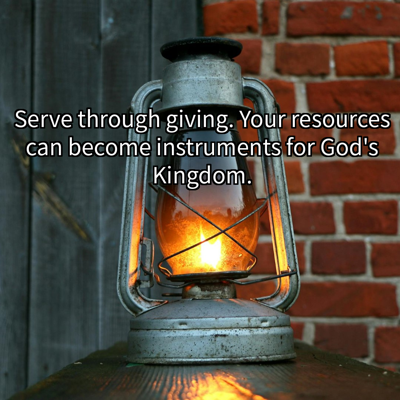
Serve through giving. Your resources can become instruments for God's Kingdom.
God doesn't merely want activity; He wants obedience. You can be extremely busy and still be outside God's will.
Don't serve people merely to impress them; serve God wholeheartedly.
If your motivation is applause, silence can discourage you. If your motivation is recognition, being overlooked can make you quit.
There is a harvest attached to faithfulness. You may not see it immediately.
Somebody needs to move from spectator to participant, from consumer to contributor, from attendee to servant.
Start with what you have. Start where you are. Start with the opportunity in front of you. God can use a willing vessel.
Don't wait until everything is perfect. Start with what you have and where you are.
The greatest decision you can make is not: "I will serve more." It is: "I will surrender my life to Jesus Christ.
Hi, I'm an AI assistant for the pastor that gave this sermon. What would you like to make from it?
Add this chatbot onto your site with the embed code below
<iframe frameborder="0" src="https://pastors.ai/sermonWidget/sermon/serving-god-benefits1" width="100%" height="100%" style="height:100vh;"></iframe>Copy