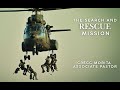
Jesus did not come to earth simply to be a moral example or a good teacher. His primary mission was a search and rescue operation for those separated from God. Like Zacchaeus, who was an outcast in his society, we are all seen and known by name. Jesus takes the initiative to find us exactly where we are, even when we feel hidden or unworthy. He is not looking for righteous people who have it all together, but for those who recognize their need for Him. [33:24]
"For the Son of Man came to seek and to save the lost." — Luke 19:10 (ESV)
Reflection: When you think about your own journey toward God, what specific moment or person can you identify as the "initiative" God took to draw you to Himself?
On our own, we often lack the desire or the understanding to seek after God. It is only after God begins working in our lives—perhaps through a friend, a scripture, or a difficult circumstance—that we start looking for Him. We are like a lost sheep separated from the shepherd, unable to survive long in the wilderness on our own. When Jesus finds us, He does not just point the way; He joyfully places us on His shoulders to bring us home. This rescue is a dynamic act of grace that snatches us from peril. [38:12]
"What man of you, having a hundred sheep, if he has lost one of them, does not leave the ninety-nine in the open country, and go after the one that is lost, until he finds it? And when he has found it, he lays it on his shoulders, rejoicing." — Luke 15:4-5 (ESV)
Reflection: In what area of your life do you currently feel like a "lost sheep" in need of the Shepherd’s strength rather than your own?
We live in a world that everyone can agree is broken, filled with chaos and division. As followers of Jesus, we are invited to join His search and rescue mission by bringing His light into the darkness. While we cannot save anyone ourselves, we can introduce them to the One who can. This often happens through simple acts of service that meet physical needs, creating a bridge to address deeper spiritual needs. By being godly people in our workplaces, homes, and gyms, we reveal the love of Christ to those who might never step foot in a church. [47:24]
"Again Jesus spoke to them, saying, 'I am the light of the world. Whoever follows me will not walk in darkness, but will have the light of life.'" — John 8:12 (ESV)
Reflection: Think of a specific place you frequent during the week, such as a gym or office; how might you intentionally reflect the "light of life" to someone there this week?
Sharing the name of Jesus can feel scary or awkward because we worry about how people will react. One of the best ways to overcome this fear is to focus on loving God first and recognizing how He has changed our own lives. When we truly appreciate the peace, joy, and hope we have in Christ, recommending Him becomes as natural as recommending a good restaurant. We do not have to force the gospel on everyone, but we can look for where the Holy Spirit is already at work. Simple, non-threatening questions can help us discern if someone is open to a spiritual conversation. [50:44]
"But in your hearts honor Christ the Lord as holy, always being prepared to make a defense to anyone who asks you for a reason for the hope that is in you; yet do it with gentleness and respect." — 1 Peter 3:15 (ESV)
Reflection: If someone asked you today why you have hope despite the world's brokenness, what is one personal story of God’s goodness you would feel comfortable sharing?
God has placed each of us exactly where we are for a reason, and He invites us to be part of the solution in a hurting world. Whether it is through a formal community outreach team or a simple prayer for a friend in a hard time, we are called to increase light rather than darkness. We can ask God for the wisdom to know when to speak and the strength to act with His love. Our goal is simply to help people move one step closer to Jesus than they were before they met us. As we overflow with His grace, we participate in the abundant life He came to bring to everyone. [01:08:12]
"We know that we are from God, and the whole world lies in the power of the evil one." — 1 John 5:19 (ESV)
Reflection: Is there a friend or neighbor currently going through a difficult season to whom you could simply ask, "Can I pray for you?"
Jesus came to earth with a focused mission: to seek and to save the lost. Framed by the encounter with Zacchaeus in Jericho and grounded in Luke 19:10, the picture is not of a distant moral teacher but of a search-and-rescue Savior who leaves the ninety-nine to find the one. Seeking is an intentional pursuit of what is separated and endangered; it presupposes human inability to find God unaided and highlights divine initiative in drawing sinners home. Saving is described not merely as moral improvement but as being snatched from peril, healed, and restored through the life, death, and resurrection of Christ—the only name by which people are rescued from spiritual death.
Lostness is portrayed with both relational and existential gravity: separation from God is ownership lost and exposure to mortal danger. Parables such as the lost sheep underscore the joy and personal cost of retrieval; the shepherd carries the found lamb home, demonstrating tenderness and risk. Believers are called not to manufacture salvation but to join Jesus’ search-and-rescue by introducing others to the One who can save. The role of the church and individual Christians is incarnational—bringing Christ into workplaces, sports teams, neighborhoods, and practical acts of service—so that spiritual conversations can naturally follow tangible help.
Practical strategies are given to lower barriers to evangelism: cultivate a clarified love for God that produces a credible testimony; learn to discern where God is already at work by asking nonthreatening questions about faith or church; offer to pray for people in crisis; and engage in organized community outreach as a bridge to gospel conversations. The congregation is invited to see service activities—yard work, material support, relational presence—not as ends in themselves but as vehicles into spiritual dialogue. The closing challenge presses listeners to identify how Jesus has brought light into their darkness and where they might be sent to share that light with others, concluding in a prayer that asks for courage, wisdom, and the overflow of Christ’s light through his people.
``Why did Jesus have to save us though? It's because we couldn't save ourselves. Right? He was the one that lived the perfect life under the law that we couldn't live. He was the one that died on the cross for as a lawbreaker that we were supposed to die but don't have to. And so whoever believes in him will be saved from their sins since he already paid for it. And so it has to be Jesus. Jesus has to be the only one that can be save us. There is no other name on heaven or on earth that a man can be saved but Jesus Christ.
[00:36:48]
(35 seconds)
#OnlyJesusSaves

In the old testament, if you wanted to meet with God, what you had to do was you had to go to Jerusalem and you had to go to the temple, and in the temple, that's where God lived. But after Jesus came, God made his temple in the hearts of his people. And so as we follow Jesus and join him in his search and rescue mission, instead of trying to pull them into the kingdom, pull them into God, God is in us, and we can take Jesus to them.
[00:44:32]
(35 seconds)
#GodLivesInUs
I'm an AI bot trained specifically on the sermon from Jan 26, 2026. Do you have any questions about it?
Add this chatbot onto your site with the embed code below
<iframe frameborder="0" src="https://pastors.ai/sermonWidget/sermon/search-rescue-grace-church-fremont" width="100%" height="100%" style="height:100vh;"></iframe>Copy