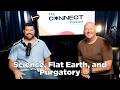
The heavens stretch like a painter’s canvas, declaring God’s glory without words. David wrote Psalm 19 under a sky undimmed by city lights, tracing constellations with his finger as evidence of divine artistry. Every star’s placement, Earth’s precise tilt, and the rhythm of seasons shout intentional design. Science measures the brushstrokes, but Scripture reveals the Artist. [07:33]
God didn’t hide behind cosmic mysteries. He spoke galaxies into being, then stepped into dust to shape Adam’s lungs. The same voice that named Orion also whispered redemption plans to prophets. Creation isn’t a rival to Scripture—it’s the opening act, pointing to the Author who wrote Himself into our story through Christ.
When stress tightens your chest, step outside tonight. Count three stars. Breathe deep. How might the Creator of infinite space be inviting you to trust His hands with your finite struggles?
“The heavens declare the glory of God; the skies proclaim the work of his hands.”
(Psalm 19:1, NIV)
Prayer: Thank God for one specific detail in nature that awed you this week.
Challenge: Text a friend a photo of something in creation that reminded you of God’s greatness.
Genesis describes God separating waters with a “vault”—not a dome, but a boundary between chaos and order. Ancient Hebrews heard this and pictured stability: a shepherd’s sky shielding the flock from storms. Modern readers stumble over the term, yet we still say “sunrise,” knowing Earth spins. God accommodates human language to reveal unchanging truths. [15:01]
The firmament wasn’t a science lesson but a love letter. Every sunrise assures us God keeps chaos at bay. When Noah saw a rainbow in that vault, he didn’t debate optics—he fell facedown. Scripture uses the ordinary to point to the extraordinary, like Christ using bread and wine to signify His sacrifice.
What “ordinary” part of your daily routine could become a prompt for worship?
“God said, ‘Let there be a vault between the waters to separate water from water.’ So God made the vault and separated the water under the vault from the water above it. And it was so.”
(Genesis 1:6-7, NIV)
Prayer: Confess one area where you’ve overcomplicated faith, then thank God for simple truths.
Challenge: Note today’s exact sunrise/sunset time as a reminder of God’s faithful boundaries.
Paul faced shipwrecks and snakebites yet wrote, “To die is gain.” He pictured death as a horizon—not an end, but a shoreline where Christ waits. The thief on the cross didn’t earn purgatory or probation; Jesus promised paradise that day. Our bodies aren’t discarded; they’re seeds awaiting resurrection. [30:25]
Believers don’t float as ghosts. We’re immediately with Christ, more alive than ever. Grief still aches, but hope tethers us: the same power that raised Jesus will rebuild our cells. Death is a defeated guard, not a prison warden.
Who do you miss today? How might their joy in Christ’s presence soften your sorrow?
“We are confident, I say, and would prefer to be away from the body and at home with the Lord.”
(2 Corinthians 5:8, NIV)
Prayer: Ask God to make His nearness tangible when grief feels heavy.
Challenge: Write “HOME WITH THE LORD” on a sticky note and place it where you’ll see it hourly.
A buried acorn seems wasted until it becomes an oak. Paul says our bodies are like that—planted in weakness, raised in power. Jesus’ resurrected body ate fish yet passed through walls. His scars didn’t vanish; they testified. Our resurrection bodies will carry stories of grace, not decay. [39:03]
Funerals aren’t final. Every grave is a garden plot. Christ’s resurrection guarantees ours, just as spring guarantees blossoms. This truth fueled early Christians to face lions and flames.
What “dead” situation in your life needs this resurrection perspective?
“The body that is sown is perishable, it is raised imperishable; it is sown in dishonor, it is raised in glory; it is sown in weakness, it is raised in power.”
(1 Corinthians 15:42-43, NIV)
Prayer: Thank Jesus for His scars—proof that brokenness leads to glory.
Challenge: Do one intentional act of care for your body (walk, hydrate, rest) as worship.
Acts 2 shows a church addicted to miracles—not signs and wonders, but daily baptisms. They didn’t wait for crusades; they shared meals and Jesus. One hundred fifty baptisms in 135 days means someone chose Christ every 21 hours. Heaven’s math counts “daily” increments. [01:47]
The early church saw people, not projects. Their homes stayed open, their stories stayed fresh. When we reduce evangelism to events, we miss the miracle of ordinary moments—like Jesus meeting a thirsty woman at a well.
Who’s already in your daily path that needs to hear your story?
“And the Lord added to their number daily those who were being saved.”
(Acts 2:47, NIV)
Prayer: Ask God for one specific opportunity today to mention His work in your life.
Challenge: Share a Bible verse with someone via text or conversation before sunset.
Science at its best studies what God has made, not as a rival to faith but as a hand-in-glove partner that notices order, beauty, and design. Scripture locates creation in God’s speech: he said it and bang, it was. Psalm 19 sets the lanes for knowing God: creation declares his glory and Scripture declares his truth, so general revelation stirs awe while special revelation names the Creator and his ways. The biblical claim is simple and sweeping: God created everything there is, and nothing exists apart from him.
The firmament names the expanse God made between the waters above and the waters below, the sky as encountered from the ground. Genesis’ language is ordinary and observational, like the way everyone still says sunrise and sunset. That register does not flatten the world; it communicates to real people in real places. Flat-earth theories get no lift from the Bible, and even Isaiah’s line about the “circle of the earth” refuses to play modern astronomy while still refusing a pancake planet. Science is limited, but it is welcome. Bring it on. It studies the canvas; God is the artist.
The hope of the New Testament speaks comfort into the question of death. To be absent from the body is to be present with the Lord, so death for the believer is a homecoming, not a holding tank. Jesus’ word to the thief, today you will be with me in paradise, underlines immediacy, not limbo. Death separates body and spirit for a time, but not from Christ’s care.
The resurrection of the body completes the story. First Corinthians 15 pictures burial like sowing seed: it is sown perishable and raised imperishable, sown in weakness and raised in power. Jesus’ bodily resurrection guarantees that the same Jesus raises the dead, and 1 Thessalonians 4 promises a reunion where the dead in Christ rise first and the living are caught up together with them. Final judgment brings every hidden thing into the light. That is why the gospel is such good news. Standing on personal record ends in ruin; standing in Christ ends in life. Death is a defeated enemy, and the urgency of mission follows right behind that victory.
works. The Bible is not a scientific textbook. You know? It's not going to it's not gonna get into the weeds on the scientific detail. But the Bible does not what the Bible says about creation and about the world that God created does not contradict what we actually find in true science. And so science, at its best, should be the study of what God has created. The problem comes when scientists who are human beings, they take the fundamental issue, and that is God, and they write God out of the equation. They make the unscientific conclusion to begin with, and they say, There is no God.
[00:04:28]
(57 seconds)
It should help us to understand the the world, and we shouldn't fear science. In fact, you know, bring it on. Bring it on. We're we're not, you know, scared of of any scientific discovery because we believe that that God is big enough and God's word is big enough to encompass all of that. So, Bobby, what would you say to student or a young adult, which this question was asked by one of our young adults, and they you know, if they felt like they had to choose between science and the bible, how how would you respond?
[00:25:30]
(58 seconds)
Yeah. And I'm total I'm I'm totally with you on that. You know? So I'm I'm young earth all the way, and it's because I've seen I've heard scientists and science that, you know, that people will scoff and laugh and point the finger. You know? You think the earth is only, you know, I don't know, six to 10,000 at the most years old. And I'm like, they were not there. And, you know, they they're just simply making their best their best guess effort. And and, you know, I have no no problem with that because because I'm gonna take God. I'm gonna trust God's word.
[00:26:34]
(40 seconds)
Yeah. And take it. If if I'm wrong, then to me, that doesn't that still doesn't disprove my faith, but I'm simply going to stand with stand on the word of God. And I think that's the best place to stand. So good. Okay? So, yeah, the scientist is just simply studying the canvas, but God is the artist. God is the one who has created it. That's a great way to Okay. Put
[00:27:13]
(34 seconds)
I'm an AI bot trained specifically on the sermon from May 20, 2026. Do you have any questions about it?
Add this chatbot onto your site with the embed code below
<iframe frameborder="0" src="https://pastors.ai/sermonWidget/sermon/science-flat-earth-purgatory" width="100%" height="100%" style="height:100vh;"></iframe>Copy