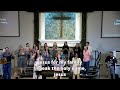
The love of Christ is vast and all-encompassing, surpassing all human understanding. It is a love that is not limited by our failures or shortcomings but is rooted in His very nature. This divine love is the foundation upon which our faith is built, providing strength and stability. It is a love that knows no boundaries of height, depth, or breadth, reaching into every corner of our existence. We are invited to be rooted and established in this profound love, which empowers us to live fully. [57:22]
I pray that out of his glorious riches he may strengthen you with power through his Spirit in your inner being, so that Christ may dwell in your hearts through faith. And I pray that you, being rooted and established in love, may have power, together with all the Lord’s holy people, to grasp how wide and long and high and deep is the love of Christ. (Ephesians 3:16-18 NIV)
Reflection: In what specific relationship or situation is God inviting you to extend His kind of unconditional, no-strings-attached love this week?
We are called to a new standard of love, one that mirrors the love Jesus demonstrated for His disciples. This love is not based on personal preference or convenience but is a command to love others with the same selfless commitment Christ showed. It is through this active, tangible love that the world recognizes we belong to Him. Such love requires a conscious choice to move beyond our natural inclinations and to see others through His eyes. [01:01:13]
“A new command I give you: Love one another. As I have loved you, so you must love one another. By this everyone will know that you are my disciples, if you love one another.” (John 13:34-35 NIV)
Reflection: Where might you be loving others conditionally, and what is one practical step you can take to move toward a more Christ-like, unconditional love in that area?
Sacrificial love lies at the heart of the Christian life, modeled perfectly by Jesus Himself. He, who was God, did not cling to His rights but humbled Himself, taking on the nature of a servant. This ultimate sacrifice, obedience unto death, was an act of love for us. We are therefore called to have the same mindset, considering the needs of others as more important than our own. [01:08:12]
In your relationships with one another, have the same mindset as Christ Jesus: Who, being in very nature God, did not consider equality with God something to be used to his own advantage; rather, he made himself nothing by taking the very nature of a servant, being made in human likeness. And being found in appearance as a man, he humbled himself by becoming obedient to death— even death on a cross! (Philippians 2:5-8 NIV)
Reflection: What is one personal comfort, right, or possession that God might be asking you to lay down sacrificially for the good of someone else?
Forgiveness is a vital characteristic of a life rooted in Christ’s love. We are to extend to others the same grace and compassion that God has shown us through Jesus. This forgiveness is not merely a feeling but an active choice to release grievances and to be kind. It is through this practice of forgiveness that our spiritual roots grow deep and intertwined with the body of Christ. [01:19:27]
Be kind and compassionate to one another, forgiving each other, just as in Christ God forgave you. (Ephesians 4:32 NIV)
Reflection: Is there a specific hurt or grievance you are holding onto that, through His strength, you can choose to forgive today, releasing it into God’s hands?
The Christian hope is anchored in the promise of eternal life, a gift made possible by God’s grace through Jesus Christ. This is not something we can earn; it is a free gift received through faith. Our future is secure in Him, promising a reign with Christ characterized by peace, purity, health, and joy. This assurance allows us to live with purpose and confidence today. [01:28:19]
For the wages of sin is death, but the gift of God is eternal life in Christ Jesus our Lord. (Romans 6:23 NIV)
Reflection: How does the certain hope of your eternal future with Christ shape your perspective and choices in the present?
Calvary Virginia Beach’s Second Sunday after Resurrection centers on what it means to be rooted in Jesus by living a love that shapes every part of Christian life. The scripture-centered exposition uses the redwood forest as a picture: individual trees cannot sustain themselves by a single deep taproot, so their roots entwine and broaden to support the whole grove. Likewise, spiritual life flourishes not in isolation but in an interdependent community rooted in Christ’s love. Ephesians 3:16–18 frames that love as immeasurable in width, length, height, and depth; John 13:34 and 1 John 4:9–11 make that love the defining mark of discipleship, revealed in God’s sending of the Son as an atoning sacrifice.
Three forms of love anchor the teaching. Unconditional love welcomes and accepts without expectations, modeled in parental and faithful friendships and illustrated by everyday examples of devotion. Sacrificial love imitates Christ’s humility in Philippians 2:5–8: the Creator emptied himself, took the form of a servant, and obeyed to the point of death on a cross; sacrifice, then, demands costly surrender rather than partial giving. Forgiving love, grounded in Ephesians 4:32 and Colossians 3:13, calls for active, mutual pardon that mirrors God’s own mercy—confession opens the way to purification and restored relationship.
Practical implications emerge: spiritual formation requires private Bible engagement and prayer to allow the Spirit to work inwardly; the church functions as a mutual support network that supplies what no single believer can provide; and ethical life expresses itself in concrete actions, not merely words (1 John 3:16–18, 1 Cor. 13). The rich young ruler story (Matthew 19) warns that moral competence alone cannot substitute for wholehearted surrender to Christ. The closing vision points ahead to ultimate reward—Revelation 20’s millennial image—promising peace, prosperity, purity, perpetual health, and personal joy for those who set their hope in Christ. The invitation emphasizes immediate response: confession of Jesus as Lord and faith in his resurrection secures justification and entrance into the kingdom of God.
You can tell a hurting well world how much we love Jesus and how much Jesus loves them. We can tell a wayward family member the same thing. We can tell them how much we care. We can tell them, well, you just fill in the blank. You can tell them anything. But without love and without loving unconditionally, without loving sacrificially, and without loving forgivingly, you know what? Nobody's ever gonna hear it. It doesn't mean anything unless you love unconditionally, sacrificially, and forgivingly.
[01:22:01]
(32 seconds)
#LoveMustBeUnconditional
We grow healthy. We grow roots that are that are intertwined. We grow roots that are strong and stable when we love forgivingly. And then lastly here, these three things all have to be rooted in love. First Corinthians thirteen one, Paul says this, if I speak in tongues of men or of angels, but do not have love. I am only a resounding gong or a clanging cymbal. Think about that. It means you just make a noise. Doesn't mean anything.
[01:21:19]
(42 seconds)
#RootsGrowInLove
Healthy roots grow. We grow when we love one another unconditionally. Have you ever thought about what the word unconditionally truly means? So I did a little study on what does it truly mean to be unconditional in love? Alright? The definition of unconditional love is the following. Loving someone unconditionally means caring for them without any conditions or expectations. Love one another without conditions or expectations. This love is character characterized by acceptance, support, and regardless of what the person's behavior or circumstances.
[01:04:50]
(39 seconds)
#UnconditionalLoveDefined
Rather, he made himself nothing. Think about this first of all. Jesus made himself nothing. The creator of the universe made himself nothing by taking the very nature of what a servant. And that's what he told the disciples as well on the last supper. His he repeats himself. He's telling Paul is repeating what Jesus told the disciples here. By taking the very nature of a servant, being made in human likeness, and being found in appearance as a man, he humbled himself by becoming obedient to death and even death on a cross.
[01:08:30]
(49 seconds)
#JesusHumbledHimself
Somebody is there to support you. We've done the church has done that many times for many people in this church whether they are members or not. And most churches will do that. So the church is part of that support system and it's important to be part of that community. But that's only rooted if it's rooted in the love of Christ. We love one another when we grow unconditionally, and this love has to be unconditionally.
[01:00:43]
(30 seconds)
#ChurchSupportRootedInChrist
This love brings us life, it brings us health, it brings us healing, and it goes back to this inner winding of the roots. It brings us together. It strengthened us as a community of believers. We can stand together. When and we'll hear this in a moment. When you all of us have issues, we have we have needs, we have we need support, and what and when we reach out to folks, you get supported.
[01:00:12]
(31 seconds)
#LoveBringsHealingAndUnity
The first may say that, but if not, what else does could this mean? Well, we gonna need to read further. It says verse seventeen and eighteen, it says, if anyone has material possessions and sees a brother or sister in need but has no pity on them, how can the love of God be in that person? That's the question you have to ask yourself. Remember, whenever you read biblical verses, you're trying to figure out what God is saying and you can read that, but then what does it mean?
[01:17:54]
(31 seconds)
#LoveShownByHelpingTheNeedy
But this is what happened. Jesus was the ultimate sacrifice that I just read here. He he sacrificed himself and he made himself nothing. But that sacrifice had to be for a reason. The very Jesus being the very nature of God made himself nothing. Think about that. He was born in a a manger. He was a helpless baby. He was relying on how many of us when we were new parents knew anything about being a parent?
[01:11:32]
(32 seconds)
#JesusUltimateSacrifice
I'm an AI bot trained specifically on the sermon from Apr 13, 2026. Do you have any questions about it?
Add this chatbot onto your site with the embed code below
<iframe frameborder="0" src="https://pastors.ai/sermonWidget/sermon/road-to-easter" width="100%" height="100%" style="height:100vh;"></iframe>Copy