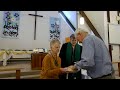
Communion is a holy mystery that invites us to encounter Christ’s presence in ways we cannot fully understand.
In the act of breaking bread and sharing the cup, we are drawn into a sacred moment that transcends our attempts to explain or control it. The bread and wine are not magical objects, nor are they simply empty symbols; rather, they are a mirror reflecting the presence of Jesus already among us and within us. Communion is not about getting a “refill” of Jesus, but about celebrating the holy mystery of God’s love and grace, a mystery that has always been bigger than our rituals or rules. As we come to the table, we are invited to bring our questions, our doubts, and our faith, trusting that Christ meets us in the mystery. [47:24]
Luke 22:14-23 (ESV)
And when the hour came, he reclined at table, and the apostles with him. And he said to them, “I have earnestly desired to eat this Passover with you before I suffer. For I tell you I will not eat it until it is fulfilled in the kingdom of God.” And he took a cup, and when he had given thanks he said, “Take this, and divide it among yourselves. For I tell you that from now on I will not drink of the fruit of the vine until the kingdom of God comes.” And he took bread, and when he had given thanks, he broke it and gave it to them, saying, “This is my body, which is given for you. Do this in remembrance of me.” And likewise the cup after they had eaten, saying, “This cup that is poured out for you is the new covenant in my blood. But behold, the hand of him who betrays me is with me on the table. For the Son of Man goes as it has been determined, but woe to that man by whom he is betrayed!” And they began to question one another, which of them it could be who was going to do this.
Reflection: When you come to the communion table, what mystery or question about God’s presence do you bring with you today?
Jesus welcomes all to the table, regardless of status, understanding, or past failures.
At the Last Supper, even Judas—the one who would betray Jesus—was present and received the bread and cup. This radical act of inclusion shows that no one is too far gone, too sinful, or too confused to be welcomed by Christ. The table is not reserved for the worthy, the knowledgeable, or the elite; it is open to all who come, because all are equal in need and grace. The church’s attempts to restrict who may serve or receive communion miss the heart of Jesus, who broke bread with friends, outcasts, women, children, and even his betrayer. [44:19]
Romans 3:22-24 (ESV)
For there is no distinction: for all have sinned and fall short of the glory of God, and are justified by his grace as a gift, through the redemption that is in Christ Jesus.
Reflection: Is there someone you have considered “unworthy” of God’s grace or presence? How might you extend Christ’s welcome to them—or to yourself—today?
Communion is an act of community, a sign of our shared life and relationship with one another.
Long before it became a church ritual, sharing food was a way for people to express trust, care, and connection. Every time we gather around a table, bless a meal, or share with others, we participate in the deep human and spiritual act of communion. Jesus’ last meal with his friends was not just a theological event, but a profoundly human one—an act of love, memory, and covenant. When we come to the table, we reaffirm our bonds with God and with each other, celebrating the relationships that sustain us. [49:18]
Acts 2:46-47 (ESV)
And day by day, attending the temple together and breaking bread in their homes, they received their food with glad and generous hearts, praising God and having favor with all the people. And the Lord added to their number day by day those who were being saved.
Reflection: Who in your life needs to experience deeper community or connection? How can you share a meal or a moment of fellowship with them this week?
The meaning of communion is shaped by the spirit and intention you bring to it.
If you come forward out of routine, the sacrament may feel routine; if you come with a sense of sin, it becomes redemption; if you come with celebration, it becomes a party; if you come seeking community, it becomes a family meal. Communion is open to the meaning you bring, and God meets you in your reality. This is an invitation to approach the table thoughtfully, honestly, and with openness to what God wants to do in your heart today. [50:35]
Psalm 139:23-24 (ESV)
Search me, O God, and know my heart! Try me and know my thoughts! And see if there be any grievous way in me, and lead me in the way everlasting!
Reflection: What are you bringing to the table today—routine, celebration, sorrow, protest, or something else? How might you invite God to meet you in that place?
Jesus is present not only in the bread and cup, but in every moment and place of our lives.
The presence of Christ is not confined to the altar or the act of communion; he is with us in the pews, in the parking lot, and in every corner of our daily existence. Communion is a way of recognizing and celebrating the presence of Jesus that is already with us, making every moment holy. As we break bread together, we are reminded that Christ’s love and grace go with us beyond the church walls, into every relationship and circumstance. [46:47]
Matthew 28:20b (ESV)
And behold, I am with you always, to the end of the age.
Reflection: Where do you most need to remember Christ’s presence with you today—at work, at home, in a relationship, or in a place of struggle? How can you acknowledge his presence there?
Communion is a simple act at its heart: a group of friends gathered around a table, sharing bread and wine, remembering Jesus and his love. Yet over the centuries, we have layered this act with rules, rituals, and debates—about what kind of bread to use, who is allowed to serve or receive, and what exactly happens when we break the bread and share the cup. We have tried to make it more special, more exclusive, or more “correct,” but in doing so, we often miss the deep mystery and radical inclusivity at the center of Jesus’ table.
When Jesus first broke bread and shared the cup, he did so with all his disciples—including Judas, the one who would betray him. This is a powerful reminder that the table is not for the worthy, but for all. The church has sometimes tried to restrict who can serve or receive communion, but the original meal was open, messy, and full of people who didn’t fully understand what was happening. If Judas could receive from Jesus, who are we to deny anyone?
We also tend to overcomplicate the elements themselves. Whether it’s unleavened bread, wafers, or cubes of white bread, wine or grape juice, the point is not the perfection of the elements but the act of sharing. Communion is not about magic words or special people; it is about remembering Jesus, celebrating the mystery of his presence, and affirming our connection to one another.
The mystery of communion is not that Jesus suddenly appears in the bread and wine, but that he is already present—at the table, in the pews, in our lives. The bread and cup are not a portal to a distant God, but a mirror reflecting the holy presence already among us. Communion is a celebration of this mystery, a human act of community that predates religion itself. Every time we share a meal, bless our food, or gather in love, we echo this ancient act.
When we come to the table, we bring our own reality—routine, repentance, celebration, protest, or longing for community. The meaning of communion is shaped by what we bring, and it is open to all who wish to receive. In the Methodist tradition, the table is open: all are welcome, all are invited to remember, to celebrate, and to be nourished by the presence of Christ.
It happens in every Christian church in every country on the planet. Once a month or every Sunday or several times on a Sunday or on several days of the week, someone usually in official robes, usually male, will stand and lift a piece of bread and lift a cup of wine or juice and utter the words, "This is my body. This is my blood." It is the most common act in Christianity. [00:36:16]
Sometimes its commonness is such that it becomes boring and easily overlooked. And the only thing that we can say beyond doubt is none of us have got it right yet. Because think about that simple story you just heard. A man is gathered in a room with friends. He picks up a piece of bread. He prays. He breaks it and he hands it out. [00:36:54]
Robert Capon in his book, Hunting the Divine Fox, has written about communion this way. Human nature being what it is, however, it wasn't long before somebody got the idea that the bread for the sacrament ought to be something special. It wasn't enough apparently that by Jesus' own words, any old bread would be nothing less than his true risen and glorious body really present in a high mystery. [00:38:02]
So you see almost from the very beginning we were taking that simple act of Jesus and we were complicating it. And the next Donny Brookke broke out over who should serve communion because in the earliest days of the church, anybody could. They could be a fisherman from Galilee or an exzelot from Jerusalem, even a female tent maker in Rome. [00:39:25]
But then the idea got around that just plain people wouldn't do for so holy in action. They had to be super people. Now this began to happen when the church moved out of being house churches and became really the established church of the Roman Empire. And from that day to this day this is what has been the standard is that only a few people are allowed to serve communion. [00:39:54]
If some poor soul had just lost a digit in an accident, he was considered unfit to serve the sacrament. And that's the situation we find ourselves in, where I only can say the words of consecration. Break the bread and lift the cup. Now the three churches here in the valley handle that in different ways. In Alamosa and Satchat, you have me come in once a month to preach and do communion. [00:41:07]
But the idea that somehow I and I alone can say these words is a little strange. And it was just a short step from saying who was fit to serve communion to who was fit to receive communion. And that's the mud our Catholic brothers and sisters are mired in every year at election time because every year some Catholic politician is denied communion by some Catholic priest because of some policy that they support. [00:42:13]
Because the idea got around that you shouldn't take communion if you were a sinner. It seems to have escaped the notice of the powers that be that in Christian belief everybody is a sinner. It was really St. Paul who got us going on this because his view was you shouldn't come to the table if you had something on your conscience. Now that's not a bad philosophy, but it should never have become a rule. [00:42:34]
So, if Judas, super sinner of all time, could receive communion from the hands of Christ himself, I don't think any clergy of any stripe, has the right to deny communion to anyone who comes forward because we are all equal in sin at the table. And we're also equal in other ways because the church has tried through history to keep women from serving the sacrament and to keep children from receiving it. [00:44:01]
Now, many churches do not serve communion to children until they are confirmed because they feel children do not understand the sacrament well enough to receive it. And where that argument falls apart is none of us understand the sacrament all that well. And that's why it continues to be a source of argument. Most of us are every bit as confused as your average six-year-old as to what is going on. [00:45:18]
Capon writes, "One of the greatest questions about communion has always been what we mean by saying Jesus becomes present in the bread and the cup. Protestants have said Jesus never becomes present in the elements but only in the people who receive them. And Catholics say he not only becomes present in the elements but also specify the exact time and place. [00:45:56]
Jesus is in the bread and on the altar and in the pews and out in the parking lot 10 minutes before church begins and 10 seconds after the world begins. Jesus Jesus is fully present in all of the baptized. He doesn't show up in a room from which he was absent. He sacramentalizes himself or makes holy a moment in a room in which he is already present. [00:46:59]
You go to do what the church has always been smart enough or lucky enough or guided enough to call it all along. you go to celebrate the holy mystery because there is a mysterious part to this that none of us will ever understand because none of us have ever really understood what those words of Jesus really meant. [00:47:49]
Communion is more than just a specific Christian ritual. It's an act of community in spiritual fellowship that predates all organized religion. Within the Jewish Christian tradition, the seder, the Passover service was observed long before Christian communion. And before the seder, before Jews were Jews, people did something like this for the same reason. [00:48:51]
Every time we hold hands and say blessing before a meal, every time we lift a glass and toast one another and say fine words about one another, every time we eat in peace and grace together, we've celebrated the covenants that bind us together. When Jesus, the Jewish carpenter's son from Nazareth, met for the last time with his friends and followers, they had supper together and they did what Jews have always done, they blessed the meal. [00:49:23]
So if you come forward to receive the elements, you bring your reality with you. If you come forward just out of routine, then the sacrament will be routine. If you come forward out of a sense of your own sin, then the sacrament will be a redemption. If you come forward with a sense of celebration, then the sacrament will be a party. [00:50:47]
I'm an AI bot trained specifically on the sermon from Nov 10, 2025. Do you have any questions about it?
Add this chatbot onto your site with the embed code below
<iframe frameborder="0" src="https://pastors.ai/sermonWidget/sermon/rethinking-communion-mystery-meaning-community" width="100%" height="100%" style="height:100vh;"></iframe>Copy