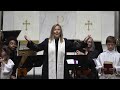
Easter morning erupts with tangible joy and careful invitation as the community gathers to celebrate resurrection life. Announcements and practical hospitality open the hour, then attention turns to the tomb narrative where two Marys encounter earth-shaking disruption, angelic appearance, and the living Christ. The physical details—an earthquake powerful enough to echo the earlier quake at the crucifixion, a stone rolled away, an angel like lightning—frame a scene both terrifying and hope-filled. The angel’s first word, “Do not be afraid,” meets human bewilderment and models divine consolation amid supernatural interruption.
Recognition shapes the response: when Jesus appears, the women fall and worship, taking hold of his feet, a posture born of intimacy and conviction. That worship arises from knowing who stands before them—God incarnate who bridged heaven and earth through word, deed, and finally through victory over death. The resurrection proves neither accidental nor merely symbolic; it fulfills God’s intention that death hold no final claim over the Creator’s own life. The narrative moves quickly from stunned silence to proclamation as the women run to share the news, becoming the first witnesses of the good news.
Theology and daily life intersect in the claim that resurrection changes how humans face fear, anxiety, and mortality. If death cannot hold the risen One, then present troubles lose their ultimacy and God’s sustaining presence reframes human action. Creation itself seems to shout—earthquakes, rock-splitting imagery, and communal exultation among those who receive the news—so that the cosmic and the personal both participate in new life. The assembly is sent to carry this reality outward: to live boldly, worship deeply, and announce urgently that life has been transformed by the risen Christ. The service closes in music and benediction, sending the community out as Easter people who refuse to look back but run toward the life and witness the resurrection requires.
Key Takeaways
- 1. Resurrection defeats death’s finality The resurrection declares that death cannot claim the Creator-made flesh; the victory over the grave rewrites the human ending. This reality reframes suffering as temporary and opens a horizon where defeat does not define destiny. Christian courage flows from living under a sovereignty that shattered death’s claim and secured new life for all creation. [48:36]
- 2. Fear meets divine reassurance The angel’s first word, “Do not be afraid,” addresses the core human reaction to the unknown and the uncanny. Scripture repeatedly pairs divine revelation with this command because fear corrodes faithful response; reassurance reorients attention to God’s purposes. Receiving that word allows movement from paralysis to obedience and from dread to witness. [43:36]
- 3. Worship flows from recognition Falling to bow and holding Christ’s feet emerges from relational knowledge, not mere spectacle. True worship springs when God’s presence is known as trustworthy, sacrificial, and victorious—an encounter that compels obedience and devotion. Such recognition transforms ritual into life-changing allegiance. [46:16]
- 4. Good news demands urgent witness The women run with the message because the gospel’s truth imposes motion: it cannot be contained. Proclamation becomes an ethical posture—moving toward others so that new life circulates through community. Witness validates resurrection as lived reality, not private consolation, and summons others into the same hopeful risk. [52:50]
Youtube Chapters
- [00:00] - Welcome
- [04:23] - Community Announcements
- [06:56] - Easter & Worship Opening
- [37:00] - Wonder: Artemis and Amazement
- [39:56] - Earthquake at the Tomb
- [42:26] - Angelic Appearance and Message
- [46:16] - Marys Encounter the Risen Christ
- [48:36] - Theological Meaning of Resurrection
- [52:50] - Running to Proclaim the News
- [61:07] - Hallelujah Chorus & Benediction