Jesus walks among His people, not from a distance but right in the middle of the lampstands. He sees the hard work, the perseverance, and the careful devotion to truth that refuses to swallow counterfeit teaching. That is both comforting and sobering—comforting because nothing faithful is overlooked, sobering because nothing hidden stays hidden. He delights in service that is rooted in love for His name, not in self-importance or mere routine. Let His nearness reassure you and recalibrate you today, because His “I know” is the most honest mirror you’ll ever stand before [02:47]
Revelation 2:1-3
The One who holds the messengers of the churches in His right hand and moves among His churches says: I see your faithful service, your strenuous labor, and the way you keep going. You do not put up with evil, and you test those who claim authority but prove false. You have carried the weight for my name and have not quit.
Reflection: Where is Jesus’ “I know” most comforting to you right now, and where is it gently confronting you to reorder how and why you serve?
It’s possible to do church well and drift from the Christ you started with. The invitation is clear: remember where love used to lead you, repent of the drift, and repeat the early practices of affection and obedience. Activity for Jesus is not the same as intimacy with Jesus, and He cares about both. He warns that if love is abandoned, His presence—the lampstand—can be removed, because what He wants most is our hearts. Today is a day to come back to simple devotion: unhurried time with Him, obedience without delay, and tenderness toward others born from nearness to Him [03:18]
Revelation 2:4-5
But I do have this against you: your first love has faded. Think about how far you’ve drifted; turn around, and do again what you did at the beginning. If you refuse to turn back, I will come and remove your lampstand from its place.
Reflection: What one first-love practice will you intentionally “repeat” this week—unhurried prayer, simple obedience, or reconciling love—and when will you do it?
When the gospel first shook Ephesus, believers brought costly items tied to their former life and burned them in public. Repentance wasn’t a feeling; it was a fire that left no path back to what once owned them. Love for Jesus produced decisive actions that reshaped the city’s economy and people’s daily habits. That same grace invites costly, concrete steps today—deleting what entangles, confessing what hides, returning what was taken, ending what compromises love. Repentance isn’t a single spark; it’s a steady flame that keeps consuming anything that competes with Him [02:36]
Acts 19:18-20
Many who believed came forward, openly admitting what they had been doing. A number of those who practiced magic gathered their books and burned them in front of everyone; the total value was enormous. In this way the Lord’s message kept spreading with power and proved stronger than the old ways.
Reflection: If you were to “burn the books” today, what specific habit, stash, subscription, or shortcut would you remove as an act of love for Jesus?
Delay often disguises itself as wisdom, but tomorrow can be the enemy of surrender. Felix trembled at the message and still said, “Come back when it’s convenient,” and convenience never came. Fear of failure, fear of people, and fear of cost can stall obedience, yet God often steers those who are moving. His Word is a lamp for your feet—not a floodlight for the whole road—so take the next step you can see. Let today hold a small but real yes before it turns into another tomorrow [03:05]
Acts 24:24-25
Later, Felix and Drusilla sent for Paul and listened as he spoke about trusting Christ, righteous living, self-control, and the coming judgment. Felix became afraid and said, “That’s enough for now; when it’s convenient, I’ll call for you again.” Convenience kept postponing the moment.
Reflection: What decision have you been postponing out of fear, and what single 10-minute step of obedience will you take before the day ends?
Jesus still asks for ears that listen and hearts that respond. Those who overcome—who keep returning to first love and living a rhythm of repentance—are promised life with Him forever. This is not grit alone; it’s grace-fueled perseverance that chooses Him over applause, habits, or even relationships when necessary, and then loves people more deeply because He is first. Strike the match you’ve been saving; choose the small, faithful yes right in front of you. The promise is worth the fight, and His presence is the reward [02:22]
Revelation 2:7
Anyone with ears should listen to what the Spirit is saying to the churches. To the one who stays faithful and wins the battle, I will give the right to eat from the tree of life in God’s paradise.
Reflection: Who is one person you will love differently this week because you’re choosing Jesus first, and what specific act of care will you offer within the next 48 hours?
We launched our “Letters to the American Church” journey by standing with the church in Ephesus and listening to Jesus’ words in Revelation 2:1-7. Ephesus was a strategic, refined, religiously charged city—a place where the gospel once exploded with power. This church had pedigree—Paul, Timothy, John, even Mary worshiped there. Jesus looks closely and says, “I know your deeds.” He commends their hard work, endurance, and doctrinal clarity. They served, persevered, and held the line against false teaching. But then He says something sobering: “You have forsaken the love you had at first.”
That’s the tension. You can do church well and still drift from the Christ you started with. Activity for Jesus is not intimacy with Jesus. In Ephesus, orthodoxy without love had become its own kind of error. Jesus doesn’t just diagnose; He gives a path: Remember, repent, and repeat the things you did at first. Remembering is present and ongoing—keep remembering what it was like when you first met Him. Repenting is more than “I’m sorry”; it’s metanoia—a change of mind that becomes a change of life. And then repeat: return to early practices of love, zeal, and sacrifice.
The warning is real: “I will remove your lampstand.” That’s not about losing branding or buildings; it’s about losing His presence. History tells us Ephesus is ruins today. Great churches have histories; Jesus looks for humility, returning hearts, and a lifestyle of repentance. We can’t keep deferring obedience like Felix in Acts 24—alarmed, almost persuaded, but always waiting for a better time. Satan’s favorite day is tomorrow; God’s favorite day is today. Sometimes repentance costs us—maybe misunderstandings, maybe relationships. We must pre-decide to prefer Jesus over everything else.
I told the story of the prairie fire: one match left, one chance to burn a safe place before the flames arrive. That’s the urgency. Strike the match. Choose repentance as a rhythm, not a moment. As we begin this fast, let’s start by asking the Spirit to search us, returning to first love so we can love one another well.
Jesus isn't distant or sitting back and letting things happen; He is watching and has observed things firsthand, speaking "I know..." to churches today—his words apply to American churches in 2026 as much as in the first century.
A church can be active, doctrinally pure, and serve the community, yet drift away—losing its first love for Jesus even while doing ministry well.
Jesus praised Ephesus for hard work, perseverance, and testing false apostles, but still held against them that they had abandoned the love they had at first.
Repentance means more than sorry; it is a change of mind and life—metanoia—a habitual, ongoing turning back to God, not merely a one-time event.
Remember, repent, repeat: go back to the place where you first loved Jesus, be contrite, change your practices, and do the works you did at first so you won't lose His presence among you.
Too often we put off returning to God, thinking we'll change later; that delay can cost you everything—don't wait for the perfect moment, step toward God now while you still can.
You must decide ahead of time whether you're willing to lose friends or family to follow Jesus; if you can't prefer Jesus over people, you're not ready to be His disciple.
Activity for Jesus is not intimacy with Jesus; serving and programs can't substitute for a vibrant, loving relationship with Him.
The same power that transformed you initially is the same power that can transform you progressively; God refuses to leave you where you are and wants you to become more like Jesus.
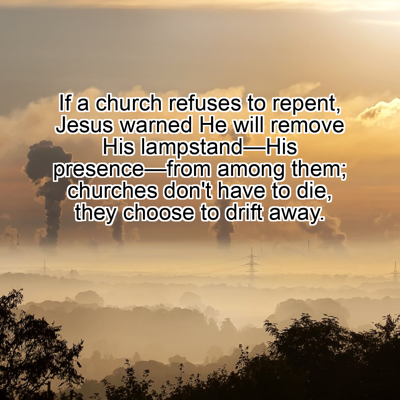
If a church refuses to repent, Jesus warned He will remove His lampstand—His presence—from among them; churches don't have to die, they choose to drift away.
Hi, I'm an AI assistant for the pastor that gave this sermon. What would you like to make from it?
Add this chatbot onto your site with the embed code below
<iframe frameborder="0" src="https://pastors.ai/sermonWidget/sermon/restore-first-love" width="100%" height="100%" style="height:100vh;"></iframe>Copy