Sep 20, 2026
Joshua secretly sent two men to scout Jericho. They entered the house of a woman named Rahab and stayed there. Before they slept, she came to them on the roof. She told them she knew the Lord had given them the land. A great fear had fallen on her people because they had heard what God did at the Red Sea and to the Amorite kings. Their hearts melted.
Rahab, a Canaanite woman living inside Jericho's walls, knew more about Israel's God than the spies remembered in that moment. They went looking for a military report on their enemy's strength. Instead, they received a testimony of God's strength from an unlikely prophet. She reframed their entire mission.
You also face walls of uncertainty, opposition, or fear. You analyze the obstacle, searching for its weak points. But what if God's first command is not to study the wall, but to remember the sea? What story of God's past faithfulness have you forgotten in your present fear?
“Before the men lay down, she came up to them on the roof and said to the men, ‘I know that the Lord has given you the land, and that the fear of you has fallen upon us, and that all the inhabitants of the land melt away before you. For we have heard how the Lord dried up the water of the Red Sea before you when you came out of Egypt, and what you did to the two kings of the Amorites who were beyond the Jordan, to Sihon and Og, whom you devoted to destruction. And as soon as we heard it, our hearts melted, and there was no spirit left in any man because of you, for the Lord your God, he is God in the heavens above and on the earth beneath.’”
(Joshua 2:8-11, ESV)
Prayer: Ask God to bring to your mind one specific story of His past faithfulness that you have neglected to remember.
Challenge: Write down that one story of God's faithfulness in a notebook or on your phone.
Israel stood on the edge of the promised land. Forty years in the wilderness were behind them. The land of God's promise was before them. But so was Jericho, a fortified city with imposing walls. They knew where God had called them to go. They just did not know how they would get through what stood in the way.
The danger for Israel was not just underestimating Jericho. It was underestimating God. Fear enlarges the wall and crops God out of the picture. They had literally walked through the Red Sea and then complained about food. They needed deliverance from Egypt and a snack. This is why Scripture repeatedly tells God's people one word: remember.
You do this too. God provides a major breakthrough, and then the next minor inconvenience becomes a crisis. You forget the sea you walked through because of the wall you now face. What current challenge is causing you to forget a past demonstration of God's power?
“And the Lord said to Moses, ‘Why do you cry to me? Tell the people of Israel to go forward. Lift up your staff, and stretch out your hand over the sea and divide it, that the people of Israel may go through the sea on dry ground.’”
(Exodus 14:15-16, ESV)
Prayer: Confess to God the specific "wall" you are staring at that has made you forget the "sea" He has already parted.
Challenge: Tell one person today about the "Red Sea" moment God brought to your mind yesterday.
Rahab told the spies, "We have heard what the Lord has done." That story was a generation old. Somebody told somebody, who told somebody, until it reached a Canaanite woman living in Jericho. The woman who had only heard the story was reminding the people who had inherited it.
God does not only give you a story. He puts you among a people who have stories. Your faith is personal, but Christianity is not a one-player game. What God has done in your life can strengthen someone else. When your own knees are shaking, you can draw courage from what God has done in the lives of others around you.
Your church is a collection of stories. Stories of salvation, healing, and provision. Stories of strength to get through another week. We need to get good at telling them. Who in your life needs to hear your story of God's faithfulness to strengthen them for their own wall?
“We will not hide them from their children, but tell to the coming generation the glorious deeds of the Lord, and his might, and the wonders that he has done.”
(Psalm 78:4, ESV)
Prayer: Thank God for one person in your church family whose story of faith has encouraged you.
Challenge: Identify one person you can encourage this week by sharing your story of God's faithfulness.
Rahab did not stop at what God did. She declared who God is. "The Lord your God is God in heaven above and on the earth below." Remembering is meant to do this. It does not just give us stories about what happened. It teaches us who God is. If you only remember the experience but miss what it showed you about God, you are just collecting spiritual souvenirs.
Life gets noisy. Fear has a song. Disappointment has a soundtrack. Anxiety gets loud. But through the noise, memory gives you a note you recognise: Faithful. Present. Good. You may not recognise the situation you are in. But you can recognise Him. You have heard His grace before.
Your current situation may be a song you do not know. But you know the Singer. What familiar attribute of God's character—His faithfulness, presence, or goodness—can you recognise in your life today?
“Jesus Christ is the same yesterday and today and forever.”
(Hebrews 13:8, ESV)
Prayer: Ask God to help you recognise His consistent character in the middle of your changing circumstances.
Challenge: Underline every attribute of God you find in your daily Bible reading.
Rahab said, "I know that the Lord has given you this land." Jericho had not fallen. Joshua had not marched. The trumpets had not sounded. Nothing she could see had changed. And still she said, "I know." She was told to hang a scarlet cord from her window, a sign of rescue before the walls came down.
Her confidence was not based on what she could see happening to the wall. Her confidence was based on what she knew about God. Faith does not pretend the wall is not there. Faith looks straight at the wall and remembers who God is. God's past faithfulness gives you courage for your next faithful step.
You do not need certainty about every outcome. You need confidence in His character. Your next step is not to see the finish line. It is to obey where your feet are. What is the next faithful step God is asking you to take, even though you cannot see the outcome?
“And she said, ‘According to your words, so be it.’ Then she sent them away, and they departed. And she tied the scarlet cord in the window.”
(Joshua 2:21, ESV)
Prayer: Pray for the courage to take your next step of obedience, trusting God's character over your circumstances.
Challenge: Take that one step you identified—make the call, have the conversation, or start the task.
Joshua 2 and the household of Rahab frame a calling to remember the faithfulness that precedes present walls. The narrative of spies entering Jericho and Rahab’s proclamation about the Red Sea becomes a pattern: what lies behind supplies courage for what lies ahead because the same faithful God stands beside the people. Three movement-words—Behind, Beside, Before—structure the reflection. Behind urges the church to collect and tell testimonies of deliverance, provision, and answered prayer so those memories anchor hope when fear enlarges obstacles. Beside insists that remembrance must teach who God is—Provider, Presence, and Faithful One—so recognition of God’s character becomes the measure for trusting in situations still unresolved. Before presses toward obedience: knowing God’s faithfulness does not guarantee repeating past methods but does give confidence to step forward without seeing the finish line.
Remembrance receives pastoral direction: memory is not nostalgia; it is testimony that points away from the congregation as hero and toward God as hero. Stories are communal resources: private memories become public instruments when shared around tables, through prayer, and across generations. The scarlet cord in Rahab’s window symbolizes rescue anchored in trust before visible change. The life of faith allows lament and unanswered prayers to sit alongside gratitude for grace already experienced; the presence of God may show itself as sustaining grace even when outcomes remain uncertain.
Practical rhythms follow: hands empty (release of what cannot be carried), eyes up (attention and affection fixed on Jesus), hearts full (feasting on remembrance). Community practices—telling stories, eating together, rehearsing God’s deeds to children, offering prayer support—function as spiritual infrastructure for facing new challenges. Vision and plans may change, budgets and methods will provoke questions, but a remembering church uses past faithfulness to spur obedience now. The final posture is one of mutual lending of memory: when personal recollection fails, other people’s stories revive recognition of the Faithful One and equip obedience for whatever walls stand before the people.
If God is leading us into something new, what are we carrying that we can’t take with us?
Hands empty: nothing should be held more tightly than Jesus.
Sometimes the answer isn’t knowing more about the wall. It’s remembering more about God.
Faith is personal. But Christianity was never designed as a one-player game.
When my memory is weak, lend me yours. And when your memory is weak, I’ll lend you mine. That’s church.
Faith doesn’t pretend the wall isn’t there. Faith looks straight at the wall and remembers who God is.
Faith is: "Whatever I’m facing, I can trust it to the God whose character I know.
Remember the stories. Remember the prayers. Remember the grace that carried you even when the answer didn’t come.

Make us a remembering church: quick to tell the stories, quick to celebrate Your goodness, and quick to give You all the glory.
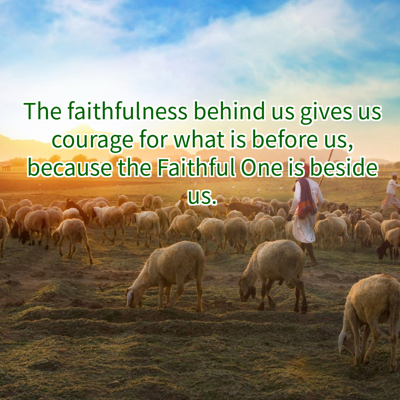
The faithfulness behind us gives us courage for what is before us, because the Faithful One is beside us.
Hi, I'm an AI assistant for the pastor that gave this sermon. What would you like to make from it?
Add this chatbot onto your site with the embed code below
<iframe frameborder="0" src="https://pastors.ai/sermonWidget/sermon/remember-gods-faithfulness" width="100%" height="100%" style="height:100vh;"></iframe>Copy