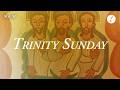
The Trinity isn’t a distant idea but a creative partnership woven into creation’s fabric. At the world’s dawn, the Father spoke, the Son (the eternal Word) enacted, and the Spirit hovered like a breath over chaos. This divine dance didn’t end with stars and seas—it pulses through every blade of grass, every sunrise. God didn’t abandon creation to tick like a clock but dwells within it, calling it "good" not as a final grade but as an ongoing love song. To be made in God’s image is to carry this rhythm of relational creativity. [46:31]
In the beginning, God created the heavens and the earth. The earth was without form and void, and darkness was over the face of the deep. And the Spirit of God was hovering over the face of the waters. And God said, “Let there be light,” and there was light. (Genesis 1:1–3, ESV)
Reflection: Where do you sense the Trinity’s creative partnership at work in your daily life? How might your acts of creativity—even ordinary ones—reflect God’s delight in making things “good”?
Three figures in Rublev’s icon lean toward one another, their circle open, a chalice at the center. This is no closed club—the Trinity’s communion invites the isolated, the fragmented, the ones still carrying COVID’s invisible weight. Loneliness isn’t solved by crowds but by the courage to sit at the table where scars and stories are shared. The church, like that icon, must leave space at the edges for those whispering, “I don’t belong.” [51:16]
“I do not ask for these only, but also for those who will believe in me through their word, that they may all be one, just as you, Father, are in me, and I in you, that they also may be in us, so that the world may believe that you have sent me.” (John 17:20–21, ESV)
Reflection: When have you felt the Trinity’s “open circle” welcoming you? Who in your life needs you to scoot over and make space at the table today?
Adam’s aloneness was the first “not good” in Eden—a crack in creation’s perfection. God didn’t lecture or scold but split Adam’s side, forming Eve from his rib. The Triune God, who exists in eternal relationship, designed humans to need each other’s breath, laughter, and tears. Yet we often hide, like Adam and Eve in the garden, mistaking isolation for safety. [53:41]
Then the Lord God said, “It is not good that the man should be alone; I will make him a helper fit for him.” (Genesis 2:18, ESV)
Reflection: What part of yourself do you keep hidden, fearing it’s “not good”? How might vulnerability with a trusted friend reflect God’s design more than your shame?
The pastor’s COVID isolation in a mountain cabin mirrors our ache for connection. We Zoom, scroll, and accumulate surface-level friendships while starving for the risky gift of being known. The Trinity models intimacy without absorption—three distinct persons united in love. To image God isn’t to perform perfection but to whisper, “Me too,” over shared bread and shared wounds. [55:18]
Therefore, having put away falsehood, let each one of you speak the truth with his neighbor, for we are members one of another. (Ephesians 4:25, ESV)
Reflection: Where have you substituted busyness for true connection? What one step could you take this week to move from “Hi, how are you?” to “Tell me your story”?
Rublev’s icon hides a secret: the chalice at the Trinity’s center is also the table where we kneel. Communion isn’t a ritual but a revolution—a taste of the day when all loneliness dissolves into the Triune embrace. Every “body of Christ” spoken at the rail is a promise: you are not a project, but family. The church’s job is to hold the cup low enough for the world to reach. [58:39]
The cup of blessing that we bless, is it not a participation in the blood of Christ? The bread that we break, is it not a participation in the body of Christ? Because there is one bread, we who are many are one body, for we all partake of the one bread. (1 Corinthians 10:16–17, ESV)
Reflection: How does receiving communion reshape your view of the person sitting beside you? What would it look like to “hold the cup low” for someone outside these walls this week?
Trinity Sunday sets the church year at a kind of climax, not only retelling what God has done, but naming who God is. The triune God stands at the center, not as a distant watchmaker or an oversized superhero who comes and goes, but as the living Father, Son, and Holy Spirit who creates, dwells, and pursues. Genesis opens the curtain: the Father speaks, the Word who is the Son is spoken, and the Spirit hovers over the waters. That “intimate dance of the Trinity” moves creation into being, and God calls it good. Scripture keeps pressing the point that God yearns to be with his people, walking in the garden, and finally becoming flesh and blood to bring them home.
The Trinity shows one God in three persons, not three gods and not one God changing hats. It is mind boggling, and that is the comfort. If God fit into a neat analogy, God would collapse into a mirror of human limits. Mystery does not make God far; it signals that God knows every flaw and knows what is needed. So instead of squeezing God into a too-small box, the church receives help from holy imagination. Rublev’s icon of the three at table gently invites the viewer to sit within that conversation, to rest, and to listen for the God who welcomes.
Genesis then tells human beings who they are: made in the image and likeness of this relational God. The first problem named in Scripture is not sin, but aloneness. God forms Eve bone to bone and flesh to flesh, because there is no such thing as a human who images God in isolation. Modern life strains that truth. An isolation epidemic leaves many lonely. Crowds without intimacy do not heal it. To be known is to be vulnerable, which is scary and also restorative. The church is called to be the kind of community where people are seen, known, and cherished, where mutual love is the way into oneness with Jesus as he is one with the Father.
Rublev’s painted chalice at the center points to the table where the body and blood of Christ gather a people and then send them. The bread of heaven and the cup of salvation do more than feed; they form. From that table the community goes out as a living sign of God’s redemptive love, carrying the imprint of the triune dance into a lonely world.
We are invited into a life of mutual love with one another and God. Before Jesus goes to die on the cross he tells his disciples that he will be one with them when we love him and each other. In this way he invites us to be one with him as he is one with the father. Through our mutual love for one another we get to experience the oneness with Jesus and somehow we get to dance into this beautiful dance of the trinity. It's this mutual giving and receiving that the church gets to do and be. This is the dance we're invited into.
[00:57:40]
(48 seconds)
But as we find in scripture, God is not hands off. He's deeply and intimately concerned with the world and the people in whom he has made. And we see from the outset of Genesis that God is so much bigger than a reflection of ourselves or a comic book superhero. We get this image of this cosmic triune God who creates because he desires to be with his creation. In the Genesis narrative we're told that God the father speaks. And in John one we're reminded that the word that is spoken is none other than Jesus Christ the son of God.
[00:45:59]
(41 seconds)
The Trinity, this one God and three persons, father, son, holy spirit, shows us the mystery of God as deeply relational. That God cares and he knows. And I think it's important to name that the father, the son, and the holy spirit aren't three separate gods nor is God putting on a hat to do something different. It is this weird confusing mystery where God is both three and one. It's mind boggling and I think that's the point.
[00:47:52]
(36 seconds)
In the text we're told that we are made in the image of God, which means that Adam wasn't complete until Eve came. Or to put another way, we are in the image and likeness of the triune God when we are together. A mentor and professor of mine, Keith Johnson once put it this way, There is no such thing as a human who images God in isolation. If our being in the image of God is determined by our relationships with God and others, then the way we exist is just as important as the fact that we exist.
[00:53:52]
(40 seconds)
I'm an AI bot trained specifically on the sermon from Jun 01, 2026. Do you have any questions about it?
Add this chatbot onto your site with the embed code below
<iframe frameborder="0" src="https://pastors.ai/sermonWidget/sermon/relational-god-image" width="100%" height="100%" style="height:100vh;"></iframe>Copy