The world, the flesh, and the devil are not vague ideas to be dismissed or only spoken about in theory. They are real pressures, habits, and spiritual forces that press on the heart, making ordinary choices shape into patterns that pull a person away from God. Recognizing where each one is at work in daily life is not a sign of failure; it is sober spiritual perception. The Christian life is a battleground—ignoring the enemy only gives him ground.
You are called to name the enemy accurately and refuse to make peace with it. Take an honest look at relationships, media, ambitions, and private habits and ask where the world’s values, the flesh’s cravings, or the devil’s lies have found a foothold. Naming the place is the first step toward the work God will do to free you.
2 Corinthians 10:3-5 (ESV)
For though we walk in the flesh, we are not waging war according to the flesh. For the weapons of our warfare are not of the flesh but have divine power to destroy strongholds. We destroy arguments and every lofty opinion raised against the knowledge of God, and take every thought captive to obey Christ.
Reflection: Identify one recurring temptation or pattern in your life that is driven by the world, the flesh, or the devil. Write it down and choose one concrete boundary or habit you will adopt this week to oppose it. What is that boundary, and when will you begin?
Deliverance often begins not with polished prayers or confident faith, but with honest need. When a person is surrounded, overwhelmed, and powerless, there is a simplicity to calling out to God that is free of pretense. God delights to hear cries from the pit because they come from a heart that knows it cannot save itself.
If you are tempted to hide your weakness or fix things in your own strength, remember that the story of God’s rescuing people begins with someone who cries for help. Learn to ring the bell of need—tell God exactly how you are lost and helpless—and trust that He hears and moves on behalf of those who reach out to Him in truth.
Jonah 2:1-2 (ESV)
Then Jonah prayed to the LORD his God from the belly of the fish, saying, "I called out to the LORD, out of my distress, and he answered me; out of the belly of Sheol I cried, and you heard my voice."
Reflection: Think of a recent moment when you felt overwhelmed and tried to fix it alone. Spend five minutes now telling God that exact need—out loud or in writing—and ask Him to help you depend on Him. Write down the words you prayed and keep them as a reminder.
The God who shakes mountains and stills seas is the same God who stoops down to lift an individual from a pit. His power is awe-inspiring and wholly capable of altering circumstances, yet He directs that power in love toward the person in need. This means the believer’s confidence rests not in personal strength but in the One who is both mighty and tender.
When God moves, He does not do so merely to show might; He comes to preserve, uphold, and bring a person into life. That reality makes prayer bold and hopeful: the infinite God is attentive to the fragile call of one heart, and His intervention will be both magnificent and intimate.
Habakkuk 3:17-19 (ESV)
Though the fig tree should not blossom, nor fruit be on the vines, the produce of the olive fail and the fields yield no food, the flock be cut off from the fold and there be no herd in the stalls, yet I will rejoice in the LORD; I will take joy in the God of my salvation. God, the LORD, is my strength; he makes my feet like the deer's and makes me tread on my heights.
Reflection: Identify one struggle that now seems too big for you. List two small ways you have seen God care in related, smaller things. Pick one of those examples and spend a short time thanking God for it today.
Righteousness is not the claim of perfection but the fruit of repentance and God’s cleansing grace. That grace makes a person new and gives power to pursue what is right, yet it does not remove the call to active resistance. God supplies strength and arms believers with means—Scripture, prayer, community, and the Spirit—but expects them to take up those weapons and contend.
To say grace is sufficient is not to license passivity. It is the reason a person can rise and fight against the world, put the flesh to death, and stand against the devil. The Christian must therefore accept grace and then step out in obedience, using the tools God provides to defend the soul and pursue holiness.
Romans 13:12-14 (ESV)
The night is far gone; the day is at hand. Let us then cast off the works of darkness and put on the armor of light. Let us walk properly as in the day, not in orgies and drunkenness, not in sexual immorality and sensuality, not in quarreling and jealousy. But put on the Lord Jesus Christ, and make no provision for the flesh, to gratify its desires.
Reflection: Choose one "weapon" God has given you (Scripture reading, regular prayer, Christian friendship, confession, or worship). This week, schedule a specific time daily to practice that discipline. What is the discipline, when will you do it, and who will hold you accountable?
The heart of the Christian life is not a list of duties but a living relationship with the living God. Worship, obedience, and spiritual disciplines are means that flow from a heart that knows and loves God, not boxes to check. If the life of praise does not come naturally, the issue is not merely more religious effort but a need for a new, humbled heart.
God promises to give a new heart and put His Spirit within, enabling a person to walk in His ways. The gospel is not about adding better habits to a heart unchanged; it is about being taken into the family of the Anointed One, receiving mercy, and letting praise and obedience flow out of rescue and love.
Ezekiel 36:26-27 (ESV)
And I will give you a new heart, and a new spirit I will put within you. And I will remove the heart of stone from your flesh and give you a heart of flesh. And I will put my Spirit within you, and cause you to walk in my statutes and be careful to obey my rules.
Reflection: Look at your spiritual rhythms for the past week and name one practice that felt like duty rather than delight. Choose one way to reshape that practice so it fosters connection (for example, read a short passage and ask one question of God instead of reading a chapter mechanically). Try that today and note how it changes your posture toward God.
of the Sermon**
This sermon explores the reality of the Christian’s three great enemies: the world, the flesh, and the devil. Drawing from James, John, Paul, and Peter, it establishes that these adversaries are persistent and formidable, but not unconquerable. The heart of the message is found in Psalm 18, where David’s testimony of God’s deliverance becomes a model for believers seeking victory over their own spiritual enemies. The sermon walks through David’s desperate circumstances, his calling out to God, God’s powerful intervention, and the resulting praise and relationship that flows from deliverance. It emphasizes that while God supplies the strength, believers must actively engage in the battle. The sermon closes with a call to examine whether we truly have a living relationship with God, and an invitation to find salvation and strength in Christ, the true Son of David.
**K
The world, the flesh, and the devil are the three primary enemies every Christian faces. We cannot expect victory over them unless we lean on God’s strength and actively fight, using what He supplies to us.
God’s power is not just a display; it comes with a purpose—to preserve, rescue, and deliver His people. When we cry out in desperation, He responds with strength that cannot be measured or stopped.
The Christian life is not enemy-free. Like David, we face battle after battle, but we do not fight alone. God supplies the strength, but we must step forward and engage in the fight.
God delights to give strength to His people, to uphold them, to help them. He is a God who sustains our souls and enables us to stand, even when we feel surrounded by enemies.
While God is the one who gives us strength, we are still called to move forward in that strength. Victory comes when we participate in the battle, trusting that God determines the outcome.
Do you have a relationship with the living God, not just religion? David’s testimony was not about rituals, but about knowing God as his deliverer, his fortress, his rock—do you know Him like that?

We cannot allow the sin we commit to defeat us or stop us from dealing with it. We are made clean by the work of Christ, so we can confess, repent, and fight against our sin, trusting God’s grace.
God is opposed to the proud but gives grace to the humble. He brings down those who exalt themselves and raises up the afflicted and lowly—His justice and compassion are perfect.
The right response to God’s deliverance is praise. When we remember His salvation, gratitude and adoration bubble up from within us, overflowing in worship for His grace and goodness.
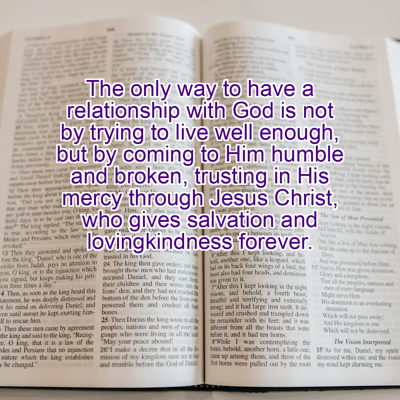
The only way to have a relationship with God is not by trying to live well enough, but by coming to Him humble and broken, trusting in His mercy through Jesus Christ, who gives salvation and lovingkindness forever.
Add this chatbot onto your site with the embed code below
<iframe frameborder="0" src="https://pastors.ai/sermonWidget/sermon/psalm-18-manuscript" width="100%" height="100%" style="height:100vh;"></iframe>Copy