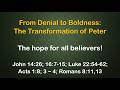
Luke 22 places Peter at the center of a stark warning: Satan will sift the disciples, and Jesus prays specifically that Peter’s faith will not fail. The narrative follows Peter’s confident vow to stand even unto death, his threefold denial by the courtyard fire, and the piercing moment when Jesus turns and looks at him—an exchange that plants the seed for restoration rather than condemnation. The text then pivots to the decisive acts that reshape everything: the resurrection and the outpouring at Pentecost. Those events move the covenant from external law to an internal work of God, where the Holy Spirit writes God’s ways on the heart and empowers ordinary people for extraordinary obedience and witness.
Acts shows the living consequence of that transformation. Peter, once silenced by fear, becomes filled with the Spirit and performs a visible miracle at the Beautiful Gate—raising a man lame from birth so that he walks, leaps, and praises God. That healing functions both as mercy and as a sign that the resurrection power of Christ breaks into human weakness, reconstituting muscle, balance, and hope in an instant. Peter uses the miracle to preach boldly, naming Jesus, confronting the very leaders who had acted against him, and declaring the exclusivity of salvation in Christ. The bold witness stirs astonishment, belief among thousands, and opposition from religious authorities who try to suppress the new movement.
The narrative ties together failure and forgiveness, warning and restoration, weakness and empowerment. Spiritual warfare and human frailty do not nullify God’s purposes; rather, they frame a gospel that forgives, restores, and commissions. The Holy Spirit functions as the decisive agent: convicting of sin, bringing righteousness into view, and granting power to speak and act. The communal response—prayer for boldness, return to Scripture, and witness in public life—becomes the practical outworking of the new covenant. The arc moves from denial to boldness, from hiding by a courtyard fire to standing in the council and declaring resurrection power, and from a crippled beggar to a living testimony that spreads in both worship and conviction. The closing charge points believers to rely on the indwelling Spirit for love, joy, courage, and sustained witness rather than on personal resolve alone.
Key Takeaways
- 1. Compassion follows failure, not condemnation Peter’s bitter weeping after denial meets Jesus’ compassionate look and a promise of prayerful restoration. That mercy interrupts shame and initiates a path back to purpose, proving that God’s discipline carries redemptive intent rather than mere reproach. Repentance therefore becomes the hinge on which deeper service swings; confession opens a door to renewed calling. [08:36]
- 2. Resurrection and Spirit change everything The resurrection and Pentecost convert legal obligation into inner transformation by writing God’s ways on the heart and gifting power for obedience. This shift makes the Christian life primarily an empowered relationship, not a listing of externals, and reframes failure as fertile ground for renewal. The new covenant reframes identity: forgiven people become empowered people. [13:25]
- 3. Boldness flows from the Holy Spirit Peter’s move from fear to fearless proclamation did not come from training or personality but from Spirit-empowerment at Pentecost. Authentic boldness issues from a cruciform courage that rests on the resurrection rather than human reputation, enabling testimony in hostile spaces. Prayer for and reliance on the Spirit cultivates speech and action that confronts both sin and spiritual forces. [16:30]
- 4. Concrete witness provokes public response The miracle at the Beautiful Gate turned private need into public proof, forcing leaders and crowds to reckon with a living sign. Tangible acts of mercy and healing authenticate verbal witness and invite both conversion and conflict; real power both attracts and unsettles. Intentional, visible compassion functions as the gospel’s spotlight in a skeptical world. [35:50]
Youtube Chapters
- [00:00] - Welcome
- [02:04] - Peter’s warning and vow
- [08:36] - Denial and Jesus’ compassionate look
- [13:25] - Resurrection and Pentecost: the shift
- [16:30] - Promise of power: Acts 1:8
- [26:07] - Healing at the Beautiful Gate
- [35:50] - Peter’s bold sermon and witnesses
- [43:44] - Council reaction and threats
- [50:37] - Call to rely on the Spirit