The true glory of God is not measured by outward success, impressive buildings, or the size of our gatherings. Instead, it is found in the quiet, abiding presence of God among His people. When we come together to worship, serve, or simply be present with one another, we are responding to a holiness that is already there—not something we create or earn. This truth frees us from the pressure to perform or to compare ourselves to others.
Even in seasons when we feel weak, uncertain, or small, God’s Spirit remains with us. Our calling is to be attentive to this presence, to rest in the assurance that God is near, and to let go of anxiety about appearances. When we focus on God’s nearness, we discover a peace that does not depend on our circumstances or achievements.
“And I will fill this house with glory, says the LORD of hosts. The silver is mine, and the gold is mine, declares the LORD of hosts. The latter glory of this house shall be greater than the former, says the LORD of hosts. And in this place I will give peace, declares the LORD of hosts.” (Haggai 2:7b-9, ESV)
Reflection: Where in your daily life do you sense God’s presence most clearly, and how can you pause today to acknowledge and rest in that presence, even if everything around you feels ordinary or unimpressive?
To remember and proclaim God’s faithfulness is more than nostalgia—it is a spiritual discipline that pushes back against despair and forgetfulness. When we recall God’s mighty acts, especially in times of uncertainty, we anchor ourselves and those around us in hope. Our praise and testimony become declarations that God’s character does not change, even when our circumstances do.
Worship and remembrance are not passive activities; they are acts of holy resistance. By choosing to remember, we refuse to let fear or discouragement have the final word. Instead, we declare that God’s steadfast love endures, and we invite others to join us in hope.
“One generation shall commend your works to another, and shall declare your mighty acts. On the glorious splendor of your majesty, and on your wondrous works, I will meditate. They shall speak of the might of your awesome deeds, and I will declare your greatness.” (Psalm 145:4-6, ESV)
Reflection: What is one specific way you can share a story of God’s faithfulness with someone today—either in conversation, a note, or a prayer?
Standing firm in faith is not about stubbornness or retreating into comfort zones. Instead, it is about being rooted in the ongoing work of God’s Spirit, allowing sanctifying grace to shape and strengthen us. We are made steadfast not by our own willpower, but by God’s transforming power at work within us.
To stand firm is to remain open to growth, to be shaped by Scripture, prayer, and the support of community. Even when the world feels unstable, God’s faithfulness is our foundation. This kind of stability is not static; it is a living witness to the world that God is still at work, making us more like Christ day by day.
“So then, brothers, stand firm and hold to the traditions that you were taught by us, either by our spoken word or by our letter. Now may our Lord Jesus Christ himself, and God our Father, who loved us and gave us eternal comfort and good hope through grace, comfort your hearts and establish them in every good work and word.” (2 Thessalonians 2:15-17, ESV)
Reflection: What is one spiritual practice—such as prayer, reading Scripture, or serving others—that you can commit to this week to allow God’s grace to deepen your roots?
Jesus’ teaching that God is “not the God of the dead, but of the living” changes how we understand loss, grief, and endings. Resurrection grace assures us that death and decline are never the final word; God’s love and covenant endure beyond every ending. For those facing personal or communal loss, this is a profound comfort and a call to hope.
The promise of resurrection invites us to live with courage, knowing that God’s life-giving power is always at work. Even in the face of grief or uncertainty, we can trust that God is bringing new life and that His story for us is not finished.
“But that the dead are raised, even Moses showed, in the passage about the bush, where he calls the Lord the God of Abraham and the God of Isaac and the God of Jacob. Now he is not God of the dead, but of the living, for all live to him.” (Luke 20:37-38, ESV)
Reflection: Where are you experiencing loss or uncertainty right now, and how might the promise of resurrection invite you to hope and act with courage today?
The call to rebuild, stand firm, and trust in resurrection life is ultimately a call to hope-filled action. God’s promise is that the “latter splendor” will be greater than the former—not because of our efforts, but because of Christ’s glory shining through us.
Our task is not to cling to the past, but to build faithfully for the future, trusting that God’s Spirit is still renewing, sanctifying, and sending us. Even small acts of faithfulness become part of God’s unfolding glory. In this work, we find peace, purpose, and the assurance that God is making all things new.
“Be strong, all you people of the land, declares the LORD. Work, for I am with you, declares the LORD of hosts, according to the covenant that I made with you when you came out of Egypt. My Spirit remains in your midst. Fear not.” (Haggai 2:4b-5, ESV)
Reflection: What is one small, concrete step you can take today to build hope for the future—either in your family, your church, or your community—trusting that God’s Spirit is with you?
of the Sermon:**
This sermon explores the enduring glory of God, especially in times when the Church feels diminished or uncertain. Drawing from Haggai, Psalm 145, 2 Thessalonians, and Luke, it reminds us that God’s presence—not our achievements—is the true source of glory. The message encourages us to remember God’s steadfastness, stand firm in faith, and trust in the resurrection promise that God is always the God of the living. Even when our efforts seem small or the world feels fragile, God’s Spirit abides with us, calling us to build for a future filled with hope and greater glory. The sermon concludes with a call to courage, faithfulness, and trust in the peace and renewal God promises.
**K
The glory that matters most is not what we build, but whom we build with. God’s presence among us—not our accomplishments—is the true source of holiness and hope, even when the church feels weary or small.
Our praise becomes resistance to despair. When we proclaim God’s faithfulness—especially in times of uncertainty—we are doing holy work, reminding ourselves and others that we will not forget who God is, even when the world feels fragile.
To “stand firm” is not to hide from the world but to stand within it—grounded in prayer, guided by Scripture, strengthened by community, and sustained by the Spirit.
The best days of God’s people are never behind them. When we look at what seems like failure, God sees future glory. Our calling is to build faithfully toward what will be, trusting the Spirit is still alive and sending us out.
Nothing—neither death, nor life—can separate us from the love of God in Christ Jesus. Every loss, every ending, every death—personal or communal—is not the final word. The final word belongs to life.
Even when our strength wanes, God’s mercy endures. Even when we don’t understand the world around us, God remains righteous in all his ways and faithful in all his works.
When churches shrink, budgets tighten, and divisions deepen, it’s easy to feel like the glory has faded. But God whispers again: “My Spirit abides among you; do not fear.”
Our calling is not to cling to what was, but to build faithfully toward what will be—trusting that the Spirit who called us is still sanctifying and sending us out in mission and service to the world.
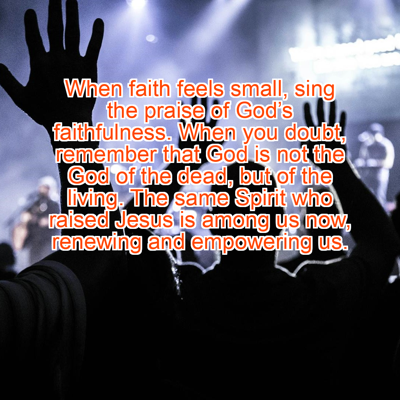
When faith feels small, sing the praise of God’s faithfulness. When you doubt, remember that God is not the God of the dead, but of the living. The same Spirit who raised Jesus is among us now, renewing and empowering us.
Add this chatbot onto your site with the embed code below
<iframe frameborder="0" src="https://pastors.ai/sermonWidget/sermon/pentecost-22c-sermon" width="100%" height="100%" style="height:100vh;"></iframe>Copy