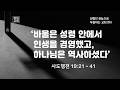
성경 읽기
Acts 19:21-41 “Now after these events Paul resolved in the Spirit to pass through Macedonia and Achaia and go to Jerusalem, saying, 'After I have been there, I must also see Rome.' And having sent into Macedonia two of his helpers, Timothy and Erastus, he himself stayed in Asia for a while. About that time there arose no little disturbance concerning the Way. For a man named Demetrius, a silversmith, who made silver shrines of Artemis, brought no little business to the craftsmen. These he gathered together, with the workmen in similar trades, and said, 'Men, you know that from this business we have our wealth. And you see and hear that not only in Ephesus but in almost all of Asia this Paul has persuaded and turned away a great many people, saying that gods made with hands are not gods. And there is danger not only that this trade of ours may come into disrepute but also that the temple of the great goddess Artemis may be counted as nothing, and that she may even be deposed from her magnificence, she whom all Asia and the world worship.' When they heard this they were enraged and were crying out, 'Great is Artemis of the Ephesians!' So the city was filled with the confusion, and they rushed together into the theater, dragging with them Gaius and Aristarchus, Macedonians who were Paul's companions in travel. But when Paul wished to go in among the crowd, the disciples would not let him. And even some of the Asiarchs, who were friends of his, sent to him and were urging him not to venture into the theater. Now some cried out one thing, some another, for the assembly was in confusion, and most of them did not know why they had come together. Some of the crowd prompted Alexander, whom the Jews had put forward. And Alexander, motioning with his hand, wanted to make a defense to the crowd. But when they recognized that he was a Jew, for about two hours they all cried out with one voice, 'Great is Artemis of the Ephesians!' And when the town clerk had quieted the crowd, he said, 'Men of Ephesus, who is there who does not know that the city of the Ephesians is temple keeper of the great Artemis, and of the sacred stone that fell from the sky? Seeing then that these things cannot be denied, you ought to be quiet and do nothing rash. For you have brought these men here who are neither sacrilegious nor blasphemers of our goddess. If therefore Demetrius and the craftsmen with him have a complaint against anyone, the courts are open, and there are proconsuls. Let them bring charges against one another. But if you seek anything further, it shall be settled in the regular assembly. For we really are in danger of being charged with rioting today, since there is no cause that we can give to justify this commotion.' And when he had said these things, he dismissed the assembly.”
[12:26]Romans 12:1-2 “I appeal to you therefore, brothers, by the mercies of God, to present your bodies as a living sacrifice, holy and acceptable to God, which is your spiritual worship. Do not be conformed to this world, but be transformed by the renewal of your mind, that by testing you may discern what is the will of God, what is good and acceptable and perfect.”
[09:27]Psalm 1:1-3 “Blessed is the man who walks not in the counsel of the wicked, nor stands in the way of sinners, nor sits in the seat of scoffers; but his delight is in the law of the Lord, and on his law he meditates day and night. He is like a tree planted by streams of water that yields its fruit in its season, and its leaf does not wither. In all that he does, he prospers.”
[15:15]Observation questions
- 로마서 12:1-2에서 성도가 이 세대를 본받지 않고 변화받기 위해 필요한 것은 무엇이며, 그 변화는 어떤 영역에서 시작됩니까? [05:30]
- 시편 1:1-3은 말씀을 즐거워하고 읊조리는 사람을 어떤 모습으로 보여 줍니까? 그 모습은 환경에 흔들리는 삶과 어떻게 대비됩니까? [09:27]
- 사도행전 19:21에서 바울은 어떤 여행 계획을 세우며, 그 계획은 어떤 방식으로 이루어집니까? [12:26]
- 에베소의 소동에서 은장색들이 바울의 복음 전파를 문제 삼은 직접적인 이유는 무엇이며, 군중은 결국 어떤 상태에 빠집니까? [20:37]
Interpretation questions
- 바울이 “성령 안에서” 자신의 길을 경영했다는 것은 단지 강한 확신을 따라 행동한 것과 어떻게 다릅니까? 말씀과 기도, 그리고 생각의 수정은 이 과정에서 어떤 역할을 합니까? [15:40]
- 복음이 아데미 신전 모형을 만드는 사람들의 생계와 충돌한 것은, 복음이 사람들의 믿음뿐 아니라 삶의 가치와 선택에도 영향을 준다는 사실을 어떻게 보여 줍니까? [21:46]
- 바울이 연극장에 들어가려 할 때 제자들과 아시아 관리들이 반복해서 막은 일은, 용기와 고집을 어떻게 구별해야 하는지 무엇을 보여 줍니까? [28:28]
- 성령의 인도하심을 따라갈 때 소동과 저항이 일어났다는 사실은, 어려움이 생길 때 그 길이 틀렸다고 곧바로 판단해서는 안 되는 이유를 어떻게 설명합니까? [15:40]
Application questions
- 말씀을 읽고 기도하는 일이 내 일상에서 자연스러운 일입니까, 아니면 시간이 남을 때만 하는 낯선 일입니까? 이번 주에 말씀을 소리 내어 읊조리는 시간을 어느 때에, 어떤 방식으로 시작해 볼 수 있겠습니까? [10:24]
- 가정이나 소그룹 안에서 말씀과 기도가 더 자연스러운 문화가 되려면, 각 사람이 부담 없이 실천할 수 있는 작은 변화는 무엇이겠습니까? 예를 들어 식사 전, 이동 중, 잠들기 전에는 무엇을 함께 해볼 수 있겠습니까? [10:14]
- 지금 내가 붙들고 있는 계획 가운데 하나님께 다시 물어야 할 일은 무엇입니까? 그 계획을 위해 말씀을 붙들고 기도하며, 필요하다면 어떤 생각이나 방향을 수정해야 하겠습니까? [14:56]
- 순종하려 할 때 생긴 어려움 때문에 멈추거나 타협하고 싶은 영역이 있습니까? 그 어려움의 크기보다 성령의 인도하심을 먼저 살피기 위해 누구와 기도하고 지혜를 나눌 수 있겠습니까? [16:52]
- 내 마음이 안전, 돈, 인정, 성공처럼 나를 잘살게 해 줄 것이라 약속하는 것에 기대고 있지는 않습니까? 그것들이 죄와 죽음의 문제를 해결할 수 없는 이유를 생각할 때, 참 하나님께 더 의지하기 위해 무엇을 내려놓거나 바꾸고 싶습니까? [21:46]
- 나의 고집을 꺾고 다른 성도의 조언을 들어야 했던 경험이 있습니까? 지금도 여러 사람을 통해 반복해서 들려오는 권면이 있다면, 그것을 하나님의 인도하심으로 분별하기 위해 어떻게 반응하겠습니까? [28:42]