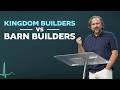
Luke lets a tense moment surface when a man in a crowd asks Jesus to settle an inheritance dispute. Jesus refuses to play judge and instead warns, “be on your guard against all greed,” because a life does not consist in the abundance of possessions. The parable of the rich man then lands like a mirror. The land produces plenty, the man plans bigger barns, he comforts his own soul with years of ease, and God calls him a fool because his soul is required that night. The point cuts through the noise: the one who lays up treasure for self and is not rich toward God dies empty.
Greed here reaches beyond cash. Covetousness shows up wherever a person gathers more than needed to feel secure, to stay in control, to justify being “right.” The crowd’s opening demand reveals that itch to be vindicated. Jesus exposes it and redirects desire: do not justify holding on to anything that has no eternal value. Only the wealth of a living relationship with God endures. That is why, in the surrounding verses, Jesus presses anxiety, provision, and trust. The Father already knows needs. “Seek the kingdom of God above all else,” because the heart always follows treasure.
The image of barns stretches into the inner life. A person can build barns in the mind, in the heart, in habits and schedules, making more and more space for comfort and control. Those barns promise ease, but they cannot carry a soul through the night. Kingdom building looks different. A disciple lays down rights to bless God, choosing what grows richness in God’s presence over what protects self. Paul agrees: faith walks by believing, not by seeing; the goal in every body is to please the Lord.
Money becomes a confessional tool here. Tithing and generous, kingdom-first giving say with actions, “God is my source.” Emotions become signals, not storage; they point back to the path that blesses God rather than demanding bigger barns to hold them. Relationships become the testing ground. Even when a person is “right,” the defensive driver inside the kingdom chooses life, not collisions, and treats the one who wronged them in ways that build the kingdom.
At the Table, the cross resets the measure. Paul warns that eating and drinking in an unworthy way is to dishonor the body, which in context is the church. Communion therefore becomes examination: What occupies space now that will vanish in God’s presence? What choices protect rights more than they bless God? What must be surrendered today? The Father delights to give the kingdom. Richness toward God begins with surrender.
Key Takeaways
- 1. Build the kingdom, not barns. The parable unmasks the urge to create more space for comfort and control. Barns can be mental, emotional, financial, or relational, but they all end in empty hands if they are not aimed at God. Richness toward God, not storage capacity, is what carries a soul through the night. [17:17]
- 2. Surrender what lacks eternal value. Jesus will not validate self-justification, even when a person looks “right.” Anxiety, entitlement, and the need to win are poor investments because they do not last before God’s face. Surrender frees the heart to seek the kingdom and trust the Father’s care. [14:46]
- 3. Lay down rights to bless God. Insisting on the right-of-way can still wreck a life; love becomes a kind of defensive driving. The kingdom way asks what most honors God, even if it costs pride, position, or payout. Being right is smaller than being rich in God. [22:46]
- 4. Examine and honor the body in communion. The Table is not routine; it is a reckoning. To eat and drink while dishonoring Christ’s body, the church, invites judgment rather than joy. Honest self-examination restores love, unity, and a Godward life that can bear the weight of glory. [25:25]
- 5. Use money to confess God as source. Firstfruits and generous giving are not God fundraising; they are soul training. Giving dethrones control, saying with action that provision rests in the Father, not in barns. Jesus always raises the bar toward kingdom building, not self-building. [19:18]
Youtube Chapters
- [00:00] - Welcome
- [05:27] - Hunger for God’s living word
- [07:22] - Four questions and SOAP
- [09:28] - Reading Luke 12:13-21
- [10:54] - Not only about rich people
- [13:05] - The brother’s demand to divide
- [14:21] - True wealth is being rich toward God
- [16:13] - Barns in mind and heart
- [17:17] - Kingdom builder or barn builder
- [18:26] - Walk by faith, aim to please
- [19:18] - Tithing and Kingdom Builders
- [20:26] - Emotions as signals to trust
- [22:46] - Defensive driving and laying down rights
- [24:20] - Communion as deep reflection
- [30:24] - Surrender fully to Jesus