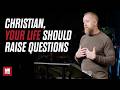
A Christian's life should be noticeably different, creating a sense of holy curiosity in those who are watching from the outside. The way believers handle money, approach marriage, and raise their children can seem alien to the surrounding culture. This distinctiveness is not meant to be odd for its own sake, but to naturally prompt questions. It is through these lived questions that opportunities arise to share the ultimate answer. [03:13]
At the same time, pray also for us, that God may open to us a door for the word, to declare the mystery of Christ, on account of which I am in prison— that I may make it clear, which is how I ought to speak.
Colossians 4:3-4 (ESV)
Reflection: Consider the circles you move in daily—your neighborhood, workplace, or family. What is one specific aspect of your life that you believe genuinely raises questions or piques curiosity about your faith in Christ?
Prayer is the essential preparation that precedes gospel mission. It is an acknowledgment that only God can truly open a person’s heart to receive the message of Christ. Believers are called to pray not only for favorable circumstances but for spiritual awakening in those around them. This prayerful dependence recognizes that any effective word spoken is preceded by God’s unseen work. [07:55]
Continue steadfastly in prayer, being watchful in it with thanksgiving. At the same time, pray also for us, that God may open to us a door for the word, to declare the mystery of Christ, on account of which I am in prison.
Colossians 4:2-3 (ESV)
Reflection: Who is one person in your life who is far from God, and how could you begin faithfully praying for God to open a door for you to share the gospel with them in a natural and clear way?
A profound shift in perspective views every difficulty as a potential setup for God’s redemptive work. Instead of praying solely for escape from hardship, one can also ask God to use their faithful response within it. Suffering, disappointment, and pain can become a powerful testimony when endured with hope. This approach turns personal trials into platforms for the gospel. [17:42]
I want you to know, brothers, that what has happened to me has really served to advance the gospel, so that it has become known throughout the whole imperial guard and to all the rest that my imprisonment is for Christ.
Philippians 1:12-13 (ESV)
Reflection: When you reflect on a current or recent challenge, how might God be inviting you to rely on Him in such a way that your response could point others toward the hope you have in Christ?
A life that raises questions is marked by three tangible qualities: godly wisdom, missional urgency, and gracious speech. Wisdom is living according to God’s design in a world that operates on contrary principles. Urgency is prioritizing eternal matters over temporary comfort. Seasoned speech is balancing truth with grace, making the message attractive without diluting it. [22:23]
Walk in wisdom toward outsiders, making the best use of the time. Let your speech always be gracious, seasoned with salt, so that you may know how you ought to answer each person.
Colossians 4:5-6 (ESV)
Reflection: Which of these three areas—wisdom in decisions, urgency with your time, or grace in your speech—feels most challenging for you right now, and what is one practical step you can take this week to grow in that area?
The core message of the gospel must be communicated with clarity and courage, not cleverness or compromise. It is the story of Christ’s perfect life, sacrificial death for sin, and powerful resurrection. This message possesses inherent power that a sanitized version lacks. Holding firmly to this truth, even when it is counter-cultural, is what truly transforms lives. [11:52]
For I am not ashamed of the gospel, for it is the power of God for salvation to everyone who believes, to the Jew first and also to the Greek.
Romans 1:16 (ESV)
Reflection: In your own words, how would you explain the core message of the gospel to someone who has never heard it, ensuring you include both the reality of sin and the hope of redemption through Jesus?
Colossians 4 presents “open doors” as the fruit of prayer, distinct Christian living, and plain proclamation. Prayer receives primary emphasis: prayer precedes mission and requests God to open doors so the word may move into lives and circumstances. The apostle’s model appears in GIF form — imprisoned yet praying not for personal release but for gospel access — which reframes setbacks as potential setups for evangelistic opportunity. Clear proclamation matters; the gospel must be declared plainly, not dressed up for cultural comfort. The text insists on speaking the crucifixion and resurrection with uncompromised clarity because power to change lives rests in the straightforward gospel.
Distinctive living creates curiosity. When lives reflect God’s wisdom in money, family, parenting, and sacrificial mission priorities, outsiders notice an alien culture and begin to ask questions. The passage pulls these strands together under three practical marks that open doors: walking in wisdom, acting with urgency because time is short, and choosing speech that is gracious and seasoned with salt. Those three virtues shape how a believer becomes an attractive anomaly rather than another noisy voice in the crowd.
Seasoned speech means refusing blunt slogans that wound the very people the gospel intends to reach; truth and grace must marry so proclamation invites inquiry rather than shuts conversation. Urgency shows in sacrificial choices — vacation days repurposed for mission, retirement years reallocated to foster care — choices that prompt others to ask why a life looks different. Wisdom shows in everyday disciplines that resist cultural idols: financial prudence, humble parenting, and marriage modeled on sacrificial leadership.
Application lands on personal sanctification and corporate imagination. Individuals should identify areas that look indistinguishable from the surrounding culture and repent; communion functions as the communal practice that exposes sin, reminds of Christ’s torn body and spilled blood, and reorients identity. At a congregational level, pursuing a bold vision — for example, thousands of chosen children touched through adoption and foster care — would generate communal questions and a multitude of gospel opportunities. The trajectory is simple and urgent: pray for open doors, live lives that raise questions, and speak the gospel clearly when those doors open.
It really is this simple. Are we living a life in which we get a chance to give answers because people are asking us questions? By the way we parent, marriage, handle money, all that kind of stuff. The way we're wise, the way we have an urgency for the mission. Man, the way that we season our speech, and we don't just go along with the crowds. Right? That we stand and we say, no. This is true. This is what I'm gonna say. This is how I'm gonna say it. Or are there parts of our life that just look like the world?
[00:31:39]
(31 seconds)
#LiveDistinctively

I just think it needs to have a little bit of this Pauline theology put into it where we realize, hey. Yes. We want safety. Yes. We want people to maybe even be able to get out of different situations or or whatever. But at the same time, god used how we react to those situations as a way that opens doors for the gospel because after all, that is our mission. That is what we're after. You know, what you can say it like this. What if we saw every setback in life is a setup of what God's about to do?
[00:17:21]
(29 seconds)
#SetbacksAreSetups
Add this chatbot onto your site with the embed code below
<iframe frameborder="0" src="https://pastors.ai/sermonWidget/sermon/open-doors-colossians-4-2-6" width="100%" height="100%" style="height:100vh;"></iframe>Copy