Matthew shows that God does not wait for neatness before entering human mess; he steps into engagement, scandal, confusion, and daily life through a birth that upends expectations. Jesus' coming is not a sanitized postcard; it is Emmanuel—God with us—moving into the ordinary and chaotic places people actually live. This is the heart of Advent: God choosing to be present in the very stuff that feels untidy and uncertain. [25:22]
Matthew 1:18-23 (ESV)
18 Now the birth of Jesus Christ took place in this way. When his mother Mary had been betrothed to Joseph, before they came together she was found to be with child from the Holy Spirit. 19 And her husband Joseph, being a just man and unwilling to put her to shame, resolved to divorce her quietly. 20 But as he considered these things, behold, an angel of the Lord appeared to him in a dream and said, "Joseph, son of David, do not fear to take Mary as your wife, for that which is conceived in her is from the Holy Spirit. 21 She will bear a son, and you shall call his name Jesus, for he will save his people from their sins." 22 All this took place to fulfill what the Lord had spoken by the prophet: 23 "Behold, the virgin shall conceive and bear a son, and they shall call his name Immanuel" (which means, God with us).
Reflection: What one “messy” area of your life have you been trying to hide or fix before inviting God in, and what would it look like to intentionally welcome Emmanuel into that exact place this week?
From Eden forward, God plants a promise in the heart of exile: a coming offspring who will break the power of the serpent and begin the journey homeward. That initial word offers a tether for longing—an assurance that the ache of being displaced is not the final word. Advent is breathing into that ancient hope and remembering that the promise itself shaped the people’s waiting. [09:42]
Genesis 3:15 (ESV)
"I will put enmity between you and the woman, and between your offspring and her offspring; he shall bruise your head, and you shall bruise his heel."
Reflection: When you feel exiled—displaced, lonely, or far from God—which element of the gospel promise (presence, rescue, restoration) do you most need to hold onto, and what small practice will help you hold it this week?
Isaiah’s sign to Ahaz reminds a frightened people that God’s answer to political and personal chaos is not more strategy but his own presence, delivered in a child named Immanuel. That promise reframes fear: even when alliances collapse and enemies circle, God has not left the room. Advent invites trust in God’s nearness more than in temporary fixes. [16:49]
Isaiah 7:14 (ESV)
Therefore the Lord himself will give you a sign. Behold, the virgin shall conceive and bear a son, and shall call his name Immanuel.
Reflection: Identify a current fear or decision that tempts you to make quick bargains for security; how would remembering "God with us" change the first practical step you take about it this week?
Isaiah paints the picture of people living in deep darkness who suddenly see a great light—the solution comes not as political might but in a vulnerable child who embodies counsel, strength, and peace. The child’s titles show that salvation is personal and practical: wisdom for confusion, power for weakness, steadiness for instability, and peace for chaos. Advent sings of a dawn that breaks slowly but surely into every weary place. [19:27]
Isaiah 9:2, 6 (ESV)
2 The people who walked in darkness have seen a great light; those who dwelt in a land of deep darkness, on them has light shone.
6 For to us a child is born, to us a son is given; and the government shall be upon his shoulder, and his name shall be called Wonderful Counselor, Mighty God, Everlasting Father, Prince of Peace.
Reflection: Which title of the coming Child (Wonderful Counselor, Mighty God, Everlasting Father, Prince of Peace) resonates most with the exact darkness you face, and what is one concrete way to invite that aspect of Jesus into your situation today?
Paul reminds the church that all creation groans and so do we, yet the Spirit joins our groaning and builds a hope that is anchored not in what is seen but in what God has promised. Advent calls for active waiting: preparing rooms, tending hearts, and practicing patience because God’s “shall come” is trustworthy. Rejoice now because of what God has done and wait faithfully because of what he will complete. [30:17]
Romans 8:22-25 (ESV)
22 For we know that the whole creation has been groaning together in the pains of childbirth until now. 23 And not only the creation, but we ourselves, who have the firstfruits of the Spirit, groan inwardly as we wait eagerly for adoption as sons, the redemption of our bodies. 24 For in this hope we were saved. Now hope that is seen is not hope. For who hopes for what he sees? 25 But if we hope for what we do not see, we wait for it with patience.
Reflection: What is one practical, faithful activity (prayer, service, confession, Sabbath, reconciliation) you will commit to this Advent season as a way of “active waiting,” and when will you do it each week?
We opened Matthew 1:18–23 and sat with a name that tells the whole story: Emmanuel—God with us. Advent teaches me to live in two directions at once. I look back to Bethlehem, to a manger that led to a cross and an empty tomb. And I look forward with aching hope for the day Jesus returns and makes all things new. Advent refuses our “skip intro” habits; it slows us down enough to feel the ache, to name the exile we live in—those places where life isn’t how it’s supposed to be—and to wait for real hope.
That ache goes all the way back to Eden. When sin entered, exile began, and humanity has been homesick ever since. But right in the middle of that heartbreak, God promised a child who would crush the serpent’s head. Isaiah picks up that promise: “The virgin will conceive… and call him Emmanuel,” and “The people walking in darkness have seen a great light.” That light is dayspring—the quiet, steady dawn that tells you night isn’t permanent.
Matthew shows how the light actually breaks in. It’s not tidy. It’s a complicated pregnancy, a confused fiancé, and an angel telling Joseph, “Do not be afraid.” This is what God is like. He doesn’t shout from a distance. He moves into the neighborhood. The answer to exile isn’t a system or a strategy; the answer is a presence—a person—Jesus. He is with us, and He has come to ransom us.
Romans 8 gives us the feel of our in-between: creation groans, we groan, and even the Spirit groans on our behalf. So we learn the difference between being hopeful for and hopeful in. Hopeful for wants circumstances to change; hopeful in rests in the unchanging Christ even if circumstances don’t budge. That’s why Advent waiting is active. We prepare rooms and hearts because a promised Someone is on the way. So we lit one small candle—not the sunrise, but a sign that dawn is certain. In your grief, anxiety, or numbness, pray the simplest prayer: “Come, Lord Jesus, into…” and fill in the blank. He meets us right there.
- Matthew 1:18–23 (ESV) — 18 Now the birth of Jesus Christ took place in this way. When his mother Mary had been betrothed to Joseph, before they came together she was found to be with child from the Holy Spirit. 19 And her husband Joseph, being a just man and unwilling to put her to shame, resolved to divorce her quietly. 20 But as he considered these things, behold, an angel of the Lord appeared to him in a dream and said, “Joseph, son of David, do not fear to take Mary as your wife, for that which is conceived in her is from the Holy Spirit. 21 She will bear a son, and you shall call his name Jesus, for he will save his people from their sins.” 22 All this took place to fulfill what the Lord had spoken by the prophet: 23 “Behold, the virgin shall conceive and bear a son, and they shall call his name Immanuel” (which means, God with us).
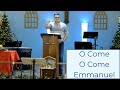
And what the church does at this time of the year, especially what we do at this time of the year, is we kind of join in with the ancient tradition of the church with a, hold up, let's slow down. We need to feel the weight of this moment. And we call this Advent. It's what we call this time of the year Advent in the church calendar. And that word itself actually comes from a Latin word that I'm not going to butcher this morning because I'm just not that guy, okay? I'm not even going to attempt it. But it comes from a Latin word that we get Advent from and it simply means this. It means a coming or an arrival. [00:03:49] (34 seconds) #AdventArrival
And in the earliest days of the church, when they celebrated Advent, when they participated in this time leading up to Christmas Day, it carried with us all of this emotional weight, this sense of anticipation, this sense of preparation, and even like this joyful tension for the coming of Jesus. And why is that? Well, it's simply because Advent has two directions. There are two directions in Advent. Of course, there's the one looking backwards, you know, with Bethlehem and a manger and a baby and all that that baby came to be, Jesus himself with all that he did, all that he said, and wrapped up within it the cross and the resurrection, all of that stuff. [00:04:24] (42 seconds) #AdventBackAndForward
And from that moment on, when they left the garden, when they left God's presence, people have been homesick. We're just homesick. We long for another world. We long for the way things should be and we have been spiritually searching. We've been reaching for a light switch in the dark ever since that moment. And the whole story of the Bible has a hint of what took place here. This idea of we were with God. Well, we messed that up. And God all the while is doing what? He's telling people, hold on. I'm coming. Hold on. You will be with me again. Hold on. There will be something good to come out of this. [00:09:51] (37 seconds) #HoldOnHeComes

And before we just make this word simply on a screen or on a page or a thought in your head, I want you to understand that all of us know what this ache feels like. It happens when faith feels dry. I don't think anyone in this room, if we're completely honest with ourselves, cannot say that there's not been a moment that faith has not felt dry. It also is when grief, when grief sneaks in your head at 1130 at night. For me, it's sometimes two in the morning. Others of you, it could be at different times of the day, but you know when grief sneaks in. How about this? When anxiety doesn't quiet down. [00:11:22] (36 seconds) #FaithInTheDark
And before we just make this word simply on a screen or on a page or a thought in your head, I want you to understand that all of us know what this ache feels like. It happens when faith feels dry. I don't think anyone in this room, if we're completely honest with ourselves, cannot say that there's not been a moment that faith has not felt dry. It also is when grief, when grief sneaks in your head at 1130 at night. For me, it's sometimes two in the morning. Others of you, it could be at different times of the day, but you know when grief sneaks in. How about this? When anxiety doesn't quiet down. [00:11:22] (36 seconds) #GriefSneaksIn
And before we just make this word simply on a screen or on a page or a thought in your head, I want you to understand that all of us know what this ache feels like. It happens when faith feels dry. I don't think anyone in this room, if we're completely honest with ourselves, cannot say that there's not been a moment that faith has not felt dry. It also is when grief, when grief sneaks in your head at 1130 at night. For me, it's sometimes two in the morning. Others of you, it could be at different times of the day, but you know when grief sneaks in. How about this? When anxiety doesn't quiet down. [00:11:22] (36 seconds) #AnxietyAtTwoAM
Or when relationships feel complicated or fractured or that this will never, this will never work. Or how about this? It's when you scroll your news feed for 10 seconds and you're like, cool, the world's on fire. Everything's floating away from me. We know what that feels like. And God's people have known that for all time. That is a feeling of exile. That is the feeling of the human heart saying, Lord, come and fix this because this is not how the world is supposed to be. Come be with us. And that's why that carol you all sing this morning, that's why it hits so hard. That's why that carol hits like it does. [00:11:58] (35 seconds) #HomesickForHome
Can I tell you something? That's not just Israel's song. That's still our song in many ways today. We mourn in loneliness sometimes. Until what? Until the Son of God appears in our lives. Until we see God's promises. Until we see the light break in. And that song carries the heartbeat that has pulsed throughout the lives of God's people for thousands and thousands of years. Now, what we have right here is, I actually fashioned this yesterday, so don't ever come up here and touch this, okay? This thing will fall apart, it will fall on the floor, and something will get broken. [00:12:47] (38 seconds) #LongingForLight
Add this chatbot onto your site with the embed code below
<iframe frameborder="0" src="https://pastors.ai/sermonWidget/sermon/o-come-emmanuel" width="100%" height="100%" style="height:100vh;"></iframe>Copy