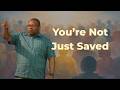
A man once lived naked among graves, howling in chains. After encountering Jesus, he sat clothed at His feet—no longer defined by chaos but anchored in peace. This transformation mirrors every believer’s journey: from spiritual isolation to intimate connection. New life in Christ isn’t about self-improvement but radical reorientation. The healed man’s first instinct was to stay near Jesus, yet purpose awaited beyond that moment. True deliverance reshapes both identity and mission. [08:24]
“And they came to Jesus and found the man from whom the demons had gone, sitting at the feet of Jesus, clothed and in his right mind.” (Luke 8:35, ESV)
Reflection: What areas of your life still feel like “tombs”—places of isolation or bondage—that Jesus is inviting you to leave? How might sitting at His feet today prepare you to stand tomorrow?
Workers who install new roofs leave signs proclaiming who did the work. Similarly, believers carry stories of Christ’s renovation in their lives. The demoniac didn’t need a theology degree to testify—he simply declared what God had done. Our credibility comes not from expertise but from authentic experience. Every healed marriage, renewed mind, or sustained hope becomes a marker pointing others to the Builder. [23:42]
“Come, see a man who told me all that I ever did. Can this be the Christ?” (John 4:29, ESV)
Reflection: What “renovation” has Jesus done in your life that others might notice? Who needs to hear the name behind the change?
The demoniac’s region sat in spiritual darkness until one man’s testimony illuminated it. Like flashlights in a blackout, believers carry stories that pierce despair. Witnessing isn’t about answering every doctrinal question but shining light on what we’ve seen. The man born blind told skeptics, “I was blind, now I see”—his story trumped their arguments. Our task is to flip the switch, not wire the grid. [30:48]
“One thing I do know, that though I was blind, now I see.” (John 9:25, ESV)
Reflection: When have you hesitated to share your story because you felt unprepared? What single “flashlight moment” could you offer someone this week?
Jesus sent the healed demoniac back to the people who’d seen him at his worst—the very community that had feared and rejected him. Our most powerful testimonies often bloom where we were once rootless. The places of our past shame become platforms for God’s present grace. Ministry begins not with crossing oceans but crossing streets. [12:47]
“Return to your home, and declare how much God has done for you.” (Luke 8:39, ESV)
Reflection: Who from your “before Christ” days needs to encounter your “after deliverance” story? How might your history with them become a bridge?
The demoniac testified under no spiritual influence—yet his words stirred a region. Believers today speak with the Holy Spirit’s power, amplifying ordinary stories into divine invitations. If a man once controlled by a legion of demons could spark revival, how much more can Spirit-filled saints ignite hope? Our inadequacy is God’s microphone. [27:20]
“But you will receive power when the Holy Spirit has come upon you, and you will be my witnesses.” (Acts 1:8, ESV)
Reflection: Where have you relied on your own eloquence instead of the Spirit’s prompting? How might trusting His power change your next conversation?
Luke shows Jesus landing in Gentile country and meeting a man overrun by demons, naked, isolated, and living among the tombs. Jesus names the darkness, drives it out, and the man is found clothed, seated at his feet, and in his right mind. That scene paints the BC to AD shift, not anno domini but after deliverance, where Jesus gives peace and a whole new life. Jesus then stretches the picture. He grants peace and also hands purpose, telling the man to go home and declare how much God has done. Knowing Jesus is enough for salvation and peace, but the text refuses the idea that knowledge is all there is to maturity. In Christ, a disciple is not just saved, but sent.
The Great Commission confirms it. Jesus claims all authority and commands his followers to go, make disciples, baptize, and teach. Sitting at his feet remains good, as Mary showed, but sitting is not the finish line. Sent-ness belongs inside discipleship. Consumer Christianity says feed me, like that hungry plant, and calls it growth. Jesus calls that immaturity and even disobedience when the going never follows the sitting. The degree-without-a-job picture nails it. Accumulated credits without contribution is wasteful, and in the kingdom it edges into irresponsibility.
Luke’s delivered man models the remedy. He carries no degrees, no polished theology, only a clear witness. Jesus loads him with a simple assignment. Tell what God did. Acts 1 says the Spirit makes witnesses, not bystanders. A witness does not just experience something, a witness speaks to what was seen and heard. The excuses fall off in the light of that call. Not every question needs a perfect answer. A true story told in genuine faith travels with power.
The images lock in the charge. A new roof comes with a yard sign so the neighbors know who did the work. A redeemed life should name the Redeemer. The man born blind kept it simple. I was blind, now I see. Acts starts at home for a reason. Jesus sent the delivered man home first. If a legion could manifest destructive power, how much more should the Holy Spirit animate holy courage. The flashlight is already in the hand. Outside, it is pitch dark. The call is simple and urgent. Turn it on at home, at work, at school. Share the story God is writing, because in Christ the miracle in one life is meant to begin a miracle in someone else.
That knowing Jesus, I'm a put it that way, is enough. I know somebody's ready to be like, wait a minute. That's a record scratch. What do you mean that's not true? It is true in the sense that knowing Jesus is enough to be saved. It is absolutely true that knowing Jesus is enough to find peace. Knowing Jesus is is enough to find satisfaction. But where it's not true is in regards that knowing Jesus is not all there is to being a disciple of Jesus.
[00:10:48]
(46 seconds)
But we can get in this very comfortable place and think, you know, I just wanna be fed. You know, this whole consumer Christianity. Feed me. I don't know if you ever saw a little shop of horrors, that that giant Venus flytrap. Feed me, Seymour. And we can live like that. And think it's maturity, But if you stay there, it's actually immaturity. It's not just immaturity, it's disobedience.
[00:16:20]
(33 seconds)
But I want you to understand, it's light on the inside. It's pitch black outside. I'm saying outside, the people of God, outside of those who know Christ, is pitch black. And they're hurting themselves, and they're hurting one another. But God has given you a flashlight, your story about who changed your life. You need to turn it on. You need to turn it on. Turn it on. Turn it on at home. Turn it on at school. it on. Help someone else move from their b c to a d.
[00:31:15]
(60 seconds)
I want you to kinda think about this man, this man who is filled with evil and controlled by evil, bound by it. He's bound in the sense that he is naked, isolated, and living amongst the tombs, living in the cemetery. And if there's a picture of brokenness, I think that's a picture of brokenness. Right? Filled with evil, isolated, and living amongst the dead. That's how we all live apart from Christ Jesus.
[00:06:57]
(31 seconds)
I'm an AI bot trained specifically on the sermon from Jun 03, 2026. Do you have any questions about it?
Add this chatbot onto your site with the embed code below
<iframe frameborder="0" src="https://pastors.ai/sermonWidget/sermon/not-just-saved-sermon" width="100%" height="100%" style="height:100vh;"></iframe>Copy