Jul 01, 2026
Jesus gathered His friends in an upstairs room. He washed their feet. He knew Judas would betray Him. In those final hours, Jesus gave them a new commandment. He told them to love one another just as He had loved them. This command was different from the old law. The old law said to love your neighbor as yourself. Jesus set a new standard. He said to love others as He loved them.
Jesus loved them by serving them. He loved them by laying down His life. This is the love He commands from His followers. He said the world would know we belong to Him by this love. Our relationships prove our faith. The world reads our love for each other, not our doctrinal statements.
You are called to love with this same sacrificial love. This love starts not with your effort, but with receiving His love for you. Hear His command to love as He loves. Then let that love flow into your relationships. Where is one relationship where you can choose sacrificial love this week?
“A new commandment I give to you, that you love one another: just as I have loved you, you also are to love one another. By this all people will know that you are my disciples, if you have love for one another.”
(John 13:34–35, ESV)
Prayer: Ask God to show you one person to love today with the same selfless love Jesus has for you.
Challenge: Text one person in your church family a specific message of encouragement or thanks.
Some people see the church as a museum. They think it is a place for perfect people. They see polished lives behind glass. They feel they cannot enter because they are broken. But Jesus never intended His church to be a museum. He designed it to be a hospital. A hospital is full of people in various stages of healing.
A hospital expects sick people. It exists for their recovery. The church is a community of broken people finding healing in Christ. We do not have love all figured out. We are learning to love together. Our honest, imperfect fellowship is our witness. The world is desperate to see real people loving each other through grace.
You do not need to hide your wounds. The church is your hospital. You can come as you are. You can find healing in this community. Are you willing to be honest about your need for healing and help from others?
“And they devoted themselves to the apostles' teaching and the fellowship, to the breaking of bread and the prayers. And awe came upon every soul, and many wonders and signs were being done through the apostles. And all who believed were together and had all things in common.”
(Acts 2:42–44, ESV)
Prayer: Confess to God one area where you have been pretending to have it all together.
Challenge: Share one personal struggle with a trusted believer in your church this week.
Imagine a city block. One house on that block is different. The porch light is always on. The door is open. Soup appears when someone is sick. Jumper cables are ready for a dead battery. A listening ear is available for a hurting marriage. This one house changes the whole street. It thaws isolation. It makes the neighborhood more human.
Jesus said you are the light of the world. Your church is meant to be that house for your city. You are God’s presence in your neighborhood. The love you receive and practice inside the church is meant to spill outside. You carry this light into your actual neighborhood, workplace, and family.
You are a missionary to a mission field only you can reach. You have neighbors no pastor will ever meet. How can your home become a place where the porch light of God’s love is always on?
“You are the light of the world. A city set on a hill cannot be hidden. Nor do people light a lamp and put it under a basket, but on a stand, and it gives light to all in the house. In the same way, let your light shine before others, so that they may see your good works and give glory to your Father who is in heaven.”
(Matthew 5:14–16, ESV)
Prayer: Ask God to make your home a place of warm welcome and practical love for your neighbors.
Challenge: Intentionally greet one neighbor by name today and ask how they are doing.
The first believers in Jerusalem devoted themselves to important practices. They learned from the apostles. They shared life in fellowship. They broke bread together. They prayed. They went deep with each other. But this love was not meant to stay inside. It spilled into their homes and their city.
They received their food with glad and generous hearts. They had favor with all the people. Their love was so real and warm that the neighborhood noticed. People were drawn to them. The Lord added to their number daily. Their evangelism was the natural overflow of their loving community.
The love you receive on Sunday is fuel for scattering on Monday. Your church gathers to be equipped to scatter. What is one way you can let the love you’ve received in church spill out to someone beyond it this week?
“And day by day, attending the temple together and breaking bread in their homes, they received their food with glad and generous hearts, praising God and having favor with all the people. And the Lord added to their number day by day those who were being saved.”
(Acts 2:46–47, ESV)
Prayer: Thank God for one specific way you have experienced love from your church family.
Challenge: Invite one person from your neighborhood or workplace into your home for a meal or coffee.
On the night He gave the new commandment, Jesus took bread. He gave thanks and broke it. He said it was His body, broken for them. Then He took the cup. He said it was the new covenant in His blood. This was the ultimate demonstration of “as I have loved you.” He gave His body and poured out His blood.
This table is not for the flawless. It is food for the broken. It is strength for those in recovery. Here, you remember you were loved first. You receive the grace to love others. You bring your lists and your neighbors to this table. You find the power to love them not just for a season, but for good.
Come to this table as you are. Receive His love for you. Will you let His sacrificial love empower you to love that one person on your list with a lasting, patient love?
“For as often as you eat this bread and drink the cup, you proclaim the Lord's death until he comes.”
(1 Corinthians 11:26, ESV)
Prayer: Ask Jesus to make His love for you so real that it overflows into your love for others.
Challenge: Write the name of one person you are committing to love intentionally and pray for them daily.
Six weeks of teaching culminates in a single, decisive claim: Jesus' new commandment—"love one another as I have loved you"—reorients neighborliness around sacrificial, incarnational love and makes the local congregation the primary place that love is learned, practiced, and sent. The phrase "as I have loved you" raises the demand from a self-referential ethic to the cross-shaped standard of service and self-giving that Jesus modeled at the Last Supper. That mutual, costly love among believers becomes the definitive witness the watching world uses to identify Jesus' followers; relationships, not programs or statements of faith, carry credibility.
The local church functions as the matrix in which roots take hold, compassion forms, and habitual neighbor-love becomes possible. Community provides the greenhouse where people receive love, practice loving, and grow in the habits that spill into everyday life. Incarnation is emphasized not only as a doctrine but as a method: after the Ascension God continues to be present in the world through embodied people—neighbors, coworkers, friends—who bear Christ's presence into ordinary places.
The congregation gets reframed as a hospital for sinners in recovery rather than a museum for polished saints. Brokenness and ongoing healing mark the reality of Christian community; authenticity in struggle, held together by grace, functions as a stronger witness than artificial perfection. The example of the first Christians in Acts 2 shows the pattern: devoted fellowship and shared life drew outsiders in because the love inside overflowed into homes and streets, producing favor with the neighborhood and steady growth.
That overflow issues in a practical commission: Sunday gathering exists to enable Monday scattering. The image of the house with the porch light on captures the aim—an open, warm, hospitable community that changes the temperature of a block by being visibly, tangibly present. The closing charge centers on permanence and practice: commit to one ongoing neighborly relationship, cultivate the church as a hospitable place for the wounded, and pray daily to be made a neighbor. Communion anchors the call—Christ’s broken body and poured-out blood constitute both the source of the love commanded and the power by which believers are sent into their neighborhoods as living proof of the gospel.
The watching world doesn't read our statement of faith. It reads our relationships.
Love one another the way I have loved you — sacrificially, humbly, all the way to the cross.
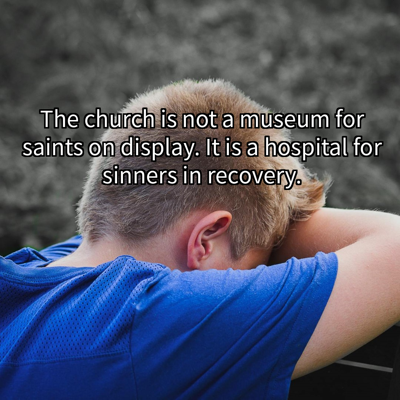
The church is not a museum for saints on display. It is a hospital for sinners in recovery.
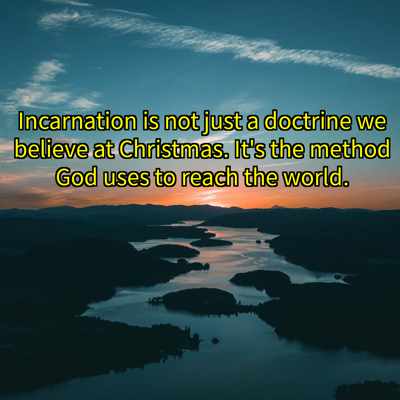
Incarnation is not just a doctrine we believe at Christmas. It's the method God uses to reach the world.
He doesn't mostly reach people through programs, broadcasts, or even sermons. He reaches them through skin-on-skin, face-to-face people who love them.
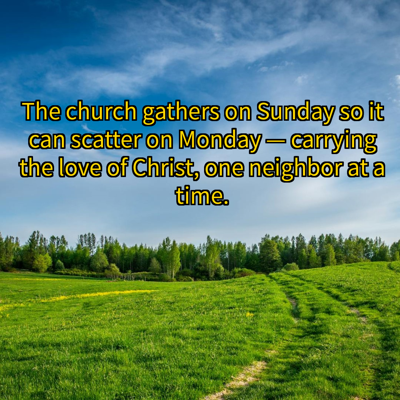
The church gathers on Sunday so it can scatter on Monday — carrying the love of Christ, one neighbor at a time.
The right question was never who qualifies for my love. The right question was always: will I be a neighbor?
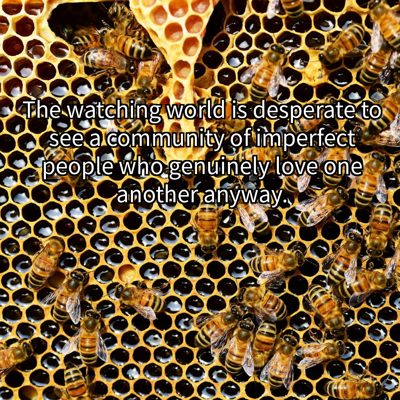
The watching world is desperate to see a community of imperfect people who genuinely love one another anyway.
Every one of you walks out of here as a missionary to a mission field no one else can reach.
Hi, I'm an AI assistant for the pastor that gave this sermon. What would you like to make from it?
Add this chatbot onto your site with the embed code below
<iframe frameborder="0" src="https://pastors.ai/sermonWidget/sermon/new-commandment-church-neighborhood" width="100%" height="100%" style="height:100vh;"></iframe>Copy