Jesus teaches that forgiveness is not about counting offenses or keeping score. When Peter asks for a limit, the answer points away from arithmetic and toward a habit of heart: a readiness to forgive again and again. Forgiveness is the posture of one who has been forgiven much; it refuses to treat relationships like bank accounts where debts are itemized and tallied.
You are invited to practice a forgiving spirit today. That means choosing not to replay offenses in private, not to rehearse grievances at the table or in prayer, and to let mercy move first when someone hurts you. The goal is not merely outward civility but a transformed heart that looks for restoration, not retaliation.
Numbers 14:18 (ESV)
The LORD is slow to anger and abounding in steadfast love, forgiving iniquity and transgression, but he will by no means clear the guilty, visiting the iniquity of the fathers on the children to the third and fourth generation.
Reflection: Name one person you have recently held a small offense against. What is one concrete, humble step you can take today (a short prayer, a text, a changed response) to begin refusing to keep a ledger in that relationship?
The measure of how freely you forgive others often shows how deeply you’ve received God’s mercy. The parable places two debts side by side: one enormous and unpayable, the other small—but the servant treats them as if they were equal. That contrast exposes a heart that has not fully grasped what was given to it.
Examine how you talk about your own forgiveness story. If you struggle to forgive, ask whether you really rest in the magnitude of God’s pardon. The more you remember the cost and the breadth of mercy extended to you, the more natural it becomes to extend mercy to others—not out of obligation but as a grateful overflow.
Micah 7:18-19 (ESV)
Who is a God like you, pardoning iniquity and passing over transgression for the remnant of his inheritance? He does not retain his anger forever, because he delights in steadfast love. He will again have compassion on us; he will tread our iniquities underfoot. You will cast all our sins into the depths of the sea.
Reflection: This week, write one short sentence describing how God has forgiven you (be specific). Keep it where you will see it daily and, when an old grievance rises, read that sentence aloud and ask God to enlarge your memory of his mercy before you respond.
Unforgiveness is not a private sin—its effects spread. In the parable, fellow servants were grieved when they saw mercy withheld; bitterness started in one life but wounded the whole household. The life of the church depends on members who refuse to let a root of bitterness take hold.
Take seriously the ways your unresolved hurts affect others. Bitterness changes the tone of worship, the shape of conversations, and the willingness of people to trust. Pursue reconciliation not only for your own peace but for the health of the whole body. Small, courageous acts of humility can prevent a wound from turning septic.
Hebrews 12:15 (ESV)
See to it that no one fails to obtain the grace of God; that no "root of bitterness" springs up and causes trouble, and by it many become defiled;
Reflection: Identify one relationship where a lingering hurt affects more than just you (family, small group, workplace). What is one concrete, humble action you can take in the next 48 hours to begin healing that wound (a phone call, a message asking to talk, a short apology)?
Forgiving someone may cost you something—peace, reputation, comfort—but the cost of Christ’s forgiveness was infinitely greater. The king in the parable paid dearly so the servant could go free. Remembering that cost reorders what we value and makes our sacrifices feel proportionate to the mercy we’ve received.
Let the memory of Christ’s price shape your responses. When forgiveness asks you to bear loss or endure discomfort, recall that you were set free at a greater cost. That truth does not make forgiveness easy, but it anchors and empowers you to choose mercy even when it hurts.
1 Peter 1:18-19 (ESV)
knowing that you were ransomed from the futile ways inherited from your forefathers, not with perishable things such as silver or gold, but with the precious blood of Christ, like that of a lamb without blemish or spot.
Reflection: Think of a current grievance that would cost you to forgive (time, resources, reputation). List the specific "costs" and then write a short sentence comparing them to what Christ paid for you. How does that comparison change one practical choice you can make today?
Persistent, heart-level refusal to forgive exposes a heart that has not been transformed by grace. It’s not about losing salvation by a single failure; it’s about recognizing that a life defined by bitterness and withholding mercy is inconsistent with one that has been truly reconciled to God. The parable ends with a sobering reminder: mercy received should lead to mercy given.
Take this as a call to honest self-examination. If you find yourself habitually unforgiving, do not hide behind excuses. Repent, renew your dependence on Christ’s mercy, and let community hold you accountable. A changed heart shows itself in changed actions—mercy, humility, and a refusal to live with a grudging spirit.
1 John 4:20-21 (ESV)
If anyone says, "I love God," and hates his brother, he is a liar; for he who does not love his brother whom he has seen cannot love God whom he has not seen. And this commandment we have from him: whoever loves God must also love his brother.
Reflection: Are there patterns in your life that show an ongoing reluctance to forgive (gossip, avoidance, repeated complaining)? Choose one pattern and name a first accountability step you will take this week (share it with a friend, a mentor, or your small group) to begin turning toward genuine change.
This sermon explores the heart of forgiveness among God’s children, focusing on Matthew 18:21-35. The passage begins with Peter’s question about the limits of forgiveness, to which Jesus responds that there should be no limit—God’s children are to forgive one another endlessly. Jesus illustrates this with a parable about a servant forgiven an unimaginable debt by his king, who then refuses to forgive a much smaller debt owed to him by a fellow servant. The parable reveals the absurdity and wickedness of receiving immense mercy from God yet withholding it from others. The sermon presses home that true forgiveness is a mark of those who have genuinely experienced God’s mercy, and that unforgiveness and bitterness are not only destructive to individuals but to the whole church. Ultimately, the call is to recognize the infinite cost of our own forgiveness and to extend that same mercy to others, from the heart.
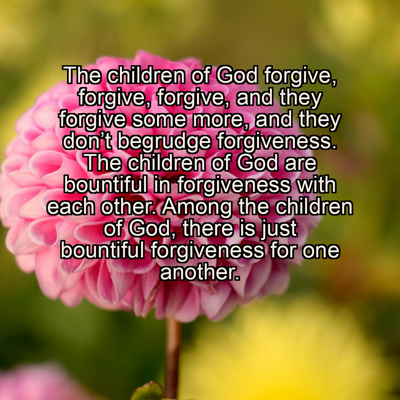
The children of God forgive, forgive, forgive, and they forgive some more, and they don’t begrudge forgiveness. The children of God are bountiful in forgiveness with each other. Among the children of God, there is just bountiful forgiveness for one another.
The point Jesus is making is that there is no limit—you are looking for the limitations, and I am telling you that there is no limit. You must not limit the number; you must continue to forgive, and forgive, and forgive.
Bitterness, unforgiveness—someone might think that is between two people only. Not in the church it isn’t. In the church, that impacts us all. It grieves the whole church when we refuse to forgive.
Salvation is not free to God. When this king in the parable forgave the ten thousand talents, it was free to the one who received it, but it was costly to the king, and so it is with our God.
How inconceivable is it then, to have that transaction completed by God’s mercy, and then to go out from that transaction and refuse to forgive someone else? This is unthinkable, unimaginable.

We live under the obligation of forgiven people, that goes beyond comprehension, and therefore, we forgive others what they do against us.
If your life does not portray mercy, especially to the children of God, then you have no right to call yourself a child of God.

Forgiveness is costly, but you are claiming to be one who has had an infinite debt that has been paid by Christ. Why would you worry about the small cost you might have to pay for someone else’s sin against you?
Once you have experienced mercy, you will realize that the bitterness you hold is so foolish, so dumb, so ridiculous, and God will help you to become a new creation, who can freely give forgiveness because you could never give away more than you have been given.
God’s children forgive one another, get that in your head, take that with you, God’s children forgive one another, because God has forgiven all of His children, and we forgive from our hearts, because our hearts are so grateful.
Add this chatbot onto your site with the embed code below
<iframe frameborder="0" src="https://pastors.ai/sermonWidget/sermon/matthew-18-forgiveness" width="100%" height="100%" style="height:100vh;"></iframe>Copy