The Bible provides a clear structure for the church, with leaders called to guide and direct those under their care. This responsibility is not about personal desires or making decisions based on individual preferences. Instead, it involves a daily, careful seeking of God's heart and His specific will. Every message shared and every direction taken is prayerfully sought and studied, ensuring that God's desires remain the central focus for the community. [01:37]
Proverbs 3:5-6 (ESV)
Trust in the Lord with all your heart, and do not lean on your own understanding. In all your ways acknowledge him, and he will make straight your paths.
Reflection: How does recognizing that church leadership prayerfully seeks God's will influence your own trust and participation in the church's direction?
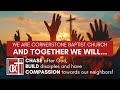
This year, a specific vision has been laid on hearts: to chase after God, build disciples, and show compassion. Chasing after God means diligently studying His Word, praying, and pleading for His guidance in our daily lives, doing things His way, not ours. Building disciples involves fostering genuine love for Jesus and for one another, leading to lives of service. Compassion for our neighbors means sharing the truth of the Gospel, recognizing that while physical needs are important, the ultimate need is Jesus. [02:57]
Matthew 28:19-20 (ESV)
Go therefore and make disciples of all nations, baptizing them in the name of the Father and of the Son and of the Holy Spirit, teaching them to observe all that I have commanded you. And behold, I am with you always, to the end of the age.
Reflection: In what practical ways can you intentionally "chase after God" this week, ensuring you are seeking His way rather than your own?
God declared that it is not good for humanity to be alone, a truth that extends profoundly to our spiritual walk and kingdom work. We are not meant to navigate our faith journey in isolation, nor are we equipped to carry the full burden of ministry by ourselves. Just as biblical figures like Moses and the apostles relied on others, we are called to love, care for, and grow with one another within the church community. This shared journey strengthens us, equips us, and enables us to collectively fulfill God's purposes. [24:21]
Genesis 2:18 (ESV)
Then the Lord God said, “It is not good that the man should be alone; I will make him a helper fit for him.”
Reflection: Where in your spiritual walk or service have you been trying to go it alone, and how might inviting others into that space bring greater strength or joy?
True compassion for others is not a human-generated emotion but a genuine, God-supplied gift that moves us to kingdom work. It begins with learning to love God deeply, which then cultivates a heart of empathy for those around us. This divine compassion enables us to see people not just as they are, but as God sees them, prompting us to share the truth and meet needs. It's a transformative process where God equips us to genuinely care for people we've never met, driving us to act with His love. [20:34]
Mark 6:34-37 (ESV)
When he went ashore he saw a great crowd, and he had compassion on them, because they were like sheep without a shepherd. And he began to teach them many things. And when it grew late, his disciples came to him and said, “This is a desolate place, and the hour is now late. Send them away to go into the surrounding countryside and villages and buy themselves something to eat.” But he answered them, “You give them something to eat.” And they said to him, “Shall we go and buy two hundred denarii worth of bread and give it to them to eat?”
Reflection: Reflect on a time when you felt a genuine, God-given compassion for someone. How did that feeling move you to act, and what was the outcome?
It is common to feel that our resources, abilities, or time are insufficient for the great tasks God calls us to. We might look at our limitations and say, "I can't," or "We don't have enough." However, the biblical narrative consistently shows that when we bring our seemingly small offerings to Jesus, He takes what is "less" and makes it "more." Our human "buts" about what we lack become divine opportunities for God to demonstrate His boundless power and provision. Trusting Him with our humble contributions allows Him to accomplish far beyond our imagination, often leaving us with more than enough. [40:20]
Mark 6:41-44 (ESV)
And taking the five loaves and the two fish, he looked up to heaven and said a blessing and broke the loaves and gave them to the disciples to set before the people. And he divided the two fish among them all. And they all ate and were satisfied. And they took up twelve baskets full of broken pieces and of the fish. And those who ate the loaves were five thousand men.
Reflection: What "five loaves and two fish" – whether time, talent, or treasure – do you feel is too small to offer God, and how might He be inviting you to trust Him with it anyway?
The church is called to clear structure, humble leadership, and intentional discipleship. Leadership exists to pray, discern, and protect the flock, not to serve personal preference or run a congregational business. Teaching must be prayerfully prepared, gathered from life experience and Scripture, and delivered with the conviction that God’s will—not human whim—shapes the congregation’s direction. A three-word vision—chase, build, compassion—frames the year: pursue God faithfully, form authentic disciples who love Jesus and each other, and show neighborly compassion rooted in truth.
Chasing God means surrendering personal methods for God’s ways through daily Scripture study and prayer. Building disciples is not manufacturing uniform behavior but cultivating people who are devoted to Christ and to serving others in ordinary life. Compassion is defined not by mere sentiment or social approval but by loving action that includes speaking gospel truth and meeting practical needs—feeding the hungry while pointing them to Jesus, and refusing to substitute comfort for correction.
Community life divides into two spheres: God’s community and the world’s community. Believers belong first to God’s community and are responsible to care for one another—sharing burdens, correcting, and encouraging—so pastoral leadership can focus on teaching, doctrine, and equipping. Delegation and shared ministry mirror biblical examples (Acts, Moses) where leaders multiply their effectiveness by empowering others to serve. Rest also plays a strategic role: Sabbath rest replenishes workers so they can return with renewed compassion to the mission.
The narrative of the feeding of the five thousand illustrates how God multiplies obedience. When people bring limited resources in faith—five loaves and two fish—God supplies abundance, satisfying needs and producing surplus for further ministry. Vision requires prayerful seeking, courageous obedience, and willingness to start with what is present. The practical call is to engage neighborhood opportunities (like Scout Sunday), invite others to worship, and step into ministries God lays on hearts, trusting that small acts of faith will be multiplied for kingdom impact.
``At the end of your life, imagine if nobody ever told you about Jesus and you died in your sins, and you woke up in the pits of hell. Would you care even a little bit that that person's excuse is, well, you might not have believed me, or you might have argued against me, or or you might have stopped being my friend, or or you might have just ignored me. Would that matter? Those excuses would matter. Why didn't you tell me?
[00:14:26]
(36 seconds)
#TellTheGospel

Having compassion means that we don't just solve their problems. Now, by the way, I wanna clarify, it also doesn't mean that we don't help them. It doesn't mean that we don't, you know, do things to help our community. We absolutely must. In fact, if a man is hungry, you better feed him first before you tell him about Jesus. But the reality is he needs more of Jesus than he does food. Because at the end of the day, food ain't gonna get him to heaven. Yeah. Food ain't gonna give him eternity. Food, he's just gonna get hungry again. But Jesus, Jesus will fulfill all his needs.
[00:04:53]
(38 seconds)
#FeedBodyAndSoul
If your house was on fire and you didn't know, would you rather me tell you your house was on fire or buy you a nice beautiful blanket to put on your bed in your house? I mean, don't get me wrong. The blanket's nice. It's the super comfortable ones. You know, that super silky soft, really fluffy blanket, whatever kinds you like. And it's wonderful, and it's a a beautiful gesture as I'm coming to visit your home to give you a gift to your house. Yes. But your house is on fire. Wouldn't you rather me go, hey. Your house is on fire.
[00:04:00]
(33 seconds)
#WarnBeforeComfort
So how do we get God driven compassion? First of all, we need to learn to love God. That's the first thing. You've gotta learn to love God. And Jesus said, you can't know my father if you don't know me. So the first thing we have to do in order to love God is to know his son. We have to do that. We have to. Some of us say, well, I know Jesus, but then we live like we don't.
[00:20:34]
(30 seconds)
#KnowJesusKnowGod
But I wanna define each of these because it's important. Chasing after God means not doing it your way. It means doing it his way. It means studying the word of God, prayerfully going before God, and begging God, and pleading with God to show us exactly what he wants from us each and every day. We're guided by his truth, his word, and we're seeking him every day.
[00:02:59]
(22 seconds)
#ChaseGodDaily
Building disciples doesn't just mean building a bunch of robotic Christians that look and talk and act like Christian, but people who are genuinely in love with Jesus and in love with each other and walk throughout the day serving God and serving each other. That's what we wanna see. And compassion is a really important one because compassion for our neighbors looks a little different than the world's version of compassion. Compassion for our neighbors means we tell them the truth.
[00:03:21]
(29 seconds)
#AuthenticDiscipleship
The Bible says that either either for Christ or they're against Christ. And now I wanna make this clear. The Bible also tells us to love our enemies. So while we can acknowledge that there are enemies from a biblical standpoint, we're also called to love them, to have compassion for them, to care for them. And one of the greatest gifts we can ever give them is the truth of the gospel, the hope of salvation. Think about it this way.
[00:13:51]
(34 seconds)
#TruthWithLove
So God laid on my heart a burden and a heaviness for discipleship this year in a way that I've never had before. He also called me to the challenge of the three words, chase, build, and compassion. Chasing after God, we're gonna do that together. We're gonna build disciples together too, but we're also gonna do it as individuals because Jesus told us to go out and make disciples. And we're gonna show compassion for our neighbors.
[00:02:32]
(27 seconds)
#ChaseBuildCompassion
I'm an AI bot trained specifically on the sermon from Jan 13, 2026. Do you have any questions about it?
Add this chatbot onto your site with the embed code below
<iframe frameborder="0" src="https://pastors.ai/sermonWidget/sermon/mark-6-jesus-compassion" width="100%" height="100%" style="height:100vh;"></iframe>Copy