God’s first move toward a broken people is gentle. The healing that begins in the soul is not earned by better behavior or clever answers; it starts when someone speaks comfort into the place of shame and hurt. Before the work of repair or the tasks of change, a voice says, “Comfort, comfort my people,” inviting the heart to receive care even while circumstances remain hard.
You are invited to accept that mercy. When shame or guilt tells you to hide, practice listening for the words of consolation first. Let the truth that God’s compassion meets you where you are shape how you approach prayer, confession, and the small next step toward restoration.
Micah 7:18–19 (ESV)
Who is a God like you, pardoning iniquity and passing over transgression for the remnant of his inheritance? He does not retain his anger forever, because he delights in steadfast love. He will again have compassion on us; he will tread our iniquities underfoot. You will cast all our sins into the depths of the sea.
Reflection: Name one specific shame or burden you have been hiding. Write a one-sentence prayer now, offering that burden to God and placing the note somewhere you will see it this week.
The promise is not that people must find their way back to God but that God will come into the harsh places where they are lost. The wilderness—whether it looks like grief, confusion, or plain exhaustion—is the setting where God often acts most powerfully. God does not wait at the edge of the desert hoping we will muster the strength to approach; he walks into the sand with us and makes a path.
Practically, this means the places of loneliness or fear are not evidence of God’s absence but invitations to his nearness. When anxiety or sorrow feels like a vast landscape, speak to God about that place and expect him to meet you there. Notice small signs of leading, even if the whole journey is not yet clear.
Psalm 107:4–9 (ESV)
Some wandered in the desert wastes, finding no way to a city to dwell in; hungry and thirsty, their soul fainted within them. Then they cried to the Lord in their trouble, and he delivered them from their distress; he led them by a straight way, till they reached a city to dwell in. Let them thank the Lord for his steadfast love, for his wondrous works to the children of man! For he satisfies the longing soul, and the hungry soul he fills with good things.
Reflection: Identify one current “wilderness” in your life (grief, fatigue, worry, etc.). For the next three days, set aside 10 minutes to tell God exactly where you are and ask him to enter that place; afterward each time, write one short sentence about anything you sensed or noticed.
God’s care looks like a shepherd who knows each sheep by name, who stoops to lift the injured and slows his walk for the weak. This is not a distant ruler demanding production but a close companion who carries when legs fail and hums comfort when fear rises. The imagery reminds people that divine strength often comes as gentle carrying rather than loud commands.
When weariness makes it hard to keep going, allow the picture of being held to change what you expect from God and from yourself. Rest is not failure; it can be the place where God’s hands are most clearly felt. Let the rhythm of your days allow for pauses where you receive care instead of pushing for constant performance.
Zephaniah 3:17 (ESV)
The Lord your God is in your midst, a mighty one who will save; he will rejoice over you with gladness; he will quiet you by his love; he will exult over you with loud singing.
Reflection: Think of one concrete way you need help right now. Today, tell one trusted person that you need support and ask them for one practical way they can help you this week (a visit, a meal, a phone call, or a specific errand).
Advent is not chiefly about appearing put together; it is about learning to live with longing and making room for hope. The season invites honesty: bring questions, tiredness, and unmet yearnings into the quiet rather than polishing a façade. Preparing the way for the Lord begins with small, intentional practices that open the heart’s door—stillness, simple gratitude, short acts of reconciliation—not with achieving a spotless schedule.
This approach frees people from the pressure to “fix” everything before God will come. Instead of frantic doing, choose a few tiny habits that create space for God’s voice. Over time, those quiet disciplines form a path through which hope can enter and grow.
Lamentations 3:21–24 (ESV)
But this I call to mind, and therefore I have hope: The steadfast love of the Lord never ceases; his mercies never come to an end; they are new every morning; great is your faithfulness. "The Lord is my portion," says my soul, "therefore I will hope in him."
Reflection: Choose one simple practice to do each morning for three days (five minutes of silence, a one-line gratitude list, or a brief reconciliation text) to make space for God’s coming. Record one sentence each day about how that practice affected your mood or attention.
God’s command to comfort his people becomes our calling: those who have received mercy are to pass it on. Comfort can look like small, ordinary acts—a listening ear, a timely word, a practical help—that prepare the way for others to encounter God’s nearness. Often, people find God’s tenderness through another human presence that refuses to hurry them or judge them.
This means the Advent work includes being alert for opportunities to bring hope. You do not need a perfect sermon or the right answers; you need presence, compassion, and a willingness to speak gently into someone’s fear. In offering comfort, the church multiplies the mercy that first found it.
Isaiah 35:3–4 (ESV)
Strengthen the weak hands, and make firm the feeble knees. Say to those who have an anxious heart, "Be strong; fear not! Behold, your God will come with vengeance, with the recompense of God. He will come and save you."
Reflection: Name one person in your life who seems tired, anxious, or discouraged. This week, send them a short message offering a specific word of comfort and one concrete offer of help (a meal, a ride, a short visit).
of the Sermon:**
This sermon, marking the beginning of Advent, centers on Isaiah 40:1–11 and the theme “Love Draws Near.” It invites us to recognize Advent not just as a countdown to Christmas, but as a season of honest longing, waiting, and preparing for God’s presence in our lives. The message highlights how God meets us in our wilderness—our places of grief, anxiety, tiredness, and uncertainty—not with condemnation, but with deep compassion and comfort. God’s promise is not that we must find our way to Him, but that He comes to us, crossing every wilderness, leveling every obstacle, and carrying us when we are weary. The sermon closes with three invitations: to make space for God’s comfort, to prepare our hearts for His coming, and to become messengers of hope to others, reminding us that hope is born not from our efforts, but because God’s love draws near.
**K
Advent is not about getting everything perfect before God arrives. Advent is about welcoming the God who comes anyway—right into the mess, the questions, the longing, and the heartbreak. God comes to us because we cannot always find our way to God.

God always begins restoration with compassion. Not with condemnation, not with “I told you so,” not with shame, but with comfort. Before anything changes on the outside, God begins by tending to the inside.
God does some of God’s best work in the wilderness. Not after the wilderness. Not before the wilderness. But in the wilderness—right in the middle of our grief, anxiety, tiredness, and loneliness.
The promise is not: “You’ll figure your way back home.” The promise is: “God will come to you.” The wilderness will not stop Him. God is already on the way, leveling mountains and lifting valleys for us.

This is not a God who shouts from a distance: “Hurry up and get it together.” This is a God who whispers: “I’ll walk with you. I’ll match your steps. I’ll carry you when you can’t go on.”
Advent says: You can be tired. You can be unsure. You can have unanswered questions. You can feel like you’re walking through a wilderness. And God will still come to you.

Life is not always easy. Faith is not always neat. Hope is not always simple. But God is always faithful.

Love draws near in the most unexpected places. Love draws near when we feel lost, discouraged, stuck, or overwhelmed. And love draws near when we feel like we’re barely making it.
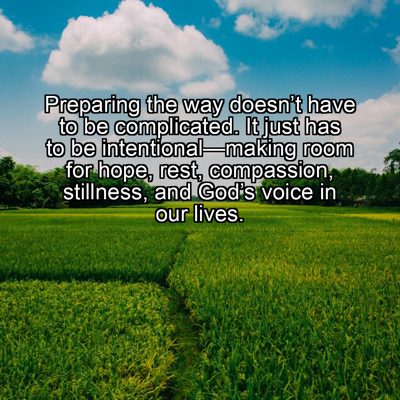
Preparing the way doesn’t have to be complicated. It just has to be intentional—making room for hope, rest, compassion, stillness, and God’s voice in our lives.

Hope doesn’t come from us, our circumstances, or having all the answers. Hope comes because Love draws near. Hope comes because God draws near. Hope comes because Christ draws near.
Hi, I'm an AI assistant for the pastor that gave this sermon. What would you like to make from it?
Add this chatbot onto your site with the embed code below
<iframe frameborder="0" src="https://pastors.ai/sermonWidget/sermon/love-near-longing" width="100%" height="100%" style="height:100vh;"></iframe>Copy