David’s psalm paints a shepherd leading sheep through dark ravines. The rod taps rocks, the staff hooks shoulders. “I will fear no evil” comes not from absence of danger, but presence: “You are with me.” Death’s valley becomes a path, not a pit. [17:42]
Jesus walked death’s canyon first. His resurrection flattened its walls into a passageway. The Shepherd’s scars prove shadows can’t swallow His flock. God’s promise isn’t valley avoidance, but companionship through them.
You face shadows today—medical reports, empty chairs, silent phones. Hear the Shepherd’s staff scrape stone ahead of you. What valley have you been treating as a dead end instead of a thoroughfare?
“Even though I walk through the valley of the shadow of death, I will fear no evil, for you are with me; your rod and your staff, they comfort me.”
(Psalm 23:4, ESV)
Prayer: Name one shadow you’re facing. Ask Jesus to walk it with you today.
Challenge: Write “Valley → Passage” on a sticky note. Place it where you’ll see it hourly.
Martha stood graveside when Jesus declared, “I AM the resurrection.” Not “I bring” but “I AM.” Tomb walls shook. Death’s contract tore as Lazarus stumbled out, graveclothes trailing. Jesus turned eulogies into intermissions. [11:21]
Resurrection isn’t a doctrine—it’s a Person. Christ holds death’s keys, not as trophies but tools. Every funeral dirge He rewrites into a comma. His pulse now beats in believers’ veins.
You’ve stood at graves. You’ll stand at more. But resurrection outlives every plot. When did you last let Jesus’ “I AM” confront a specific loss?
“Jesus said to her, ‘I am the resurrection and the life. The one who believes in me will live, even though they die; and whoever lives by believing in me will never die.’”
(John 11:25-26, NIV)
Prayer: Thank Jesus for three people whose lives declared His resurrection.
Challenge: Text one person grieving: “Christ’s ‘I AM’ outloses [name]’s grave.”
Lourdes’ casket lay like a comma, not a period. Her story continues in unseen ink. The resurrection turns every saint’s death into a semicolon; their biography pauses mid-sentence. [21:36]
Jesus’ empty tomb punctuates history. Death’s finality broke when He stepped out, graveclothes discarded. Now every believer’s exit becomes an entrance. Funerals are intermissions, not final curtains.
Your life’s sentence stretches beyond earth’s margins. What daily choice reflects your belief in the “semicolon”?
“Dear friends, now we are children of God, and what we will be has not yet been made known. But we know that when Christ appears, we shall be like him, for we shall see him as he is.”
(1 John 3:2, NIV)
Prayer: Confess one area where you’ve lived like death ends the story.
Challenge: Write your epitaph as a semicolon, then add “Continued in glory.”
Lourdes’ smile outlived her final breath. Like Moses’ face after Sinai, her countenance carried resurrection glow. She met pain with peace, knowing death couldn’t dim her Shepherd’s light. [23:22]
Jesus’ post-resurrection appearances radiate settled joy. Scars didn’t shame Him—they spotlighted victory. Saints’ smiles in suffering preach louder than sermons. Eternal life leaks through present-tense peace.
Whose faith-smile strengthens you? How might your joy point others to the Shepherd today?
“Let your light shine before others, that they may see your good deeds and glorify your Father in heaven.”
(Matthew 5:16, NIV)
Prayer: Ask God to make your face reflect His victory in one hard situation.
Challenge: Smile intentionally at three people today, praying they see Christ’s hope.
“I will be with you.” God spoke it to Moses at the burning bush, to Joshua after Moses’ death, to disciples staring at an empty sky. Five words dismantle panic’s grip. [20:10]
Jesus upgraded the promise: “I AM with you always.” Not just presence, but Person. Resurrection power walks beside us, in us. Fear melts where “I AM” dwells.
What crisis shrinks when you hear “I AM here” in it?
“Have I not commanded you? Be strong and courageous. Do not be afraid; do not be discouraged, for the Lord your God will be with you wherever you go.”
(Joshua 1:9, NIV)
Prayer: Whisper “You’re here” three times when anxiety rises.
Challenge: Write “I AM WITH YOU” on your palm. Re-read it before every decision.
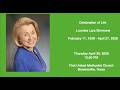
The gathering celebrates a life held in gratitude and anchored in the hope of the resurrection. Worship opens with baptismal and Easter language that claims Christ as destroyer of death and restorer of life, and moves into Psalm 23 as a firm promise of guidance and comfort. The text positions suffering as an expected part of human experience, naming valleys of illness, loss, and discouragement, while centering the assurance that God walks beside the believer through every dark place. Repeated biblical instances of God saying I will be with you shape a theology of presence rather than mere consolation.
The resurrection functions as the decisive validation of those promises. Death receives a fresh metaphor as a comma instead of a period, signaling continuity rather than finality. That conviction transforms grief into a ritual of thanksgiving and hope, celebrating both the particular gifts of the departed life and the broader reality of belonging to God whether alive or dead. Memories of warmth, laughter, and steadfast faith illustrate how a long life marked by trust in God becomes a testimony to the living hope.
Prayers of commendation and the liturgy of commendation frame death within the community that entrusts the departed into God’s mercy and the company of the saints. The Lord’s Prayer and hymns such as Precious Lord and Amazing Grace structure the congregation’s response with lament, praise, and a sending that carries the promise of God’s abiding presence into daily life. The final blessing summons the gathered to live out the assurance of resurrection, to be sent with presence, blessing, and a pastoral confidence in God the Father, Son, and Holy Spirit.
Throughout, Scripture anchors pastoral reflection: God’s steadfast presence, the reality of valleys, and the validating power of the risen Christ converge to reshape grief into sustained hope. The gathering models a way to remember a beloved life without severing it from the communal and eschatological claim that in Christ the story continues.
One of the ways that I like to think of death, if you will, is as a comma, not a period. A period represents an end to something. And if the end of it all was this casket, that would be an unredeemable sadness. But it's not. It's a comma because the sentence continues. Life continues. The story continues. Our sister Lourdes' life continues in eternity. And we can have the assurance of this because of the risen Christ.
[00:21:19]
(35 seconds)
#DeathIsAComma
I believe that in the bible, we find five of the most powerful words ever. Five of the most powerful words in the bible, if not the most powerful words, are God's promise to us when he says, I will be with you. Time and time again, throughout scripture, throughout the history that we see in scripture, we see these words, I will be with you. To Moses who God sent back to Egypt, he said, I will be with you.
[00:19:53]
(31 seconds)
#IWillBeWithYouPromise
To Joshua who no doubt was troubled after Moses' death, God said, don't be afraid. I will be with you. To Joseph whose life was prospered while in Egypt, God said, I will be with you. And we could go on and on and see throughout scripture these words, I will be with you. Up until the moment when king David, as we read here a moment ago in his masterpiece Psalm, would echo that and say, even though I walk through the valley of the shadow of death, I will fear no evil for you are with me.
[00:20:23]
(37 seconds)
#GodWithUsInScripture
Loss is never an easy thing to face. The loss of a loved one is not something that we can adequately plan or prepare for. Though sometimes we can sense that maybe the near the the end is near, but in the end, it just isn't really something we're really ready to fully cope with. And so to the family of our dear sister, Ludwig Simmons, it it is our hope and prayer that the god of peace and comfort would cover your lives, that that peace that surpasses all understanding and that only god can give would be yours, especially during this time.
[00:19:06]
(47 seconds)
#GodsPeaceForSimmons
I'm an AI bot trained specifically on the sermon from May 01, 2026. Do you have any questions about it?
Add this chatbot onto your site with the embed code below
<iframe frameborder="0" src="https://pastors.ai/sermonWidget/sermon/lourdes-lara-simmons-celebration-of-life-brownsville" width="100%" height="100%" style="height:100vh;"></iframe>Copy