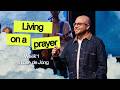
Prayer is the essential core of our walk with Christ, not merely a moment to present needs. It is the communication that sustains our relationship with Him, just as communication is vital for any relationship to grow and thrive. This divine dialogue opens the doorway to encounter Christ's love, live by faith, and be filled with hope. It is the bridge that connects our hearts to the heart of the Father. [02:47]
“But when you pray, go into your room and shut the door and pray to your Father who is in secret. And your Father who sees in secret will reward you.” (Matthew 6:6 ESV)
Reflection: What word would you honestly use to describe your prayer life right now? Consider what one practical step you could take this week to move it from an occasional activity toward a more consistent relational dialogue.
In a world filled with constant notifications and demands, everything vies for our focus. Prayer requires the intentional decision to create space and turn our full attention toward God. It is in these quiet moments, when we shut the door on distractions, that we can truly behold who He is. This act of focusing on Him is the first step toward a transformative prayer life. [29:07]
“And we all, with unveiled face, beholding the glory of the Lord, are being transformed into the same image from one degree of glory to another. For this comes from the Lord who is the Spirit.” (2 Corinthians 3:18 ESV)
Reflection: What is one specific distraction that most often pulls your attention away from God? How might you practically “shut the door” on that distraction to create a dedicated space for prayer this week?
Prayer moves us from a self-centered focus to a God-centered reality. It involves a daily decentering of ourselves, acknowledging that our needs are less important than His desires and His kingdom purpose. This humility recognizes God’s holiness and our need for Him, allowing us to approach not with a shopping list, but with a surrendered heart that seeks His will above all else. [35:20]
“O God, you are my God; earnestly I seek you; my soul thirsts for you; my flesh faints for you, as in a dry and weary land where there is no water.” (Psalm 63:1 ESV)
Reflection: In your recent prayers, what indicates whether you are approaching God primarily to get your needs met or to align your heart with His purposes? How can you incorporate praying “Your will be done” into your daily concerns?
God invites us into honest and open communication, where we can pour out our hearts without pretense. He is not a judgmental taskmaster but a loving Father who already knows everything about us and loves us unconditionally. Vulnerability in prayer is not a weakness; it is the pathway to genuine divine encounter and freedom, as we trust in His good and safe character. [38:57]
“Trust in him at all times, O people; pour out your heart before him; God is a refuge for us.” (Psalm 62:8 ESV)
Reflection: Is there an area of your life or a true feeling in your heart that you have been hesitant to be completely honest about with God? What would it look like to trust His loving nature and vulnerably share that with Him today?
Jesus Himself modeled a life of prayer, often withdrawing to solitary places to spend time with the Father despite a demanding schedule. He demonstrated that prayer is about intimacy, reverence, and dependence, and He taught that it should be a natural, integrated part of our daily walk. His example shows us that a powerful life flows from a consistent prayer life. [23:04]
“But now even more the report about him went abroad, and great crowds gathered to hear him and to be healed of their infirmities. But he would withdraw to desolate places and pray.” (Luke 5:15-16 ESV)
Reflection: Looking at your schedule for the coming week, where can you intentionally carve out a specific time and place to withdraw and pray, following the example Jesus set for us?
A new series titled Living on a Prayer frames prayer as the heartbeat of Christian life. Prayer does more than list needs; it opens the doorway to faith, hope, and love in Christ and builds intimacy with God. Scripture presents prayer as non-negotiable: communication with the Father that shapes conduct, guards against temptation, and activates the Word. The Lord’s Prayer in Matthew 6 serves as both instruction and model — avoid attention-seeking public displays and empty repetition; instead, enter private, sincere communion with God. The structure of prayer emerges as praise, repentance, asking, and yielding: begin with worship, confess honestly, present requests, then submit to God’s will. The address “Our Father” insists on relationship and reminds that God’s love precedes judgment, making honest vulnerability possible.
Prayer requires intentional rhythms. Jesus repeatedly withdrew to pray, often at dawn or in solitude, showing that persistent busyness cannot substitute for deliberate times of communion. Practical disciplines — setting aside quiet moments, reading Scripture, and creating space away from distractions — allow attention to rest on God rather than on urgent demands. Three postures form a healthy prayer life: giving God undivided attention instead of treating prayer like a shopping list; adopting humility by decentering self and recognizing God’s holiness; and embracing vulnerability, bringing the whole heart before a loving Father who already knows the hidden places. These postures free honest confession, deepen dependence, and make room for the Spirit to transform daily living.
Prayer also holds ethical implications. Asking for daily provision teaches dependence on the present moment; requesting forgiveness presumes a willingness to forgive others; pleading against temptation acknowledges both sin and trial; and yielding to God’s kingdom aligns human will with divine purpose. The culmination of prayer’s power appears in the call to respond with turning of the heart — a simple, honest confession that ushers in forgiveness, new life, and secure relation with God. Ultimately, prayer functions not merely as ritual but as the relational practice that forms believers into the likeness and mission of Christ.
Jesus shows and models to us the vulnerability of heart to get to a point where there is nothing in our heart that is unconfessed to the Lord. Because I believe vulnerability isn't weakness to overcome. It's actually an honest posture through which divine encounter now becomes possible. Yeah. And the closeness we all desire to have with God the father is found in the depth of our vulnerability.
[00:40:23]
(34 seconds)
#VulnerabilityIsStrength

We've got to come to an understanding that we must not just turn our gaze and our attention towards him, but we must humble ourselves before him. Rather than viewing God as a transaction, like I said, a shopping list that we submit to a cosmic vending machine, we need to understand prayer is a spiritual activity through which we actually attune ourselves to God's frequency so that the divine life flows into our hearts, which actually clarifies his purpose in our lives and gives us the understanding of the role we are to play in bringing his kingdom here on earth.
[00:34:43]
(45 seconds)
#AttuneToGodsFrequency
I'm an AI bot trained specifically on the sermon from Mar 15, 2026. Do you have any questions about it?
Add this chatbot onto your site with the embed code below
<iframe frameborder="0" src="https://pastors.ai/sermonWidget/sermon/living-on-a-prayer-luke-de-jong" width="100%" height="100%" style="height:100vh;"></iframe>Copy