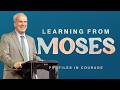
Moses’ story began with desperate trust - a mother hiding her child in a papyrus basket, releasing him to river currents and divine care. This wasn’t resignation but radical faith, believing God could repurpose even a death sentence into destiny. Jochebed didn’t see Pharaoh’s daughter rescue her son, yet her act became the first thread in a tapestry of deliverance for millions. Our shaky beginnings don’t disqualify us; they position us to witness God’s redemption. What looks like abandonment often becomes the pathway to purpose. [07:01]
“By faith Moses, when he was born, was hidden for three months by his parents, because they saw that the child was beautiful, and they were not afraid of the king’s edict.” (Hebrews 11:23, ESV)
Reflection: What “basket moment” in your life feels like chaos right now? How might God be using this uncertainty to position you for His purpose?
The Israelites traded slavery for freedom yet romanticized their chains, craving Egyptian leeks and garlic over God’s manna. Nostalgia for familiar bondage often outweighs the courage to embrace new territory. Like Lucy blaming missed fly balls on past failures, we let yesterday’s shadows darken today’s possibilities. Moses refused to idealize Pharaoh’s palace or Midian’s safety, recognizing both as prisons compared to God’s calling. [11:44]
“We remember the fish we ate in Egypt that cost nothing, the cucumbers, the melons, the leeks, the onions, and the garlic. But now our strength is dried up, and there is nothing at all but this manna to look at.” (Numbers 11:5-6, ESV)
Reflection: What “Egyptian onion” still tempts you to distrust God’s provision? Where is nostalgia for past bondage hindering your present freedom?
Eagles deliberately dismantle their nests, replacing soft down with prickly twigs to push fledglings into flight. Divine discomforts - job losses, health crises, relational strains - often signal God’s invitation to soar higher. Moses traded Pharaoh’s luxuries and Midian’s predictability for the thrill of leading a nation. Comfort zones become danger zones when they keep us from depending on God’s strength. [17:21]
“Like an eagle that stirs up its nest, that flutters over its young, spreading out its wings, catching them, bearing them on its pinions, the Lord alone guided him.” (Deuteronomy 32:11-12, ESV)
Reflection: What “twigs” is God allowing in your life to stir you toward deeper dependence? When did last week’s discomfort actually protect you from stagnation?
Moisés stood before a miracle - a flaming shrub unharmed - yet focused on his stutter and criminal past. God countered every objection: “I AM sends you” trumps “Who am I?” Our insecurities shrink before the God who qualifies the called. That desert bush symbolizes God’s persistence - He speaks through ordinary moments, patient with our hesitations but relentless in His purpose. [22:28]
“But Moses said to God, ‘Who am I that I should go to Pharaoh and bring the children of Israel out of Egypt?’ He said, ‘But I will be with you.’” (Exodus 3:11-12, ESV)
Reflection: What “but I…” excuse have you repeated to God this month? How might His “I AM” response redefine that struggle?
Moses’ final test wasn’t confronting Pharaoh but believing an 80-year-old fugitive could lead a nation. The Promised Land awaited those willing to exchange Egypt’s temporary thrills and wilderness survival for God’s abundance. Like the eagle trusting air currents, courage means leaning into the unseen support of God’s character when the future feels like freefall. [26:54]
“For I know the plans I have for you, declares the Lord, plans for welfare and not for evil, to give you a future and a hope.” (Jeremiah 29:11, ESV)
Reflection: What “land of not enough” have you settled for? How would embracing God as your “enough” change your next bold decision?
Hebrews 11 sets Moses before the church as a profile in courage. By faith, Moses’ parents were not afraid of the king’s command, seeing he was a proper child. By faith, Moses refused to be called the son of Pharaoh’s daughter, choosing rather to suffer affliction with the people of God than to enjoy the pleasures of sin for a season. Sin will thrill, then it will kill. Sin will fascinate, then it will assassinate. Faith sees past the season.
Moses first overcomes the experiences of his past. Pharaoh’s decree says drown the babies, yet Jochebed hides her son, tucks him into a tarred basket, and trusts God in the Nile. It never just so happens. Providence places the basket at Pharaoh’s daughter’s feet, providence brings Moses’ own mother to nurse him, and providence plants identity in him day after day. You are not an Egyptian. You are an Israelite. Moses later kills an Egyptian and flees. Past shame could have frozen him. Nostalgia for Egypt could have pulled him back. The past got in many eyes, but Moses lets the past be the past and leaves Egypt in head and heart.
Moses then overcomes the comforts of his present. He could have stayed a prince in Egypt, or a settled son-in-law in Midian, heir apparent to Jethro’s spread. God does not pull a servant out of the gift zone, but God does pull that servant out of the comfort zone. A life is like a rubber band. It is no good until it is stretched. The eagle becomes the picture. The nest starts soft with feathers and leaves, then the parents pull the soft out and stir up the nest. Twigs scratch, the edge appears, and the push comes. Falling forces faith. At a hundred miles an hour, the wings of rescue sweep in. That is how God stretches a believer into dependence on the Spirit.
Moses finally overcomes the insecurity of his future. The bush burns but will not burn up, and the voice says God has heard the prayers and will bring his people out. Moses is eighty. Moses says, Who am I. Moses says, I stutter. Failure and limitation speak loud, but God answers, I will be your mouth. God does not call the equipped. He equips the called. Therefore, an unknown future can be trusted to a known God.
The journey then unfolds as a choice of lands. Egypt is the land of not enough, even with every luxury. The wilderness is the land of just enough, fire insurance religion that stops short. The promise is the land of more than enough. Courage steps in, or else Red Seas do not part, manna does not fall, and the pillar does not lead. Faith says, let my people go, and then goes.
It says Lucy approaches Charlie Brown on the mound and says, sorry I missed that fly ball manager, I thought I had it, but suddenly I remembered all the others I've missed. As she walks away she says, the past got in my eyes. Folks, sometimes the past gets in our eyes. Sometimes the past gets in our eyes, but I'll tell you what I learned from Moses. Moses overcame the experiences of his past, and he said, I'm gonna let the past be the past.
[00:11:28]
(45 seconds)
Moses could have stayed in Egypt and Moses could have stayed in the wilderness. But here's what I would tell you, He would have never seen the Red Sea part. would have never seen manna supernaturally fall from heaven. He would have never seen God lead him with a pillar of cloud by day and a pillar of fire by night. took courage to go in the to the land of more than enough.
[00:29:10]
(41 seconds)
You say, what do you mean? You can have all the luxuries of Egypt and you'll still live in the land of not enough because there'll be something missing in your life. Friend, let me tell you something. The the success, the status, the sports, the sex, it's all gonna leave you in the land of not enough. It's all gonna leave you in the land of not enough.
[00:27:15]
(35 seconds)
When's the last time you did something new? Folks, let me let me let me tell you something. If you're doing what you're if you can do what you're doing with your eyes shut, you ought to be doing something else because we're not any good until we're stretched. We're not any good until God takes us out of that comfort zone. We're not any good till we get to the point we're out of our comfort zone and I've got to depend upon the holy spirit.
[00:13:53]
(32 seconds)
Add this chatbot onto your site with the embed code below
<iframe frameborder="0" src="https://pastors.ai/sermonWidget/sermon/learning-from-moses" width="100%" height="100%" style="height:100vh;"></iframe>Copy