Prayer is beautifully simple. Jesus invites you to slip away, shut the door, and speak honestly—no show, no big words, no pressure to impress. Pull up an empty chair and talk to your Father who sees what is hidden and delights to be with you. Start small: two quiet minutes, twice a day, simply showing up. In time, showing up becomes showing love, and showing love becomes a life soaked in prayer. Begin today, even if it feels awkward, and keep showing up tomorrow. [02:16]
Matthew 6:5–6, 8–9a — When you pray, don’t put on a display in public for applause; that’s all the reward performers get. Slip into a room, close the door, and speak with your Father who is unseen; He notices what’s done in secret and will care for you. Don’t pile up endless words like people who think chatter unlocks heaven—your Father already knows what you need. So pray like this: Our Father in heaven…
Reflection: Where, specifically, will you “shut the door” this week for two quiet minutes, and what honest first sentence will you actually say to God when you sit down?
Jesus teaches us to come to God as Father—deeply personal—while honoring Him as the Holy One—utterly powerful. Begin prayer with adoration, not asking, letting your heart remember who He is before you list what you need. You are not chiefly “Christian” to Him; you are “beloved.” Let that identity settle your breathing and soften your posture. Whisper a simple phrase of adoration, then rest there without hurry. This is the posture that opens the soul: Our Father, hallowed be Your name. [03:12]
Matthew 6:9–10 — Our Father who is above all, let Your name be treated as holy. Let Your reign arrive, and let Your desires be carried out here on earth just as they are in heaven.
Reflection: What brief phrase of adoration could you pair with your breathing today (for example, “Abba, I belong to You”) to help your heart remember you are the beloved?
From the garden onward, shame has trained us to hide. Prayer is redemption’s call to step out from the trees and into the arms of the One who names you beloved. If fear or failure keeps you quiet, try the simple gift of breath prayer: as you breathe in, “I am my beloved”; as you breathe out, “and His desire is for me.” Or place an empty chair before you and speak with Jesus as with a trusted friend. Two minutes of honest presence can begin a lifetime of courage. The Father still asks, “Where are you?”—and He means to find you with love. [01:44]
Genesis 3:8–10 — They heard the Lord God walking in the garden in the cool of the day, and the man and his wife hid among the trees. The Lord called out, “Where are you?” The man answered, “I heard You, and I was afraid because I was exposed, so I hid.”
Reflection: What is one sentence you’ve been avoiding saying to God, and when will you sit with Him today—chair pulled close—and say it honestly?
Life can feel like the picture is tilting, ready to topple out of the frame. Adoration brings us to our knees—literally or in our hearts—and from that posture, everything realigns. Pray from the mountaintop down: remember who God is, then look at your valleys. Like the critic who finally knelt and saw the painting rightly, humility restores holy perspective. Consider the sky, the moon, the stars—and the One who holds them. Then trust that the One who orders galaxies cares for your day. [02:58]
Psalm 8:3–4 — When I look at Your sky—the moon and stars You set in place—I marvel that You even notice us. Yet You do; You pay attention to human beings and care for them.
Reflection: What situation currently feels like it’s “falling out of the frame,” and how could you kneel (physically or inwardly) for three minutes today to let adoration reframe it?
Prayer is often physiotherapy, not surgery—little by little, the muscle strengthens. Some answers arrive quickly; others, like Monica’s prayers for Augustine, unfold over long years and hidden tears. Don’t despise small practices: two minutes, twice a day; a name spoken daily before the Father; a steady knock on heaven’s door. Miracles are beautiful and messy, but intimacy with God is the first and lasting goal. Keep asking, keep seeking, keep knocking—with a gentle, stubborn hope. The God who hears in secret is forming you as you show up again. [04:12]
Luke 11:9–10 — So keep on asking, and you will receive; keep on seeking, and you will find; keep on knocking, and the door will open. Everyone who asks receives; the one who seeks finds; and for the one who knocks, the door is opened.
Reflection: Who is one person you will carry before God every day this week, and what simple reminder (a phone alarm or sticky note) will help you keep asking with gentle persistence?
We began the year by naming our aim: to become a house of prayer. Not complicated, not flashy—simply a people who pull up an empty chair and talk with Jesus. I shared Brennan Manning’s story of a dying man who “prayed” by speaking to Christ in an empty chair, a posture so simple and honest that I’m convinced it delights Jesus. That is our vision this year: inspire and equip you to pull up a chair, to know the God who wants to be known.
Jesus’ teaching in Matthew 6 resets our expectations: don’t show off; just show up. Shut the door, speak honestly, and keep showing up. The prayer Jesus gives begins with adoration: “Our Father in heaven, hallowed be your name.” He makes the all-powerful God deeply personal—Father—and keeps Him holy—hallowed. Before we ask for anything, we return our hearts to the One who loves us. Scripture calls us “beloved” far more than “Christian.” In the garden, humanity began to hide out of shame. Prayer is the slow, brave work of coming out of hiding again.
To help us, I offered breath prayers—simple lines you pray with your breathing: “Abba, I belong to You,” or “Lord, I believe; help my unbelief.” Start small: two minutes, twice a day. Prayer is physiotherapy, not surgery. The muscle strengthens through gentle persistence. Augustine’s story—brought to Jesus after his mother’s 17 years of tearful prayer—reminds us that perseverance is often the path God uses, even when we don’t know why it takes so long.
Adoration also restores perspective. Like standing before a Renaissance altarpiece on your knees, everything comes into focus when we begin with who God is—personal and powerful. We’ll face big questions too. Many of us carry stories of both answered and unanswered prayer. We won’t dodge that tension; we’ll run the Unanswered Prayer Course as we move toward Easter. Along the way, we’ll add “colors to the palette” of prayer—petition, intercession, and more—while welcoming voices like Jill Weber and Phil Togwell to help us practice.
My hope is simple: that Jesus would walk into this house and find a people who don’t show off, but who keep showing up. Two minutes becomes ten, ten becomes thirty, and in time a life becomes a prayer.
Don't show off. Just show up. And keep showing up. Find a place on your own. Don't try and use big words. Just be honest.
Prayer is physiotherapy, not surgery. Little by little we grow; the prayer muscle gets stronger. Keep practicing two minutes twice a day and you'll rebuild strength.

The primary identity God wants you to have is not "Christian" but "beloved." If God wrote you a letter he wouldn't address it to his hardworking Christian, but to his dearly beloved.
Prayer seems to work like marriage: intimacy is the goal, the miracles are messy byproducts. The primary goal of prayer is simply to grow in intimacy with the one you love.
Start with the posture of prayer that doesn't ask God for anything, but just brings your heart and mind back into loving adoration with the God who longs to know you.
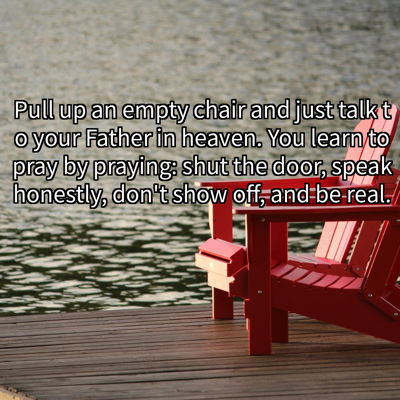
Pull up an empty chair and just talk to your Father in heaven. You learn to pray by praying: shut the door, speak honestly, don't show off, and be real.

Don't set your goals too high. If you're new, start with two minutes. Two minutes twice a day. Build the habit; two minutes becomes ten, becomes thirty, becomes an hour.
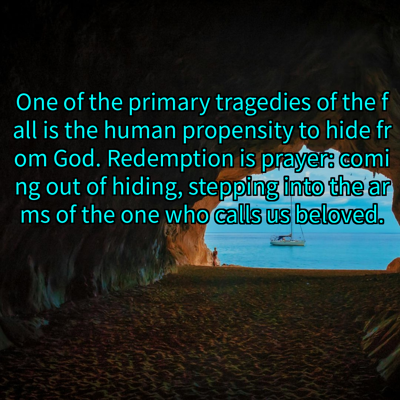
One of the primary tragedies of the fall is the human propensity to hide from God. Redemption is prayer: coming out of hiding, stepping into the arms of the one who calls us beloved.
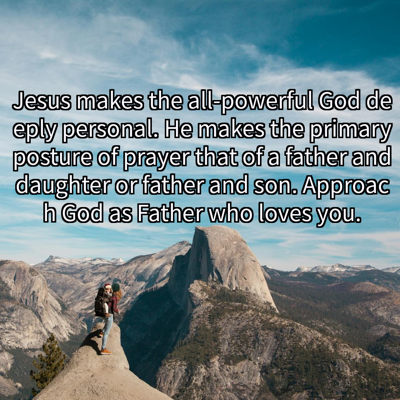
Jesus makes the all-powerful God deeply personal. He makes the primary posture of prayer that of a father and daughter or father and son. Approach God as Father who loves you.
Hi, I'm an AI assistant for the pastor that gave this sermon. What would you like to make from it?
Add this chatbot onto your site with the embed code below
<iframe frameborder="0" src="https://pastors.ai/sermonWidget/sermon/learn-to-pray" width="100%" height="100%" style="height:100vh;"></iframe>Copy