God’s truth does not change to fit somebody’s preferred version of reality. Romans 1 shows what happens when people trade the truth about God for a lie they like better. That exchange darkens the mind, turns created things into idols, and produces lives marked by sin and broken relationships. “My truth” cannot make a lie true. God is the source of truth, not personal desires or political preferences.
The whole Bible matters. Jesus constantly quotes the Old Testament, points to it as evidence of who he is, and uses Scripture when he is tempted. The Spirit does not supersede the Word. The Spirit’s guidance is not permission to skip Scripture or assume that every spiritual impression comes from God. The Bible’s connected story, across different authors, places, and centuries, gives something far stronger than a collection of personal opinions.
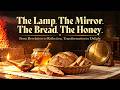
The Word is a lamp, a mirror, bread, and honey. Each picture shows something necessary about life with God.
The lamp establishes truth, gives direction, and exposes deception. God’s Word does not just give information; it gives revelation. A lamp is not meant to sit there and be admired. Its light is meant to guide actual steps of obedience. God does not have to reveal the whole road before the next step becomes clear.
The mirror reveals the person walking that road. Scripture reaches deeper than behavior into thoughts and desires that the heart cannot honestly sort out on its own. Comparison with other people gives a distorted picture and damages relationships. God’s Word shows the truth, but not to leave somebody stuck in shame. The Spirit transforms believers more and more into Christ’s image.
The bread supplies nourishment for growth. Spiritual maturity is not the same as gathering knowledge or attending church for years. The Word must be received in faith and practiced in obedience through the Spirit’s work. That growth produces discernment, stability, and the fruit of the Spirit. Sunday nourishment is good, but dependence on Sunday alone leaves solid food untouched.
The honey points to delight. God’s Word is not merely useful; it is desirable. Jesus connects obedience, remaining in his love, and overflowing joy. The cross opens fellowship with the Father, not just a life of religious duty.
These four pictures form a cycle rather than a checklist. The Word reveals truth, exposes what needs changing, feeds growth, and brings delight in God. That delight draws believers back to the Word. God does not expose what is wrong and then walk away; he stays present to bring transformation.
Key Takeaways
- 1. The lamp calls for actual steps. God’s Word gives enough light for obedience without explaining the entire road ahead. The demand for complete clarity can become a way of delaying what Scripture has already made clear. The lamp does its work as its light guides the next step, not merely as its truth receives agreement. [1:15:04]
- 2. The mirror exposes without abandoning anyone. Scripture reaches beneath outward behavior to the desires that comparison with other people cannot accurately measure. God’s exposure is not an invitation to stay absorbed in personal failure. The Spirit brings what is uncovered into the work of making a believer more like Jesus. [1:21:53]
- 3. Solid food requires more than knowledge. Spiritual maturity grows through truth received in faith and practiced in obedience. Knowledge alone can leave a person familiar with biblical words but untrained in recognizing right and wrong. The Spirit makes that truth fruitful in ordinary life through patience, faithfulness, self-control, and the other marks of Christ’s character. [1:24:09]
- 4. Delight draws the heart back again. God’s Word is sweeter than honey because fellowship with God is more than a duty to complete. God’s goodness becomes personal as his truth exposes, nourishes, and changes a life. That delight sends the believer back to Scripture, turning repeated obedience into an ongoing relationship rather than a finished assignment. [1:35:05]
Youtube Chapters