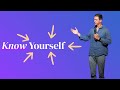
“Know yourself” begins as an old, weighty bit of wisdom from Delphi, carved into the seat of the oracle at what the Greeks called the belly button of the world. The line sounds good, and in one sense it is good. Self-awareness matters. But the world has hijacked it and turned it into “find yourself,” “live your truth,” “follow your heart,” and “you do you, boo.” That version puts the whole weight of identity on the individual, and it does not actually give any answers.
The modern world tells a person to be fit, resilient, ambitious, balanced, hydrated, productive, emotionally intelligent, socially engaged, and somehow not stressed about any of it. That burden becomes exhausting. The deeper danger is that the world does not only set impossible standards, it also whispers lies: “not good enough,” “not lovable,” “on your own,” “going to be found out.” A person is always being formed. There is no neutral gear. If Christ is not shaping identity, then the world is doing it by default.
Psalm 139 gives a far better word than “know yourself.” God has searched and known his people. God knows sitting and rising, thoughts from afar, going out and lying down, even the word before it is spoken. The seven verbs of knowing in the opening lines show a complete, perfect, intimate knowledge. Psalm 139 is not just saying God knows everything. It is saying God knows me. That knowledge is too wonderful, and it brings rest because being fully known and fully loved removes the need to perform, hide, or explain.
Romans 12 shows how this truth gets worked into the mind. Paul says not to be conformed to the world, but transformed by the renewing of the mind. That renewing is not a one-off moment. It is again and again and again. Repetition strengthens the pathway. The lies of the world get answered by the words of God: forgiven, justified, not condemned, adopted, loved, held, precious, engraved on the palm of God’s hand.
The gaze then moves outward. Genesis 1 says every person is made in the image of God, so every person carries infinite worth. The call is not to see people through annoyance, fear, convenience, or self-interest, but through God’s eyes. Jesus demonstrated and proclaimed love. He had time for people, welcomed interruption, showed kindness, and spoke good news. Identity moves from inward to upward to outward: from knowing oneself, to being known by God, to knowing and loving others.
##
Key Takeaways
- 1. Being known beats self-discovery Psalm 139 gives a deeper answer than the endless project of trying to work out identity alone. God’s knowledge is not cold surveillance, but intimate understanding that reaches thoughts, habits, wounds, reactions, and words before they are spoken. The soul can stop performing when it rests in being fully known and still fully loved. [12:23]
- 2. The world forms by default Formation is never paused. If Christ is not actively shaping the mind, the world will fill the space with demands, comparison, fear, and quiet lies that feel true because they are repeated so often. “No neutral gear” names the danger clearly: discipleship is always happening in one direction or another. [10:17]
- 3. Renewing the mind takes repetition Romans 12 describes transformation as the renewing of the mind, not as a quick emotional lift. Repeated truth makes a new pathway, just as repeated lies can dig an old groove deeper. God’s words about forgiveness, adoption, freedom, and belovedness must be returned to again and again until they become more real than accusation. [16:24]
- 4. God names before the world does The picture of a parent whispering worth over a sleeping child shows how identity is planted before fear gets the first word. God speaks like that over his people: loved, valued, precious, of infinite worth. The deepest freedom comes when that voice becomes louder than shame, pressure, and performance. [21:00]
- 5. Image bearers change the gaze Genesis 1 does not leave space for deciding who deserves dignity. Every person bears the image of God, including the difficult colleague, the ignored stranger, the boss, the in-law, and the person easiest to dismiss. Seeing through God’s eyes leads to both demonstration and proclamation: practical love and spoken good news.
## [22:59]
Youtube Chapters
- [00:00] - Welcome
- [00:23] - A Very Long Two-Part Series
- [01:22] - The Failed America Travel Grant
- [02:46] - Delphi and the Ancient Call
- [04:35] - When Knowing Yourself Gets Hijacked
- [06:13] - The Exhaustion of Modern Identity
- [08:06] - Lies That Sink Deep
- [10:17] - No Neutral Gear in Formation
- [11:20] - Psalm 139 and Being Known
- [15:09] - Renewing the Mind Again and Again
- [18:28] - Replacing Lies With God’s Words
- [20:36] - Whispering Identity Before the World Does
- [22:59] - Seeing Others as Image Bearers
- [25:44] - Demonstration and Proclamation
- [28:25] - From Inward to Upward to Outward