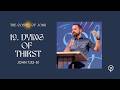
The Israelites built temporary shelters each year during Sukkot. They slept under palm branches to remember their ancestors’ 40-year desert wandering. God commanded this feast so prosperity wouldn’t make them forget His wilderness provision: manna, water from rocks, clothes that never wore out. But by Jesus’ day, Sukkot had become empty ritual. The religious leaders knew Scripture about Bethlehem’s Messiah yet missed Christ standing before them. [03:16]
Jesus enters a culture addicted to self-made righteousness. The Pharisees clung to theological correctness but rejected the Word-made-flesh. Their knowledge became a weapon against wonder. God still interrupts our complacency through spiritual disciplines—Sukkot-like interruptions that expose our drift toward entitlement.
When did you last let Scripture disrupt your assumptions? Spiritual habits like prayer or fasting aren’t about earning favor—they’re guardrails against forgetting. What daily practice could help you remember God’s wilderness provision this week?
“You shall dwell in booths for seven days. All native Israelites shall dwell in booths, that your generations may know that I made the people of Israel dwell in booths when I brought them out of the land of Egypt.”
(Leviticus 23:42-43, ESV)
Prayer: Ask God to reveal one comfort you’ve begun treating as a right rather than a gift.
Challenge: Write “Remember the Wilderness” on a sticky note; place it where you’ll see it hourly.
Moses struck the rock at Horeb, and water gushed for two million grumbling Israelites. Centuries later, Jesus stood in Jerusalem’s temple during Sukkot and declared Himself the true rock. The feast’s water-pouring rituals pointed to Him—the only source satisfying spiritual thirst. But the crowd debated His birthplace instead of drinking. [04:15]
We still choose mirages over living water. Careers, relationships, and achievements promise fulfillment but leave us stranded like sailors surrounded by undrinkable saltwater. Jesus confronts our misplaced cravings: “If anyone thirsts, let him come to ME.”
What earthly “ocean” have you been sipping from lately? Christ offers springs of living water through His Spirit. Where do you need to stop striving and start drinking?
“Behold, I will stand before you there on the rock at Horeb, and you shall strike the rock, and water shall come out of it, that the people may drink.”
(Exodus 17:6, ESV)
Prayer: Thank Jesus for three specific ways He’s quenched your soul’s thirst this month.
Challenge: Replace one 15-minute scroll session today with silent meditation on Psalm 63:1.
The woman at the well ran to her village after encountering Jesus, shouting, “Come, see!” She didn’t have all the answers—just a transformed heart. Nathanael scoffed, “Can anything good come from Nazareth?” Philip didn’t argue theology. He simply said, “Come and see.” Jesus’ credibility grows when we taste His goodness firsthand. [18:21]
Apologetics matter, but arguments rarely soften hearts. People notice when our lives drip with living water—or when we’re parched but pretending. The world judges Christ by our patience in suffering, generosity in lack, and joy in mundane obedience.
Who needs your “come and see” invitation this week? Not a doctrinal lecture, but shared bread from your table. What relationship have you neglected to cultivate because you prioritized being right over being present?
“Philip found Nathanael and said to him, ‘We have found him of whom Moses in the Law and also the prophets wrote, Jesus of Nazareth, the son of Joseph.’ Nathanael said to him, ‘Can anything good come out of Nazareth?’ Philip said to him, ‘Come and see.’”
(John 1:45-46, ESV)
Prayer: Confess one area where your actions contradict your professed beliefs.
Challenge: Text someone today with “I’d love your thoughts on this” and share a recent God-sighting.
Eddie Rickenbacker fed seagulls daily, not to repay the bird that saved his life, but to remember his helplessness at sea. Sukkot wasn’t about earning favor—it was fighting forgetfulness. Jesus’ living water flows best from hearts that rehearse their rescue daily. [35:27]
Gratitude isn’t natural; it’s a discipline. We reset to entitlement like Israel craving Egyptian onions. Spiritual habits—prayer before meals, Sabbath unplugging, spontaneous praise—are seagull moments. They shout, “I was dying! He saved me!”
What mundane task could become your gratitude ritual? Folding laundry? Commuting? Let it whisper: “I once thirsted. He gave drink.”
“Let them thank the Lord for his steadfast love, for his wondrous works to the children of man! For he satisfies the longing soul, and the hungry soul he fills with good things.”
(Psalm 107:8-9, ESV)
Prayer: Recite aloud three specific rescues God has performed in your life.
Challenge: Place a bowl of birdseed outside your window; pray thanks each time a bird visits.
On Sukkot’s final day, priests poured water from the Pool of Siloam as crowds chanted Isaiah 12:3. Jesus stood, crying, “If anyone thirsts!”—knowing He’d soon be struck like Horeb’s rock. His pierced side released blood and water, the Spirit’s flood for a parched world. [23:19]
We don’t manufacture rivers; we channel them. The Spirit flows through cracks in our surrendered lives—our weaknesses, questions, and ordinary acts of trust. A cup of water given in Christ’s name carries living water’s taste.
Where have you dammed the flow by insisting on self-sufficiency? What broken place might God want to make a conduit?
“On the last day of the feast, the great day, Jesus stood up and cried out, ‘If anyone thirsts, let him come to me and drink. Whoever believes in me, as the Scripture has said, “Out of his heart will flow rivers of living water.”’”
(John 7:37-38, ESV)
Prayer: Ask Jesus to turn one desert place in your life into a spring for others.
Challenge: Bring a water bottle to someone today—a neighbor, coworker, or homeless person—with a note: “Christ refreshes the thirsty.”
John sets the scene inside Sukkot, the feast that pulled Israel out of the house and into a booth so the people would remember life in the wilderness where God gave manna and water from a rock. The feast exposes how the human heart drifts. Gratitude fades. Entitlement sets a new normal. Spiritual rhythms like prayer, fasting, hospitality, and Sabbath work like Sukkot. They interrupt the slow fade and retrain desire toward the God who provides.
Jesus steps into that feast and into a people wandering in a spiritual wilderness. The crowd wonders, is he the Christ. The authorities send officers to arrest him. The officers come back saying, no one ever spoke like this man. Nicodemus calls for a hearing. The Pharisees cite the scriptures about Bethlehem and David. Their facts are right, but their posture is wrong. The problem is not questions. The problem is where the questions go. Self trust, echo chambers, and sharp one liners cannot do what seeing Jesus does. John keeps saying come and see, not come and solve. People meet him, taste the goodness, and then invite others to come and see.
On the last and great day of the feast, Jesus cries out, if anyone thirsts, let him come to me and drink. He names the real condition. Not minor dryness. Dying of thirst. He offers living water. John says he spoke about the Spirit who would be given when Jesus was glorified. The rock in the wilderness becomes a person who can be struck and pour out life. Money, career, romance, even kids’ success cannot quench soul thirst. Salt water is everywhere, but not a drop to drink. The invitation is not fix every riddle. The invitation is come and drink.
The Spirit turns that drink into a river. Living water flows out. Words about Jesus must be paired with a life that looks like Jesus. Inconsistency muddies the well. The disciplines matter because they keep the channel open. Prayer in hardship, rest that refuses anxiety’s clock, hospitality that throws the door wide, all of it says Jesus satisfies. Gratitude becomes a rhythm, like old Eddie Rickenbacker feeding seagulls because rescue was not forgotten. The shape of Christian life is simple. Never move on from being rescued. Keep coming. Keep drinking. If the living water has truly been received, it will show.
``He never forgot the moment he was helpless, when he was dying, and provision came for him, when he could not save himself. And that's the shape of the Christian life. You were not a little thirsty. You were not just looking for improvement. You were dying of thirst. And Christ did not come to make your life a little better. He came to rescue you. He came to give you living water in the midst of an ocean of temporary satisfaction.
[00:36:39]
(28 seconds)
It's not that we can solve every question here on this side of eternity. It's not that we know how everything is gonna go in the future. It's not that we can make sense of everything that's happening in the world, but that if we come and we drink and we believe in Jesus, we will have a different kind of satisfaction. Again, you don't need all your questions answered. You need the thirst of your soul satisfied.
[00:29:14]
(39 seconds)
So we don't pray because we're trying to earn something. We don't fast because we're trying to prove something. We don't practice hospitality because we're trying to impress God, and we don't rest because we've checked enough boxes. We do these things because we refuse to forget. We refuse to drift. We refuse to become so accustomed to the grace that we have received that we stop seeing it as grace. We never forget being rescued. A Christian is someone who never moves on from the moment they realize that they were dying of thirst, and Christ came and gave them living water.
[00:37:07]
(39 seconds)
Sometimes, one of our worst apologies or I don't know how to say it well. The one of the biggest barriers to belief for people is the lives of Christians. I have never heard a more consistent critique of Christianity than Christians treating people poorly. One of the biggest barriers to belief for many people is not, is it an intellectually viable? But it's how do Christians treat me? Do I see the love of God? Have I experienced the love of God? This is that famous Mahatma Gandhi quote. Like, he said, I love your Jesus, but not your Christians.
[00:21:41]
(51 seconds)
Add this chatbot onto your site with the embed code below
<iframe frameborder="0" src="https://pastors.ai/sermonWidget/sermon/john-19-dying-thirst" width="100%" height="100%" style="height:100vh;"></iframe>Copy