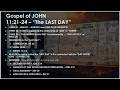
John 11 opens with a needed reminder: being loved by Jesus and being His friend does not put a believer beyond trouble. Lazarus was loved, yet Lazarus died. Mary and Martha were loved, yet they faced loss, confusion, and the hard question of why Jesus did not come sooner. The Christian life is not a promise that hardship will stay away, but it is a promise that Christ is present and working beyond what can be seen.
Martha’s confession that Lazarus would rise “at the last day” rests on the general resurrection revealed in the Old Testament. Daniel 12 points to a day when those sleeping in the dust will awake, some to everlasting life and some to everlasting contempt. Revelation 20 shows the end of that last day: Christ reigns for a literal thousand years, Satan is loosed, Gog and Magog comes, and the great white throne judgment follows. The books are opened, and God is justified when sinful men try to judge Him and say life was not fair.
The contrast between the judgment seat of Christ and the great white throne matters deeply. The church, as the body of Christ, has a unique judgment concerning rewards, inheritance, time, talents, and treasures given after salvation. The great white throne concerns those outside that unique body, including the lost and saints from other dispensations. Christ’s righteousness placed on the believer’s account means that the believer’s sins have already been dealt with at Calvary.
Jesus does not give Martha a long chart about future events. Jesus gives Martha Himself: “I am the resurrection, and the life.” Martha knows a true thing, but Christ opens the door to something greater. Christ is not merely the One who gives resurrection; Christ is resurrection and life in His own person.
First Thessalonians 4 and First Corinthians 15 show the two groups wrapped up in Christ’s promise: those asleep in Jesus and those alive and remaining at His coming. The dead in Christ will rise, and living believers may be changed “in the twinkling of an eye,” never tasting death. The resurrection is not fluff or religious comfort. The resurrection is the sure future of every believer because Jesus Himself conquered death.
Martha’s final confession lands where faith must land: not merely on what Christ can do, but on who Christ is. Christ does not need to fix every problem on demand to remain good. Christ remains “I am” when the answer is delayed, when the path is confusing, and when the heart cannot see what He is doing.
##
Key Takeaways
- 1. Loved by Jesus, yet still tested [03:13] Lazarus proves that hardship is not evidence that Christ has stopped loving someone. Sickness, loss, broken plans, and family pain can enter the life of someone Christ dearly loves. Christ’s delay does not mean Christ’s absence. Christ can be working a purpose far bigger than the immediate rescue being requested. [03:13]
- 2. The last day reveals God’s justice [32:33] The great white throne will not be a place where God has to defend Himself because He has done wrong. Sinful men may try to say life was unfair, but God will overcome when He is judged. Christ’s sinless life stands as exhibit A against every excuse. God’s judgment will be perfectly righteous, personal, and impossible to overturn. [32:33]
- 3. Christ is resurrection, not merely help [24:45] Jesus does not tell Martha only that He can perform a resurrection. Jesus tells Martha that He is the resurrection and the life. Faith grows deeper when it stops treating Christ mainly as the answer to a crisis and receives Him as the all-sufficient Lord. His person is steadier than any outcome being requested. [24:45]
- 4. The believer’s future is already secured [37:07] Christ took the believer’s sin and placed His righteousness on that believer’s account. The judgment seat of Christ therefore concerns reward and inheritance, not whether salvation can be lost. That truth should not produce lazy living, but grateful, serious service. A sealed salvation gives weight to every use of time, talent, and treasure. [37:07]
- 5. Faith rests in who God is [48:33] Martha’s confession centers on Christ’s person, not merely His ability to fix Lazarus’s death. Prayer can easily become a list of conditions: “If You do this, then You will be my God.” Christ calls faith beyond that bargain-making posture. God remains good when His ways are not understood, because God is not required to fit inside human expectations.
## [48:33]
Youtube Chapters
- [00:00] - Welcome
- [02:18] - A Reprieve From the World
- [03:13] - Loved by Jesus and Still Troubled
- [05:42] - Martha and the General Resurrection
- [09:48] - Daniel’s Picture of the Last Day
- [17:42] - Armageddon and Christ’s Kingdom
- [22:47] - The Great White Throne Judgment
- [34:27] - Judgment Seat of Christ vs. Final Judgment
- [38:00] - I Am the Resurrection and the Life
- [41:42] - The Rapture and Resurrection Hope
- [47:24] - Trusting Who Christ Is
- [48:33] - Martha’s Confession of Faith