The family tree of Jesus is full of people who messed up, who made bad choices, and who carried shame. That detail shows a simple truth: God does not wait for perfection to begin redeeming. Instead, God steps into the tangled places of family, reputation, and failure and begins to weave something new out of what looks wasted or broken.
If you feel like your history or your family is too messy for God, this is good news: the story of God’s work runs through the same sorts of lives. You don’t need to clean everything up first. The invitation is to come with honest hands and a willing heart, and to watch God work where you are, not only where you wish you had been.
"When the LORD first spoke by Hosea, the LORD said to Hosea, 'Go, take to yourself a wife of whoredom and have children of whoredom, for the land commits great whoredom by forsaking the LORD.' So he went and took Gomer the daughter of Diblaim, and she conceived and bore him a son." (Hosea 1:2–3, ESV)
Reflection: Name one part of your past or family you call "too messy." What is one small, concrete action you will take this week to let God work there (a prayer, a conversation, a reconciling step)?
It’s painful when others hurt us, when loved ones make choices that bring shame or when institutions fail. Those wounds feel like derailments, and it’s easy to rehearse the harm again and again. Yet the story of God’s work shows that human failure never finally cancels God’s purposes; disappointment can be the soil where new mercy grows.
This does not minimize the real cost of sin or the need for justice and healing. But it does free people from living under the tyranny of bitterness. When one practices praying for those who have harmed them and rests in the truth that God’s promises continue, a person can move from clutching resentment to opening toward peace — not by pretending the wrong didn’t matter, but by trusting God to do something greater through it.
"Remember the former things of old; for I am God, and there is no other; I am God, and there is none like me, 10 who declares the end from the beginning and from ancient times things not yet done, saying, 'My counsel shall stand, and I will accomplish all my purpose,' 11 calling a bird of prey from the east, the man of my counsel from a far country." (Isaiah 46:9–11, ESV)
Reflection: Think of one person whose failure you replay in your mind. Pray for them by name today and write one concrete, loving step (a boundary, a prayer, a message, or a gesture) you will take in the next week toward releasing bitterness.
Many carry a voice that says, "You blew it; you’re disqualified." That voice makes people hide, hold back, or try to prove themselves. The gospel speaks a different word: Christ came for sinners. That means the door of God’s purposes is not shut to those who have failed; mercy meets failure and turns it toward life.
Repentance is honest and practical: it names the wrong, it turns from it, and it takes steps to change. Confession and turning are not rituals of shame but thresholds into partnership with God’s renewing work. The question is not whether one has failed — everyone has — but whether one will step back into the flow of God’s mercy and join in the redemption that is already happening.
"The saying is trustworthy and deserving of full acceptance, that Christ Jesus came into the world to save sinners, of whom I am the foremost. 16 But I received mercy..." (1 Timothy 1:15–16, ESV)
Reflection: Identify one specific sin or regret you keep hiding. Confess it to God in a one-sentence prayer now, and decide on one concrete habit or accountability step you will begin today to turn from it.
Exile is a powerful image for the experience of loss, displacement, and longing. To be exiled is to live where one does not feel at home. The story of Israel — and of so many lives — shows that God does not only promise a future return; God comes into the exile itself. God meets people in their emptiness and begins to breathe life where there is despair.
This means the season of waiting or lament is not wasted. Honest prayers of lament and confession are part of faith; they name the pain and also hold on to hope. When God comes into exile, the promise is that the story will not end in loss. There is movement toward new life, even if it begins in the middle of grief.
"Then he said to me, 'Son of man, these bones are the whole house of Israel. They say, "Our bones are dried up, and our hope is lost; we are clean cut off." ' Therefore prophesy and say to them, Thus says the Lord GOD: Behold, I will open your graves and raise you from your graves, O my people. And I will put my Spirit within you, and you shall live..." (Ezekiel 37:11–14, ESV)
Reflection: Name one loss, disappointment, or place of exile you carry. Write a brief lament to God about it today (1–3 sentences), place it somewhere visible, and name one small hope you will hold this week.
People search for one thing that will finally satisfy — the perfect gift, the right achievement, approval, or a full schedule checked off. Those things can bring momentary joy, but they leave the deep longing intact. True fulfillment is not a thing to obtain; it is a Person who comes to abide with us: Emmanuel — God with us.
Preparing for Christmas involves shifting hope from getting to receiving, from doing to being held. That shift looks like choosing practices that orient the heart to God’s presence: simple moments of silence, a short Scripture reading, serving someone in need. These practices don’t earn love; they open the hands to receive the love that is already coming.
"Let them thank the LORD for his steadfast love, for his wondrous works to the children of man! For he satisfies the longing soul, and the hungry soul he fills with good things." (Psalm 107:8–9, ESV)
Reflection: What is one thing you are hoping will finally satisfy you this season? Choose one spiritual practice (5–10 minutes of silence, reading Luke 1–2 slowly, or serving someone) and do it for five minutes today to reorient toward Emmanuel.
of the Sermon:**
This sermon, launching the Advent series "Emmanuel: God’s Indescribable Gift," explores the opening chapter of Matthew and the genealogy of Jesus. The message begins with updates about the church’s vision and community life, then pivots to the deeper spiritual hunger we all feel for joy, peace, and fulfillment—longings that can’t be satisfied by gifts, achievements, or completed to-do lists. Instead, the sermon points to Jesus as the one true gift that brings lasting fulfillment, entering into the messiness of our families and circumstances. By examining the surprising and broken people in Jesus’s family tree, the sermon highlights how God’s promises and purposes are not thwarted by human sin or failure. The story of exile—both Israel’s and humanity’s—frames the coming of Jesus as God’s answer to our deepest sense of displacement and longing. Through honest prayers of lament, confession, and hope, the congregation is invited to trust that God is at work in and through the mess, and that exile is never the last word.
**K
The bad news is that no gift, experience, or accomplishment—no matter how great—can give you the joy, peace, and fulfillment you were made for. But here’s the good news: the indescribable gift of Jesus can and does.

There IS actually ONE gift that truly rules them all. Jesus sets every other gift in its proper place, so we can enjoy what is good in this world without expecting it to give us ultimate joy, peace, or fulfillment.

Jesus is born into generations of messy, beautiful family, and into a people stuck in a messy, not-beautiful situation. He totally gets your messy family and your messy, not-so-beautiful circumstances.

The peace, joy, and fulfillment Jesus brings doesn’t rely on anything in your family or your circumstances getting better. It’s not about those messy people or difficult situations being fixed—it’s found in Jesus and walking in His way.

If you’ve got some shady or questionable characters in your family tree, Jesus totally gets that. His family tree is a hot mess, too.
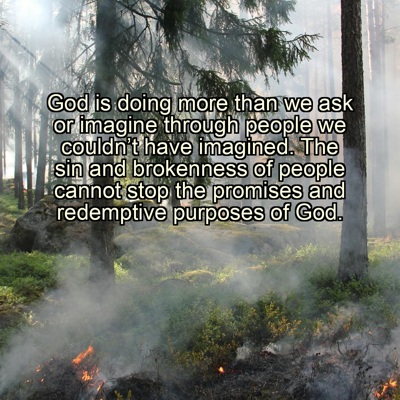
God is doing more than we ask or imagine through people we couldn’t have imagined. The sin and brokenness of people cannot stop the promises and redemptive purposes of God.

We’re not pretending that people didn’t do bad things, even terrible things. We’re just believing the truth that a good God is more powerful than the bad, terrible, wicked things that people do.

It’s not just Jesus’s family line that’s a mess—Israel is in exile, the whole situation is a mess! Exile isn’t an accidental part of Jesus’s story; it’s the problem Jesus has come to solve.

The first and every Christmas comes to people living under the weight of life in exile, in a world that is not as it should be, so that exile is not the last word.

God’s promises and God’s purposes are going to happen. Wouldn’t it be great if God’s good work happened through you instead of in spite of you?
Hi, I'm an AI assistant for the pastor that gave this sermon. What would you like to make from it?
Add this chatbot onto your site with the embed code below
<iframe frameborder="0" src="https://pastors.ai/sermonWidget/sermon/jesus-messy-beautiful-family" width="100%" height="100%" style="height:100vh;"></iframe>Copy