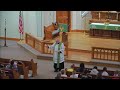
Psalm 98 calls the whole earth to make a joyful noise, and that call bookends the school year with praise that starts and ends in God’s faithfulness. The baptismal font names students as Christ’s own, so monthly “baptismal birthdays” are not small moments but reminders that identity in Jesus is given, not earned. Alpha and Omega frame time itself, so the year begins and ends in the Name of the Father, and of the Son, and of the Holy Spirit. The Ten Commandments stand as God’s good order, and under that law the students learned virtues that teach how love actually looks: honor, mercy, truth, contentment.
The Reformation window paints sin as a dark cross and grace as a blooming red flower, so the gospel is not gray advice but bright rescue. The communion cup proclaims that Christ’s body and blood are given for life, not as a symbol but as a gift that strengthens the weak. The Ascension window shows Jesus crowned as King, and that crown came only by way of the cross, a Lent-shaped path that tells the truth about glory on the far side of suffering. The Heilige Schrift window names the Holy Scriptures as the base, not the topping, under every class and lesson; God’s Word sits under math and science like a foundation under a house.
The Lamb of God holds the victory banner, so the center of the room is a slain-and-risen Lord who wins by self-giving love. The dove and the ship’s gear point to the church as a vessel held steady, because all these windows are not decorations but catechisms in glass. Everything learned here is an anchor, and the cross is the holdfast in the storm, so students are told they will not be moved, whether days are bitter or sweet. Psalm 98 then gathers it all up again: “Sing to the Lord a new song” because “his right hand and his holy arm have worked salvation.”
The right hand means strength, and the text names God’s own action, finally seen in Jesus’ right hand and holy arm earning salvation. That is the content of the new song the church keeps singing week after week. That song does not shift with moods; it is the anchor of a life held by Christ.
Key Takeaways
- 1. Christ’s cross anchors life’s storms. The cross is not just a past event; it functions as ballast in present trouble. When emotions surge, the crucified-and-risen Jesus fixes reality to a love that does not move. Stability comes from who holds the boat, not how smooth the water feels. [24:38]
- 2. The right hand earns salvation. Psalm 98 names salvation as God’s own work, not a joint project. Right hand means strength, and in the gospel that strength is Jesus taking the burden and finishing it. Praise flows from certainty that the saving is already done. [26:31]
- 3. The church’s symbols teach truth. Baptismal font, Alpha and Omega, Commandments, chalice, crown, Scripture, Lamb, and dove are not decoration; they are daily catechism. When memory blurs, stained glass still preaches Christ’s death and victory. The eyes are trained so the heart can remember. [22:09]
- 4. The new song steadies worship. The “new song” is not novelty but news: God has acted. Singing that truth forms endurance, because praise names what cannot be taken away. Joy rises not from changing circumstances but from the finished work of Jesus’ holy arm. [25:17]
Youtube Chapters
- [00:00] - Welcome
- [18:16] - Joyful Noise and Year Theme
- [18:45] - Baptismal Font and Identity
- [19:06] - Alpha and Omega Frame the Year
- [19:34] - The Ten Commandments Recited
- [21:50] - Ascension Window and the Crown
- [22:09] - Heilige Schrift as Foundation
- [22:48] - The Lamb of God Victorious
- [24:01] - Dove and the Ship’s Anchor
- [24:18] - Windows as Living Catechism
- [24:38] - The Cross Holds Steady
- [25:17] - Back to Psalm 98’s New Song
- [25:50] - Right Hand and Holy Arm
- [26:31] - The Song That Anchors Life