It’s easy to get stuck looking over our shoulders, longing for the “good old days” or wishing things could go back to how they were. But when we fixate on the past, we risk missing the blessings God is pouring out right now. The Israelites, wandering in the wilderness, kept remembering Egypt—not the slavery, but the food and comfort they thought they had. They forgot that God was providing for them every single day, even in the middle of their struggle.
Gratitude doesn’t mean pretending we haven’t lost anything or that life hasn’t changed. It means being honest about our grief, but also choosing to trust that God is still at work in our present. Even if life doesn’t look like we expected, God’s hand is still shaping our story. Today, let’s ask God to help us see the blessings He’s giving us right now, and to trust Him with what’s ahead.
“Remember not the former things, nor consider the things of old. Behold, I am doing a new thing; now it springs forth, do you not perceive it? I will make a way in the wilderness and rivers in the desert.” (Isaiah 43:18-19, ESV)
Reflection: What is one way God is providing for you right now that you might be overlooking because you’re focused on the past?
The voices we allow into our lives have a powerful effect on our hearts. The Israelites’ complaints didn’t start on their own—they were influenced by the “mixed multitude” traveling with them, people who stirred up discontent and negativity. In our own lives, negativity is contagious. If we’re always around people who focus on what’s wrong and ignore what God is doing, it’s easy for our own gratitude to fade.
We need to be intentional about who we let speak into our lives. Are we surrounding ourselves with people who point us to God’s faithfulness, or with those who magnify problems? It’s not about cutting people off, but about making sure the loudest voices in our lives are those that encourage us to trust God and be thankful. Let’s seek out relationships that help us see God’s goodness, even when life is hard.
“Whoever walks with the wise becomes wise, but the companion of fools will suffer harm. The simple believes everything, but the prudent gives thought to his steps.” (Proverbs 13:20; 14:15, ESV)
Reflection: Who are the three people whose voices most influence your attitude? Do they help you see God’s faithfulness, or do they feed your complaints?
Complaining isn’t just about venting our frustrations—it’s a spiritual issue. When we complain, we’re making a statement about what we believe about God’s care for us. The Israelites’ grumbling was more than just words; it was a way of saying, “God, we don’t trust You to take care of us.”
God invites us to bring our cares and struggles to Him in prayer, not in grumbling. He wants us to be honest about our pain, but also to trust that He hears, cares, and is able to help. Complaining can become a habit that slowly erodes our trust in God. Instead, let’s choose to bring our worries to Him, believing that He is good and that He’s working for our good, even when we can’t see it.
“But you murmured in your tents and said, ‘Because the Lord hated us he has brought us out of the land of Egypt, to give us into the hand of the Amorites, to destroy us.’ Yet in spite of this word you did not believe the Lord your God, who went before you in the way to seek you out a place to pitch your tents.” (Deuteronomy 1:27, 32-33a, ESV)
Reflection: What is one complaint you’ve been holding onto? Can you turn it into a prayer today, asking God for help and trusting His care?
Complaints don’t start on our lips—they start in our hearts. When we let bitterness, disappointment, or unresolved pain take root, it eventually spills out in our words and attitudes. Proverbs tells us to guard our hearts, because what we allow to grow there will shape the direction of our lives.
Gratitude and bitterness can’t live together. One will always push out the other. If we want to be people marked by thankfulness, we have to be honest about the places where bitterness has crept in. God invites us to bring those hurts to Him, to let Him heal us, and to fill our hearts with gratitude instead. Let’s ask God to help us guard our hearts and choose thankfulness, even when it’s hard.
“Let all bitterness and wrath and anger and clamor and slander be put away from you, along with all malice. Be kind to one another, tenderhearted, forgiving one another, as God in Christ forgave you.” (Ephesians 4:31-32, ESV)
Reflection: Is there a place in your heart where bitterness has taken root? What would it look like to invite God to heal that place today?
Hardship is real, and sometimes it feels like the heat of life’s trials will break us. But Scripture reminds us that we are like clay in the hands of a master sculptor. The same God who delivered, provided, and protected the Israelites was still holding them in the wilderness. He is still holding you, even in the hardest moments.
Gratitude doesn’t mean denying our pain. It means trusting that God is using even the hard things to shape us, strengthen us, and draw us closer to Him. We can choose gratitude, not because life is easy, but because we know whose hands we are in. Even when it’s hard out here, God is at work, and He will never let us go.
“Behold, as the clay is in the potter’s hand, so are you in my hand, O house of Israel. If at any time I declare concerning a nation or a kingdom, that I will pluck up and break down and destroy it, and if that nation, concerning which I have spoken, turns from its evil, I will relent of the disaster that I intended to do to it.” (Jeremiah 18:6-8, ESV)
Reflection: Where are you feeling the “heat” of hardship right now? How might God be using this season to shape you for His purposes?
of the Sermon:**
In this sermon, “It Be Hard Out Here,” we looked honestly at the hardships we face in life—financial struggles, family issues, health challenges, and uncertainty about the future. Drawing from Numbers 11, we saw how the Israelites, in their wilderness journey, responded to hardship with complaining, losing sight of God’s constant provision. The message challenged us to examine our own hearts: how easy it is to slip into grumbling, to romanticize the past, and to overlook the blessings God is giving us right now. We were reminded that complaining is not just venting—it’s a challenge to God’s goodness and care. Instead, we are called to be conscious of our blessings, careful about the voices we let influence us, to cast our cares to God in prayer, and to guard our hearts from bitterness. Ultimately, gratitude is not about having perfect circumstances, but about trusting the hands of the God who shapes, holds, and provides for us—even in the heat of life’s trials.
**K
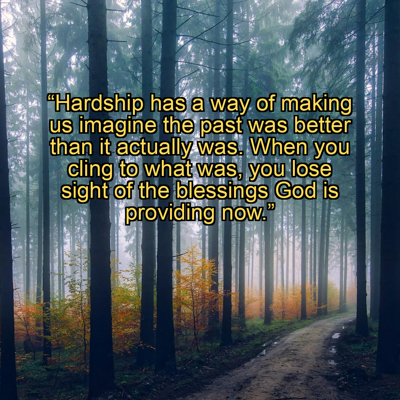
“Hardship has a way of making us imagine the past was better than it actually was. When you cling to what was, you lose sight of the blessings God is providing now.”
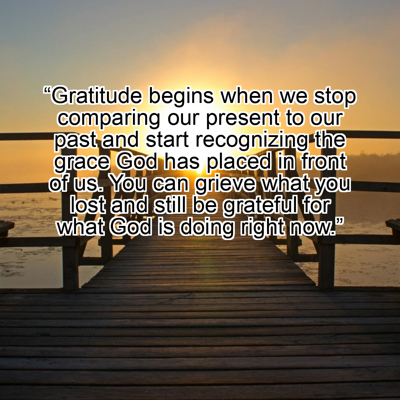
“Gratitude begins when we stop comparing our present to our past and start recognizing the grace God has placed in front of us. You can grieve what you lost and still be grateful for what God is doing right now.”
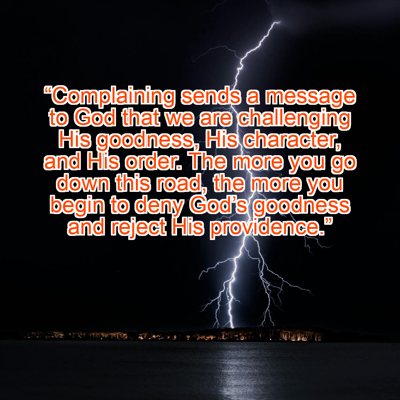
“Complaining sends a message to God that we are challenging His goodness, His character, and His order. The more you go down this road, the more you begin to deny God’s goodness and reject His providence.”
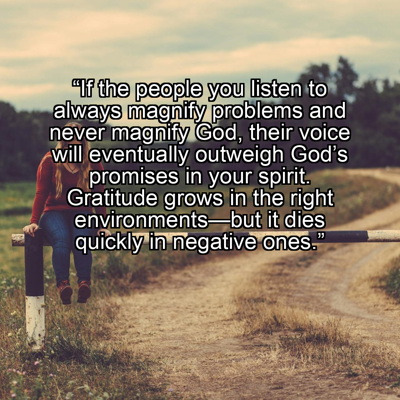
“If the people you listen to always magnify problems and never magnify God, their voice will eventually outweigh God’s promises in your spirit. Gratitude grows in the right environments—but it dies quickly in negative ones.”
“Sometimes the most spiritual thing you can say is: ‘I hear you, but I can’t receive that.’ You need voices in your circle that will remind you God is able, God is good, and God is still providing.”
“The more we complain, the more we set the atmosphere for negativity. Complaining changes nothing. But prayer changes everything.”
“Gratitude isn’t denial of the hardship. It’s confidence in the hands that shape us through it. We don’t give thanks because everything feels good—we give thanks because we know whose hands we are in.”
“Don’t harbor the spirit of discontentment or pain so long in your heart that you create a home for it. Gratitude can’t live where bitterness pays rent.”
“When you’re emotionally attached to what used to be, many times you cannot embrace the blessings God is providing now. Face forward to see the constant blessings in your life.”
“Israel saw the heat of the wilderness, but they forgot the hands of the Sculptor. The fire doesn’t destroy the bowl—it completes it. The heat meant development, not danger.”
Hi, I'm an AI assistant for the pastor that gave this sermon. What would you like to make from it?
Add this chatbot onto your site with the embed code below
<iframe frameborder="0" src="https://pastors.ai/sermonWidget/sermon/it-hard-here-pastor-ej" width="100%" height="100%" style="height:100vh;"></iframe>Copy