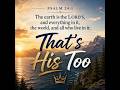
Psalm 24 announces that “the earth is the Lord’s and all its fullness,” and that line does not wobble. David sets the tone with a definite word. Not the earth might be, not the earth used to be. The earth is the Lord’s. The text then walks the room like a call and response, naming creation’s foundations and asking who can stand where God is holy. The answer lands clear and searching: the one with clean hands and a pure heart, who will not bow to an idol or bend the truth. The blessing that follows is not guesswork but promise, because the King of Glory does not visit like a stranger. He comes as owner.
The Ark’s return sits behind these words as a living reminder that God not only reigns and rules, but resides. David’s song insists on that order. He reigns over all things seen and unseen. He rules as author and illustrator, the chief orchestrator of this offbeat symphony. And he resides, not as a distant landlord who collects on the first and disappears, but as owner and occupant who loves what he built and is present in every room. That is where the tension lives. People call only when something breaks, hide the messy rooms, and try their own repairs until the kitchen falls apart. Psalm 24 keeps saying, throw open the doors. Lift up your heads, O gates. Let the King of Glory come in.
The world’s headlines may brag like man is in control, but the text answers back with a steady bass line. The earth is the Lord’s. That truth holds when laws twist, when fame outruns faith, and when a game show participant can rise to power. The King of Glory does not ask permission. He founded, established, and now he enters where he is welcomed. The sound the text wants in the mouth is invitation. Not “God, stop by,” but “God, come dwell.” And the grace tucked in here is this: there is no need to clean up before he comes. The struggle that stays hidden, that’s his too. The relationship never mentioned, that’s his too. The dream shelved, the work that feels too far gone, even that belongs to him. When the doors lift, the King shall come in. Not might, shall. So the church is called to live like tenants who know the owner lives inside, to stand in blessing with clean hands and a pure heart, and to keep saying with faith and some bass, he reigns, he rules, he resides.
Key Takeaways
- 1. The earth is the Lord’s The line is settled and present tense for a reason. Sovereignty is not seasonal, and it does not bend to polls or panic. When creation is named as God’s possession, burdens can be handed back to the rightful owner. That certainty steadies prayer and straightens posture. [41:29]
- 2. God reigns, rules, and resides Kings reign and rulers rule, but Israel’s God adds presence. He builds, commands, and then moves in, making the holy place a home. That nearness is not sentimental; it is the basis for trust in battle and obedience in the ordinary. Invitation becomes the doorway to awareness. [45:07]
- 3. Treat God as owner and occupant Landlord religion keeps God at arm’s length, calling only when something breaks. Owner-and-occupant faith hands over keys to every room and stops hiding the messy closets. When space belongs to him and he lives there, reverence grows and self-repair gives way to surrender. [45:51]
- 4. Clean hands and a pure heart Access to the hill is moral, not cosmetic. Clean hands refuse manipulation, a pure heart refuses divided loyalty, and truth refuses cheap oaths. The blessing that follows is not payment but alignment with the God who is present and holy. [38:18]
- 5. Everything hidden is his too Grace does not ask the house to be spotless before the door opens. Naming the struggle, the silence, and the shelved dream as “his too” turns shame into an invitation for God to work. Surrender is not abdication; it is returning property to its owner. [47:25]
Youtube Chapters