Jul 12, 2026
Jesus told His disciples a hard truth. He said, "When your brother sins, go and show him his fault in private." He did not say to talk about him to others. He did not say to post about it online. He commanded a direct, private conversation. This approach protects the other person's dignity.
Jesus gave this command in an honor-based culture. Public shame could ruin a person. His method was radically gracious. The goal was never humiliation. The goal was always restoration. A private conversation seeks to heal a relationship, not win an argument.
Many of us choose gossip or bitterness over obedience. We talk about people instead of talking to them. We hold onto pain instead of pursuing peace. Jesus calls you to a different way. He invites you to protect your brother's dignity as you seek his restoration. Who is one person you need to approach in private this week?
“If another believer sins against you, go privately and point out the offense. If the other person listens and confesses it, you have won that person back.”
(Matthew 18:15, NLT)
Prayer: Ask God for the courage to initiate a private, loving conversation for the sake of restoration.
Challenge: Identify one relationship strained by an offense and commit to praying for that person today.
What if a private conversation fails? Jesus provided the next step. He said, "Take one or two others with you." This was not about gathering allies for your side. This was about inviting mature believers to seek truth. These witnesses help confirm the facts and encourage repentance.
This instruction comes from the Law of Moses. Truth is established by the testimony of two or three people. These witnesses serve to prevent false accusations. They bring clarity and objectivity to a heated situation. Their goal is to help put out the fire, not add fuel to it.
We often triangulate, pulling a third person into our conflict to control it. This creates division and picks sides. Jesus calls you to reject manipulation. Invite wise, objective believers to help pursue reconciliation, not victory. Who are the mature Christians in your life you could trust to be truth-seeking witnesses?
“But if you are unsuccessful, take one or two others with you and go back again, so that everything you say may be confirmed by two or three witnesses.”
(Matthew 18:16, NLT)
Prayer: Pray for God to raise up wise, truthful believers who can help mediate conflict.
Challenge: Write down the names of two people you consider spiritually mature and trustworthy.
If even the witnesses are refused, Jesus said to "tell it to the church." This brings the matter before the whole Christ-centered community. The church becomes a place for loving accountability. This step is a final plea for repentance and restoration.
This is not a call for public shaming. Church discipline protects the holiness of God's people. It protects the witness of the gospel. It also protects the unrepentant person from the consequences of their sin. The goal remains to gain back your brother.
We might see this as harsh or unloving. But Jesus treated outsiders like Gentiles and tax collectors with love and an invitation to salvation. Treating someone as an outsider acknowledges their broken fellowship. It never stops hoping for their return. Is your view of church discipline shaped by punishment or by restoration?
“If the person still refuses to listen, take your case to the church. Then if he or she won’t accept the church’s decision, treat that person as a pagan or a corrupt tax collector.”
(Matthew 18:17, NLT)
Prayer: Confess any fear of accountability and ask God to give your church a spirit of grace and truth.
Challenge: Read 2 Thessalonians 3:14-15 to understand the heart behind treating someone as an outsider.
The entire process in Matthew 18 aims for one thing: to "gain your brother." The word "gain" means to acquire or win over. It is a trading of a broken relationship for a restored one. It is about seeing a person trade their sin for a renewed life in Christ.
This is the ministry of reconciliation Paul describes. God Himself reconciled us to Himself through Christ. Now He gives us that same ministry. We are to be agents of healing and restoration in the body of Christ. Our methods must reflect His goal.
Our human instincts desire to be right or to avoid pain. God's desire is for redemption. He calls you to see the person not as an opponent but as a brother or sister to be won back. Will you adopt God's goal of restoration as your own in conflict?
“In that way, you will have won your brother or sister back.”
(Matthew 18:15b, NLT)
Prayer: Thank God for reconciling you to Himself and ask Him to give you His heart for reconciliation.
Challenge: Set aside five minutes to meditate on 2 Corinthians 5:18-20 and your role as a minister of reconciliation.
Jesus concluded His teaching with a profound promise. He said, "For where two or three gather together in my name, I am there among them." His presence is guaranteed in the midst of the process. He is in the private conversation. He is with the small group of witnesses. He is in the church meeting.
This promise is not just for prayer meetings. It is for the messy work of conflict resolution. We do not pursue righteousness alone. Christ Himself is with us, guiding us and empowering us to handle hard conversations in a holy way.
You can move forward in obedience because you are not alone. The King of reconciliation is standing with you. His presence turns a difficult confrontation into a holy moment. Are you relying on Christ’s presence in the midst of relational challenges?
“For where two or three gather together as my followers, I am there among them.”
(Matthew 18:20, NLT)
Prayer: Ask Jesus to make His presence known to you as you seek to obey His commands in relationships.
Challenge: Before your next difficult interaction, pause to acknowledge Christ’s presence with you and pray for His guidance.
Matthew 18:15–19 provides a concrete, pastoral framework for handling sin within the covenant community, with a single aim: restoration. Jesus frames conflict as inevitable—“when” a brother sins—not hypothetical, and calls the congregation to respond with disciplined, redemptive action rather than gossip, avoidance, or bitterness. The text lays out successive steps: confront the offender privately to protect dignity; if that fails, bring one or two mature witnesses to confirm truth and prevent false accusation; if still unheeding, bring the matter before the Christ-centered assembly; and, if persistent unrepentance remains, alter fellowship toward the person as with a Gentile or tax collector while maintaining a posture of hopeful accountability. The underlying logic refuses public shaming and embraces a restorative ethic rooted in Scripture, law, and cultural sensitivity to honor and shame in the first-century context.
The sermon situates this process within a larger spiritual battle. Sin infiltrates the church covertly, the devil seeks cracks in community life, and congregational health demands vigilance—prayer, the armor of God, and sober alertness. Practical warnings sharpen the pastoral application: gossip, triangulation, social-media denunciation, avoidance, and bitter silence all subvert reconciliation and corrode the culture Christ intended. Witnesses function not as prosecuting jurors but as truth-seeking companions who guard against partial narratives and foster repentance. Church discipline, properly executed, protects God’s holiness, the gospel’s witness, the congregation’s purity, and the sinner’s soul; its end remains reconciliation, not exile.
Restoration receives special emphasis. Discipline that achieves repentance requires subsequent forgiveness, comfort, and reintegration so that the restored believer truly gains new life in Christ. The final promise in the text—where two or three agree in Christ—frames congregational discernment and prayer as participatory with God’s will. The overall call urges the community to protect the culture Christ intended by handling hard conversations in holy ways: private truth-telling, sober accountability, communal adjudication, and relentless hope for a transformed brother or sister.
Healthy and holy congregations don’t avoid conflict; they handle the hard conversations in a holy manner.

The goal of Matthew 18 is not confrontation; it is all about resolving broken relationships.

This is not a game, Beloveds; we are always in a battle as soldiers in the army of the Lord.

Private conversations protect dignity: go privately, go humbly, go truthfully, go redemptively.

Too often we talk about people before talking to people; the godly approach is to confront privately and encourage repentance.

Avoidance is not an option: seek the private conversation that leads to reconciliation instead of staying away in bitterness.

Triangulation is not an option; involving a third party to manage conflict divides relationships and avoids direct, redemptive communication.
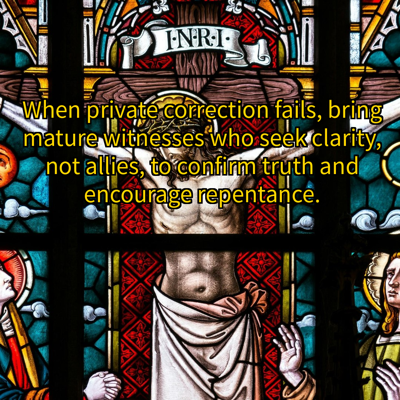
When private correction fails, bring mature witnesses who seek clarity, not allies, to confirm truth and encourage repentance.

Church discipline isn't revenge; it protects the church, the sinner, the gospel, and the culture Christ intended.

The purpose behind everything is restoration: encourage brothers and sisters to trade sin for a renewed life in Christ and return to the path of righteousness.
Hi, I'm an AI assistant for the pastor that gave this sermon. What would you like to make from it?
Add this chatbot onto your site with the embed code below
<iframe frameborder="0" src="https://pastors.ai/sermonWidget/sermon/hush-your-mouth-pt2-resolution" width="100%" height="100%" style="height:100vh;"></iframe>Copy