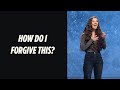
Forgiveness is not a single act but a daily process that we must choose to enter again and again, especially when pain resurfaces or memories of hurt return. Just as Mary and Martha faced the disappointment of Jesus’ delayed arrival and the loss of their brother, we too encounter moments when we must repeatedly decide to forgive, even when it feels difficult or unfair. Jesus teaches us in the Lord’s Prayer to ask for forgiveness and to forgive others daily, reminding us that this is a journey, not a destination. Each time the pain resurfaces, you are invited to make the choice to forgive again, trusting that God is with you in the process and that healing often comes step by step, not all at once. [34:29]
John 11:1-6, 17 (NIV)
Now a man named Lazarus was sick. He was from Bethany, the village of Mary and her sister Martha. (This Mary, whose brother Lazarus now lay sick, was the same one who poured perfume on the Lord and wiped his feet with her hair.) So the sisters sent word to Jesus, “Lord, the one you love is sick.” When he heard this, Jesus said, “This sickness will not end in death. No, it is for God’s glory so that God’s Son may be glorified through it.” Now Jesus loved Martha and her sister and Lazarus. So when he heard that Lazarus was sick, he stayed where he was two more days... On his arrival, Jesus found that Lazarus had already been in the tomb for four days.
Reflection: Is there a hurt or offense that keeps resurfacing in your heart? What would it look like to invite God into that pain and choose forgiveness again today, even if you’ve already tried before?
Forgiveness is not the same as forgetting what happened; it is possible to remember the pain and still choose to forgive. Martha came to Jesus honestly, expressing her disappointment and grief, yet she also declared her faith in Him. God invites us to bring our true feelings and wounds to Him, not to hide or pretend they don’t exist. Healing cannot happen in hiding, and God does not ask us to ignore our pain or to be taken advantage of, but to walk with Him in honesty and wisdom, setting healthy boundaries as needed. You can show up to God with your real emotions, knowing He meets you there and helps you move forward. [41:08]
John 11:20-27 (NIV)
When Martha heard that Jesus was coming, she went out to meet him, but Mary stayed at home. “Lord,” Martha said to Jesus, “if you had been here, my brother would not have died. But I know that even now God will give you whatever you ask.” Jesus said to her, “Your brother will rise again.” Martha answered, “I know he will rise again in the resurrection at the last day.” Jesus said to her, “I am the resurrection and the life. The one who believes in me will live, even though they die; and whoever lives by believing in me will never die. Do you believe this?” “Yes, Lord,” she replied, “I believe that you are the Messiah, the Son of God, who is to come into the world.”
Reflection: What honest feelings or memories have you been hiding from God? Take a moment to bring them to Him in prayer, trusting that He can handle your honesty and meet you in your pain.
There is a difference between restoring a relationship and reconciling with someone; forgiveness may lead to restoration, but sometimes it simply means releasing the offense to God while maintaining healthy boundaries. Mary and Martha both approached Jesus with the same words but different hearts, and both were accepted by Him. In your own life, you may need to discern whether God is calling you to restore a relationship or simply to reconcile in your heart and move forward. Forgiveness is about setting yourself free and letting God handle the rest, whether or not the relationship returns to what it once was. [45:28]
John 11:28-32 (NIV)
After she had said this, she went back and called her sister Mary aside. “The Teacher is here,” she said, “and is asking for you.” When Mary heard this, she got up quickly and went to him. Now Jesus had not yet entered the village, but was still at the place where Martha had met him. When the Jews who had been with Mary in the house, comforting her, noticed how quickly she got up and went out, they followed her, supposing she was going to the tomb to mourn there. When Mary reached the place where Jesus was and saw him, she fell at his feet and said, “Lord, if you had been here, my brother would not have died.”
Reflection: Is there a relationship in your life where you need to set a boundary rather than pursue restoration? Ask God for wisdom to know the difference and courage to take the next right step.
It is easy to let offense and hurt keep us from seeing the miracles God is working in and around us. Mary almost missed witnessing Lazarus’ resurrection because she stayed home in her pain, but Jesus called her out to experience the wonder of what He was about to do. Sometimes, the greatest miracle is not just the healing or restoration, but the way God meets us in our pain, weeps with us, and brings new life where we least expect it. Don’t let offense keep you from the blessings and breakthroughs God wants to show you—He is inviting you to step out and see His glory. [50:44]
John 11:38-44 (NIV)
Jesus, once more deeply moved, came to the tomb. It was a cave with a stone laid across the entrance. “Take away the stone,” he said. “But, Lord,” said Martha, the sister of the dead man, “by this time there is a bad odor, for he has been there four days.” Then Jesus said, “Did I not tell you that if you believe, you will see the glory of God?” So they took away the stone. Then Jesus looked up and said, “Father, I thank you that you have heard me. I knew that you always hear me, but I said this for the benefit of the people standing here, that they may believe that you sent me.” When he had said this, Jesus called in a loud voice, “Lazarus, come out!” The dead man came out, his hands and feet wrapped with strips of linen, and a cloth around his face. Jesus said to them, “Take off the grave clothes and let him go.”
Reflection: Is there an area where offense or disappointment is keeping you from seeing God’s work? What step can you take today to move toward Jesus and open your eyes to the miracles He is doing?
Choosing forgiveness is not just about your own healing—it has the power to change lives, families, and even generations. When Mary chose to move beyond her offense and follow Jesus, others witnessed the miracle and believed in Him. Your decision to forgive can break chains, inspire faith, and open the door for God’s glory to be revealed in ways you may never see. The process of forgiveness is a declaration that you will not partner with the enemy’s agenda of bitterness, but with Jesus’ mission of redemption and freedom. [53:45]
Luke 23:34 (NIV)
Jesus said, “Father, forgive them, for they do not know what they are doing.” And they divided up his clothes by casting lots.
Reflection: Who in your life might be impacted if you choose to forgive today? Ask God to show you how your act of forgiveness could be a testimony of His grace to others.
Today, we gathered to reflect on a subject that is both deeply challenging and profoundly transformative: forgiveness. As I shared from my own life—stepping into a new season as a newlywed and recalling stories of both joy and pain—I was reminded how much our relationships and our spiritual journeys are shaped by the way we handle hurt. Whether it’s the sting of careless words, the ache of betrayal, or the disappointment of unmet expectations, each of us carries wounds that can either imprison us or become the very places where God’s power is revealed.
Drawing from John 11, the story of Mary, Martha, and Lazarus, we see that forgiveness is not a simple, one-time act. When Jesus delayed in coming to heal Lazarus, the sisters experienced real pain and confusion. Their honest questions—“Lord, if you had been here…”—mirror our own cries in moments of loss or injustice. Yet, in their vulnerability, they teach us that forgiveness is a daily, sometimes moment-by-moment process. It’s not about forgetting the hurt or pretending it didn’t happen. Instead, it’s about bringing our pain honestly before God, trusting Him with our disappointments, and choosing to release the debt others owe us.
Forgiveness also requires wisdom. There is a difference between restoration—rebuilding a relationship—and reconciliation—releasing someone in your heart even if the relationship cannot be restored. Both are valid, and both require discernment. Sometimes, the healthiest thing we can do is set boundaries, not out of bitterness, but out of a desire to love well and protect what God is doing in us.
Perhaps the most powerful truth is that forgiveness positions us to witness miracles. Mary was on the verge of missing the resurrection of her brother because of her pain, but Jesus called her by name, inviting her to see what only He could do. When we choose forgiveness, we not only experience freedom ourselves, but we also open the door for God to work in ways that impact generations. The process is hard, but it is holy. As we partner with Jesus in forgiveness, we declare that the chains of the past will not define us, and we make space for God’s glory to be revealed in our lives.
John 11:1-44 (NIV) — (Read the story of Mary, Martha, and Lazarus, focusing on their interactions with Jesus, their pain, and the miracle of Lazarus being raised from the dead.)
Lazarus is sick. So his sisters called on Jesus to come and heal him. And yet Jesus doesn't show up. And the result is that Lazarus is now dead. I told you when it comes to forgiveness that there's four things for us to hear today. Here's the first thing. Forgiveness is not a one-time decision, but rather a continual invitation. It can't just be a one and done thing. See, Mary and Martha are quite possibly going through one of the most difficult moments in their entire life. [00:32:33] (34 seconds) #BreakingTheCycle
See, what Jesus is doing right here is he's teaching us that the process of forgiveness is so important that it must be something we must daily decide to do. So every time one of those pain pops up, we make the choice to forgive. See, one of my favorite authors says that forgiveness is both a decision and a process. Meaning it's simply not enough to just make the one-time decision, hey, I'm gonna forgive you and never revisit it. We must choose daily to enter the process of forgiveness. [00:34:29] (32 seconds) #PowerOfWords
So for a second, what did Martha just do here? She showed up to Jesus honestly. She didn't just forget what had happened when the Savior of the world came face to face with her. Which leads me to my next thing. Forgiveness does not mean forgetting. It's not the same thing. See, Martha showed up to Jesus hurt. And yes, I know she says that he's the resurrection and the life, and they have this holy moment together. But she gave praise in the midst of her disappointment while not forgetting what had just happened. [00:40:51] (38 seconds)
And you see, I think so often in modern day Christianity, we think that we can't be honest with God. We tend to convince ourselves and assume that just because how we're really feeling doesn't sound happy or holy, that we can't bring it to God. When that's simply not true. Because here in my heart today, you cannot heal in hiding. And you could be exhausting yourself, trying to forgive in a way that God has never called you to. See, when we misentangle scriptures, we can so easily get entangled to believing that when it comes to forgiveness, we're supposed to forgive to the point of getting taken advantage of. [00:41:29] (42 seconds)
When that is not God's heart for us. No, church, we serve a God of biblical boundaries. In fact, just a few weeks ago, we had an event at our church where someone asked our senior pastor, Adam Bishop, about what forgiveness means. And I'll never forget, he said that forgiveness means forgiving like God forgives. And do you know what that means for us? It means when we go to God, he does not withhold it against us. It does not mean turning a blind eye to patterns. That would not be wise. It means entering the place where we can forgive like Jesus, where we can let go of what they owe. [00:42:11] (37 seconds)
And I'm even gonna trust you with more information like I once did. That's following the process of restoration. Reconciliation is just a little bit different. It's a spiritual forgiveness. It's saying in my heart, hey, I'm making the choice to forgive you because you wronged me, but I know that it's not in my best interest to continue pursuing a relationship with you like I once did. Maybe a conversation needs to happen or a boundary needs to get put into place before that relationship, if able can be pursued again. See, there's a difference. [00:46:14] (37 seconds)
Church, do you catch what just happened there? A dead man came back to life. What in the world? Hear me, I know that we live in the Easter era where we know that Jesus is alive and resurrected from the grave. But just for a second, place yourself in their shoes. They had never seen the wonder-working power of God before that could command a dead person back to life. They're experiencing a true miracle, which leads me to our last point today. Don't miss the miracle over the offense. [00:50:05] (37 seconds)
See, I don't know about you. It could very well just be a me thing, but I tend to get overly offended, wondering, what did that look just mean? Do they not like me? I can get offended. And isn't it fascinating that God's word actually tells us plainly that it is impossible to live with no offenses. God's word says that it is impossible that no offenses should come. Meaning God himself is taking a moment to say, hey, sometime, somewhere, someone is going to offend you. But don't miss the miracle over the offense. [00:50:42] (40 seconds)
People got saved that day. And the only reason why is because they were the very same people who made the choice to go and follow Mary. See, generations change lives were changed because one woman chose not to stay offended. Lives were changed because someone chose to forgive. Lives were changed because one person chose not to let hurt keep them at home. Lives were changed because someone thought that the process of healing was greater than any offenses that should come. That's how lives were changed. [00:53:10] (37 seconds)
When someone chooses to say the words, that quite possibly could be some of the hardest words to ever be spoken. Father, forgive them for they know not what they do. When someone makes a choice to forgive like that, generations could change and they could change in line, making a statement of glory to say, God, you are good and I thank you for the wonder-working power of forgiveness that changes everything. Could you enter that process today? [00:54:20] (35 seconds)
I'm an AI bot trained specifically on the sermon from Nov 23, 2025. Do you have any questions about it?
Add this chatbot onto your site with the embed code below
<iframe frameborder="0" src="https://pastors.ai/sermonWidget/sermon/how-to-forgive-abbey-frazier" width="100%" height="100%" style="height:100vh;"></iframe>Copy