God does not wait for perfect faith or polished devotion to draw near. The shepherds were not on a spiritual retreat; they were doing their night shift, tired and unnoticed. That is where light broke in. The glory of God stepped into an ordinary field and flooded it with presence. This is how grace works: it moves first. It does not ask if you are ready; it finds you where you are.
You do not have to climb out of the dark to be seen by God. He moves toward fragile and forgotten places and names them visited. Expect God to step into the most unremarkable corners of your life—your commute, your kitchen, your loneliness. Let His initiative become your hope. You are not overlooked. You are found.
Luke 2:8-14
In the fields at night, shepherds were keeping watch. Suddenly the Lord’s brightness surrounded them and an angel stood before them, and they were terrified. The angel said, “Don’t be afraid. I bring good news that will bring great joy to all people. Today in David’s town a Savior—Christ the Lord—has been born for you. Here’s the sign: you’ll find a baby wrapped and lying in a feeding trough.” Right then a vast heavenly crowd praised God, saying, “Glory to God in the highest places, and on earth peace to those He shows His favor.”
Reflection: What is one overlooked corner of your day (a routine task, a quiet ache, a place you avoid) where you will invite God’s presence today? Write a one-sentence prayer you will pray every time you step into that space: “Lord, meet me here.”
When God draws near, the night may still be night—but it is not the same night. The shepherds still stood in the cold field, yet the meaning of the moment shifted. God’s arrival did not erase their work; it surrounded it. Hope often interrupts before anything looks different on the outside. The change begins with nearness.
Today you may carry the same responsibilities and the same unanswered questions. Let God’s presence be the new lens. You can breathe in the truth that He is with you, not after the storm, but in the wind and rain. His nearness doesn’t deny your struggle; it defines it.
Isaiah 9:2
People walking in deep darkness have seen a great light. Those living under the shadow of gloom—on them a light has dawned.
Reflection: Name one situation that hasn’t changed. How will you mark God’s nearness within it today—perhaps by setting a 3-minute alarm to pause and pray, placing a Scripture card where you see it most, or whispering, “You are here with me,” each time the worry returns?
Fear is not a failure; it is a place to be met. The shepherds’ terror was understandable, and heaven did not shame them. God spoke a promise into their fear: a Savior has come. Information alone rarely calms the heart, but a trustworthy Person and His word can steady trembling. The announcement didn’t offer a formula; it offered Jesus.
Your fears may name real threats, but they do not get the last word. Anchor them to the stronger word of Christ. Take the trembling by the hand and lead it to the promise—He has come, He is with you, He will not let you go.
Luke 2:10-11
The angel said, “Don’t be afraid. I’m here with good news that brings great joy for everyone. Today, in David’s town, your Savior has been born—the Messiah, the Lord.”
Reflection: What fear keeps circling your mind today? Write it down. Next to it, write one promise of Jesus you will hold (for example, “You are with me,” “You give me peace,” “You are my Savior”). Put it where you’ll see it and speak it out loud three times today.
Heaven exploded with praise while the world was still messy and Rome still ruled. Worship is not the prize at the end of an easy path; it is the response to God’s already-given grace. When praise breaks out in the middle of our mess, it tells the truth about who God is right now. Worship shifts our focus from what is unresolved to what is ultimate.
Do not wait for a quiet house or a finished to-do list to honor God. Let a simple song in the kitchen, a whispered “thank You” in traffic, or a written line of gratitude become your altar. Worship in the dark trains the heart to see light.
Habakkuk 3:17-18
Though the fields fail and the barns are empty, though nothing seems to be working, still I will rejoice in the Lord; I will celebrate in the God who saves me.
Reflection: Where have you been delaying praise until life “settles down”? Choose one concrete act of worship in the middle of today’s chaos—sing one song while doing a chore, write three sentences of gratitude, or pray a short doxology during a stressful moment.
The peace announced at Christ’s birth is not the calm we manufacture; it is the reconciliation God accomplished. Peace is not a scoreboard of your performance—it is a Person who made you right with God through His cross and resurrection. From that secure place, you can move in obedience without the pressure to prove yourself.
Lay down the weight of trying to be “enough.” Receive the peace Jesus has already purchased. Let His settled love quiet your striving and shape your steps. Rest first; then respond.
Romans 5:1-2
Since we have been made right with God through trusting Jesus, we now live at peace with God through our Lord. Through Him we’ve gained access to this grace in which we now stand, and we rejoice in the hope of God’s glory.
Reflection: In what specific area are you striving for approval (at work, at home, in your spiritual life)? What will practicing received peace look like today—five minutes of silent prayer to hand it over, a simple confession to God, or stopping work at a set time and entrusting the rest to Him?
of the Sermon:**
In this sermon, we explored the story of the shepherds in Luke 2:8-14, focusing on how hope steps into the darkness of our lives, often when we least expect it. Through personal stories and the biblical narrative, we saw that God’s glory breaks into ordinary, overlooked places and people, not because of their worthiness, but because of His mercy. The message of Christmas is not about us finding our way out of the dark, but about God stepping into our darkness with hope, peace, and the invitation to worship. Fear is not erased by information or control, but by the presence and promise of Christ, who meets us where we are and calls us to respond in faith and worship. Ultimately, the incarnation is God’s glory on display, offering peace not through our efforts, but through the finished work of Jesus.
**K
You think everything is holding together, and then suddenly — with no warning — something slips, something breaks, something hurts, something scares you.
I wasn’t looking for it. I wasn’t planning on it. Hope broke through the darkness wearing a neon "OPEN" sign and smelling like fried rice.
The message of Christmas is not that we find our way out of the dark. It’s that hope breaks into the darkness.
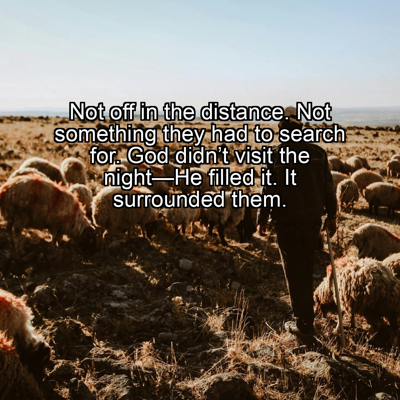
Not off in the distance. Not something they had to search for. God didn’t visit the night—He filled it. It surrounded them.
Before God explains the plan… before He gives direction… before He sends them anywhere… hope breaks through their fear right then.
The sign isn’t power on display—it's humility on purpose: a baby wrapped tight and laid low, showing the Savior arrives not above us but among us, close enough to touch and trust.
Worship doesn’t wait for the environment to calm down—it breaks out when something greater enters the chaos, changing our hearts even while the noise keeps going and the night remains dark.
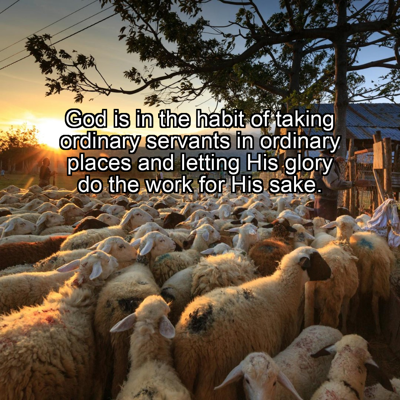
God is in the habit of taking ordinary servants in ordinary places and letting His glory do the work for His sake.
Don’t wait for everything to calm down before you trust God. Stop postponing obedience until fear quiets itself. Let hope shape how you respond right now—right in the middle of the pressure.
Add this chatbot onto your site with the embed code below
<iframe frameborder="0" src="https://pastors.ai/sermonWidget/sermon/hope-darkness" width="100%" height="100%" style="height:100vh;"></iframe>Copy