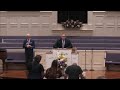
The congregation opens with urgent prayers, family updates, and testimonies, then moves into a close reading of 1 Corinthians 9 to anchor practical doctrine. The text exhorts that those who labor in spiritual work deserve material provision, illustrated by the Old Testament law about not muzzling an ox that treads out grain; spiritual sowing rightly yields carnal support. The argument emphasizes that full-time ministry can and should be supported by the flock, and that mission fields ought to learn to sustain their own pastors so the gospel can expand responsibly.
The central warning focuses on ways the gospel gets hindered. Unbelief hardens hearts and nullifies the power that alone saves; vocal profession without inner conviction leaves people unchanged. Hypocrisy and inconsistent living turn the church into its own greatest barrier, because the saved serve as the living epistle through which the world reads Christ. Failure to give, to study Scripture, and to engage in active witness all starve the missionary enterprise and stall local evangelism.
Practical illustrations thread through the teaching: anecdotes about revivals, difficult visits, mission deputation, stolen offerings, and the gritty realities of soul-winning underscore both vulnerability and hope. Mission strategy receives attention—independence in sending and supporting missionaries stands defended as a way to preserve doctrinal integrity and to prioritize direct church-to-mission relationships. The message closes with an earnest appeal for personal involvement: carry tracts, learn Scripture, give sacrificially, and go to doors despite fear. An altar call invites renewed commitment to evangelism, asking believers to resolve not to hinder but to advance the gospel with boldness and joy.
Key Takeaways
- 1. Gospel workers deserve rightful provision The ministry that tills spiritual ground merits material provision just as an ox deserves a share of the grain it helps harvest. Supporting full-time laborers sustains concentrated gospel work, extends pastoral care, and enables missionaries to remain on the field without constant fundraising distraction. A community that feeds its ministers reflects stewardship that multiplies kingdom fruit, not merely sustains institution. [37:48]
- 2. Hindering occurs through persistent unbelief The gospel functions only where faith receives it; exposure to truth without trust produces gospel-hardening rather than conversion. An audience can hear doctrine repeatedly and still remain untouched if the heart resists divine persuasion. Cultivating personal faith sets the root that allows preaching to bring forth salvation. [44:34]
- 3. Living the gospel amplifies witness Personal conduct serves as the church’s visible Bible; inconsistent lives negate verbal witness and repel seekers. New life must display transformed patterns—speech, work, and relationships—that demonstrate the gospel’s power. Consistent holiness invites curiosity and opens doors for conversation that words alone cannot create. [51:30]
- 4. Study, give, and tell actively Scholarly neglect, stingy support, and silent witness each choke forward movement of the gospel in different ways. Intentional Bible study equips believers to confront false teaching; generous giving funds mission and local outreach; and bold evangelism moves doctrine from theory into the lives of others. Combined, these disciplines build a church that both knows and sends the gospel worldwide. [1:06:03]
Youtube Chapters
- [00:00] - Welcome
- [07:19] - Prayer Requests and Updates
- [11:46] - Funeral & Visitation Announcements
- [12:28] - Thanksgiving and Salvation Reflection
- [29:03] - Hymn and Worship Time
- [35:10] - Reading: 1 Corinthians 9
- [37:48] - Ox Analogy: Provision for Workers
- [44:34] - Introducing "Hindering the Gospel"
- [51:30] - Living the Gospel as Witness
- [1:04:11] - Importance of Study and Missions
- [1:06:03] - Call to Evangelism and Invitation